Procurement Guides
Decision Log: childrens shoes wholesale UK sample revision checklist
A buyer-led method for recording children's footwear sample decisions, requested revisions and unresolved questions without extending approval to production or packing.
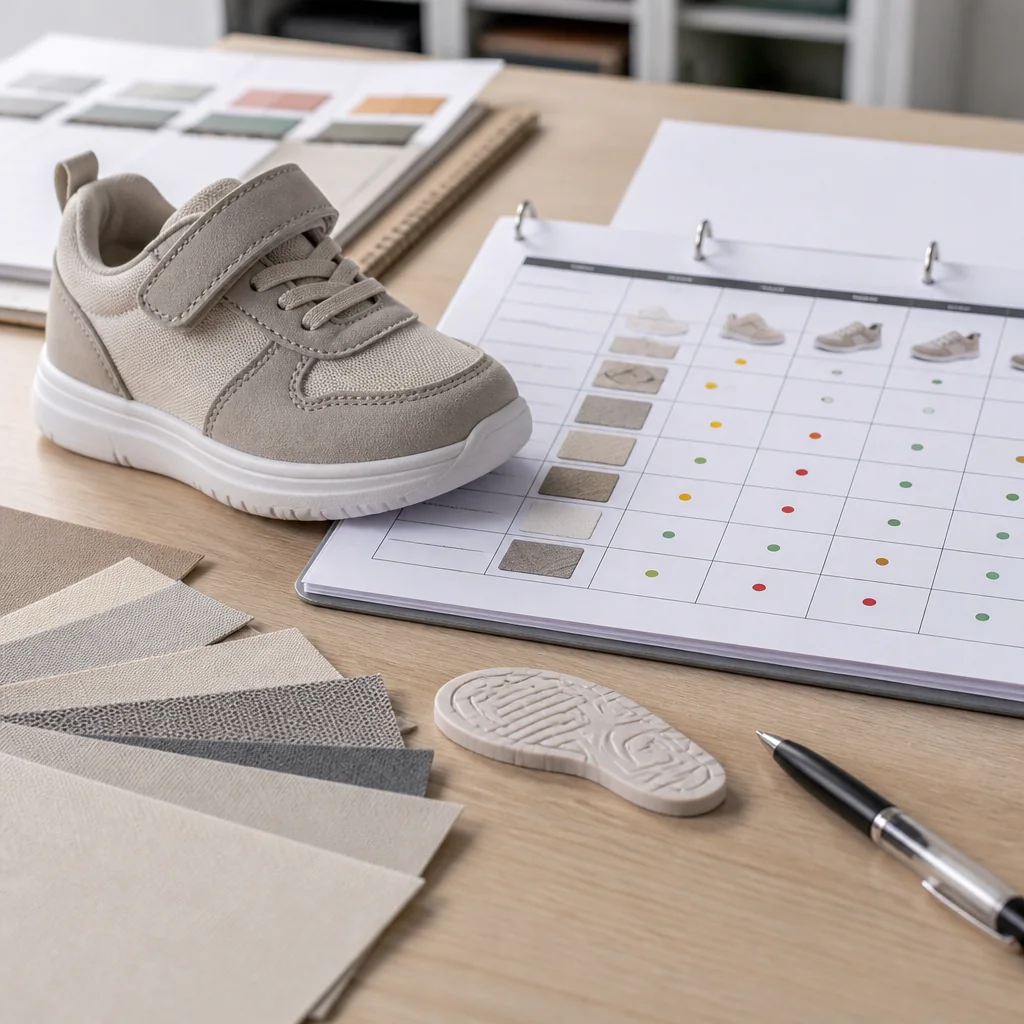
For teams searching for a childrens shoes wholesale UK sample revision checklist, the useful deliverable is not another page of comments. It is a decision record showing what appeared on the reviewed sample, what the buyer accepts, what should change and what still needs an answer.
KidsShoeWorks' quality overview places fit, comfort, logo placement, finish and closure together at sample review. Those published fields provide the factual frame for this guide. The matrix, its statuses and the writing method below are editorial recommendations for buyers, not a KidsShoeWorks form, approval system or promised service.
Scope: The available sources do not establish UK compliance requirements, a formal company revision workflow, automatic third-party testing or importer documentation, or a guarantee that bulk production will reproduce an approved sample. Buyers should resolve those project questions with the appropriate evidence rather than closing them through sample sign-off.
What is the buyer approving?
A sample comment can identify a problem without recording a decision. Naming the logo, finish or fit does not tell the next reviewer whether the field was accepted, rejected or left open. For the buyer's revision brief, separate the observed sample from the requested outcome and the next recheck.
One row, one decision.
This means recording fit separately from comfort, even though KidsShoeWorks reviews them at the same sample stage. Logo placement, finish and closure also retain their own statuses. The buyer can use accepted for a field accepted on the reviewed sample, revise when a different outcome is requested, and unresolved when a reference, method or decision is still missing. These are buyer-added statuses rather than published company terminology.
The decision record
The following matrix separates published review fields from the information a buyer adds to control its own decision. Each row should cover a single feature or question.
Suggested buyer-owned sample revision matrix
| Origin | Matrix field | Buyer entry |
|---|---|---|
| Published KidsShoeWorks review field | Feature under review | Fit, comfort, logo placement, finish or closure |
| Buyer-added decision field | Governing reference | The relevant brief, artwork, material description or previously recorded choice |
| Buyer-added decision field | Sample observation | A neutral account of what is present on the reviewed sample |
| Buyer-added decision field | Decision status | Accepted, revise or unresolved |
| Buyer-added decision field | Requested revision | The outcome the buyer wants reviewed on the next submission |
| Buyer-added decision field | Recheck status | Open or closed according to the buyer's review |
As an editorial recommendation, add the sample identifier, review date and current product definition once at record level. Approval roles should follow the buyer's own document controls. Used this way, the matrix becomes a kids footwear sample revision brief rather than a collection of disconnected annotations.
Materials carried into review
The published quality sequence places confirmation of upper, lining, outsole and adhesive choices before the sample stage. A buyer can therefore carry those choices into the matrix as existing references. If a choice was not settled, the corresponding row should remain unresolved rather than treating the sample itself as the missing specification.
- Upper: carry forward the upper description or reference used in the current brief.
- Lining: retain the previously selected lining reference and record any observed difference as a separate point.
- Outsole: compare the sample with the defined outsole reference without adding unsupported performance criteria.
- Adhesive: keep the confirmed choice visible. The published sequence places bonding among later in-line production checks.
These entries record what was previously defined; they do not establish that a material is suitable for every style, use or destination market. Suitability questions belong in the project's unresolved decision list until supported.
Five fields, one decision at a time
Within the published sample-review scope, buyers have five fields to resolve. The prompts below are editorial guidance for writing the record; they are not factory test methods or pass criteria.
- Fit
Identify the size being reviewed and the buyer's governing fit reference. Leave the field unresolved when the reference or assessment method has not been defined.
- Comfort
Record the observation and requested outcome independently from fit. A numeric score or wear threshold belongs only where the project has separately defined one.
- Logo placement
Link the decision to the relevant artwork or placement reference. Other logo characteristics can remain in separate rows when they require their own decisions.
- Finish
Name the affected area and describe what is visible. A marked image may locate the area, while the matrix records the written decision.
- Closure
Identify the closure definition under review and assign a field-level status. Unsupported strength, cycle or durability criteria should not be added to complete the row.
Any required tolerance, measurement or test method should come from an agreed project specification or another appropriate source. When it is missing, the checkable status is unresolved.
Where sneaker details belong
The kids' sneaker product entry describes its build as a breathable mesh or PU upper. Separately, it lists colorway, logo, closure and outsole texture as customization fields.
Sneaker-specific additions to the buyer's matrix
| Published sneaker field | Buyer-added decision prompt |
|---|---|
| Breathable mesh or PU upper | Which listed upper description defines the current sneaker? |
| Colorway | Which color reference governs the reviewed sample? |
| Logo | Which logo definition governs this customization row? |
| Closure | Does the sample follow the closure definition in the current sneaker brief? |
| Outsole texture | Which reference or requested outcome will govern the next review? |
These rows apply only when the product under review is the kids' sneaker described in that entry. The source does not extend the same upper or customization list to school shoes, sandals, rain boots, canvas shoes or toddler footwear, and it does not document available combinations or UK-market suitability.
From a comment to a recheck instruction
For consistent buyer records, write each revision in the same order:
- Name the field and reference. Point to the part of the brief, artwork or material definition governing the review.
- Describe the observation. State what is visible or assessable without assigning an unverified cause.
- Record the decision. Mark the field accepted, revise or unresolved.
- Set the requested outcome and recheck. State what the buyer wants reviewed next and which reference will be used.
Hypothetical buyer entry: this row shows the writing pattern only and is not a factory finding or customer case.
| Field and reference | Observation | Decision and request | Recheck |
|---|---|---|---|
| Logo placement, artwork reference [A] | The reviewed position does not align with reference [A]. | Revise the placement to reference [A]. | Keep open and compare the next sample with [A]. |
If the requested outcome depends on a tolerance, test method or measurement that has not been agreed, add that missing definition as an open question. A precise-looking limit should not be invented to make the row appear complete.
Sample approval versus later checks
The quality sequence assigns different fields to sample review, in-line production and final packing. A buyer's records should preserve those stage boundaries.
- Sample review
The published fields are fit, comfort, logo placement, finish and closure. The buyer's matrix records decisions and revisions for the reviewed sample.
- In-line production
Assembly, stitching, bonding, flex and stability are checked during production. Those fields belong in a production record rather than being closed by sample approval.
- Final packing
Carton counts, inner packing, labels and outer cartons are checked before shipment. They remain packing-stage matters even when the footwear sample has been accepted.
The quality page describes sample review as giving a better chance that the bulk run will match the approved sample. That qualified statement is not a guarantee. The buyer's sign-off should record only the decisions reached for the reviewed sample, not claim proof of bulk construction, production consistency or completed packing.
For the wider sequence, consult the quality checkpoints guide and the separate construction checks guide. Their production and packing subjects should remain outside the sample revision matrix.
Questions for a scoped inquiry
Send a current product definition and decision record rather than a general request for children's footwear. The inquiry can include:
- The product type and current material references.
- The sample fields accepted, marked for revision or left unresolved.
- The references that should govern another sample review.
- A question about which development, sampling or quotation options may apply.
- Questions about applicable MOQ and packing information without assuming standard terms.
- UK compliance, third-party testing, importer-document and project-proof questions that still require appropriate evidence.
Share that material through the quotation inquiry. The immediate task is to establish which options may apply to the defined footwear project and which questions remain open, while leaving production construction and final packing for their proper review stages.
Sources and verification
- Quality Control for Children's Shoes | KidsShoeWorks First-party site source
- Children's Footwear Products | KidsShoeWorks First-party site source
Share the current children's footwear definition and ask which development, sampling or quotation options may apply to the project.
Send your project brief