Sourcing Guides
Define Childrens Shoes Wholesale UK Construction Checks Before Bulk
UK wholesale briefs that stop at style photos, size runs and unit price leave construction uncheckable. Isolate stitching, bonding, flex point and outsole stability beside materials, fit and packing.
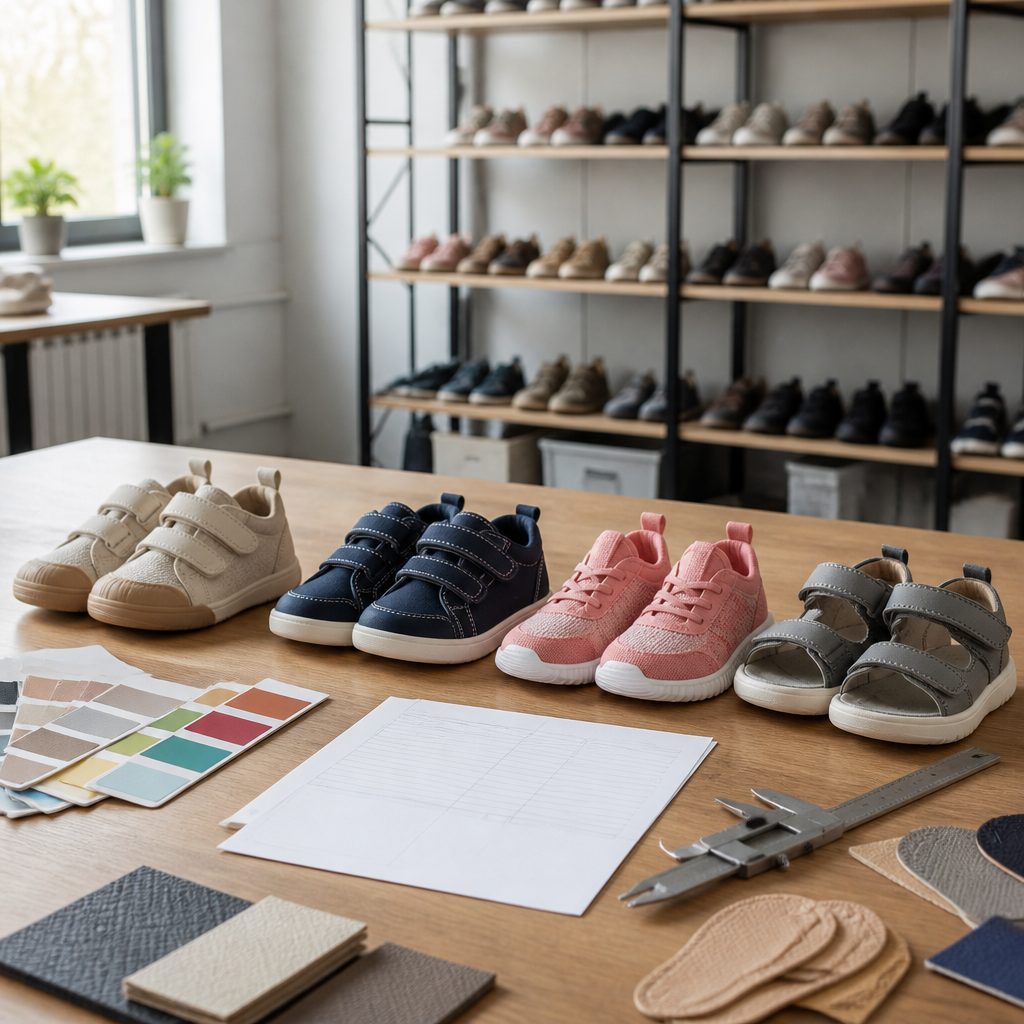
UK wholesale buyers often lock style photos, size runs and unit price while stitching, bonding, flex point and outsole stability stay unwritten. A sample can look acceptable and still leave construction drift unprotected before bulk ships. That gap is why childrens shoes wholesale uk construction checks belong in the specification as a buyer-owned mini-brief, kept beside materials, fit and packing rather than assumed after appearance approval.
This guide uses only construction language published on the KidsShoeWorks quality page. It separates sample-review timing from in-line checks, maps proof topics that stay inside an evidence-over-badges frame, and ends with a short inquiry block for the quote path. Lab methods, pass thresholds and commercial quantities sit outside the published excerpts, so they stay out of this article.
Why do clean sample photos still leave bulk construction exposed?
Programmes aimed at UK retail and school channels often freeze three early fields: upper look, size run and a target unit cost. Those fields matter for assortment and margin, yet they do not make assembly quality reviewable. The quality page states that children's shoes need more than a nice photo and that fit, bonding, flex, wear and packing all need to be checked before the order leaves the factory. When those checks stay unnamed, a photo-led approval can still ship bulk with construction that no one agreed to measure.
The failure mode is quiet rather than dramatic. A sample looks right in the office. Cartons then arrive after logistics costs are already sunk, and receiving teams discover that construction was never owned in writing. Construction checks exist so buyers can make stitching, bonding, flex point and outsole stability explicit before production volume locks in. They do not replace material confirmation or fit work; they sit next to those fields.
Construction language the quality page actually publishes
Construction review appears as one rung on a practical quality ladder for kids' footwear. The page names a fixed set of attributes. Use those names when you write the brief. Treat any method, force value or wear-cycle claim as outside published scope unless your own protocol supplies it.
| Published term | Where the quality page places it | Outside published scope |
|---|---|---|
| Stitching | Named under construction review and again under in-line checks | Needle type, stitch-count targets, tensile numbers |
| Bonding | Named under construction review and under in-line checks | Adhesive brand lists, peel-strength criteria |
| Flex point | Named as a construction-review attribute | Named flex-test machines or cycle counts |
| Outsole stability | Named under construction review before packing | Hardness scales, abrasion indices |
| Assembly | Named among in-line production checks | Line takt times or station maps |
On the same page, construction review is described as catching problems before the bulk run is finished. That is a timing claim about when checks happen relative to packing, not a promise of zero defects. Keep modality at that level. For UK wholesale teams that need tighter operational detail than the published terms, label those extras as your own buyer examples rather than as factory-published criteria. When you draft kids shoes wholesale uk bonding flex language, stay inside bonding and flex point as named attributes; do not invent peel numbers or cycle counts the page never states.
Materials, fit and packing stay adjacent—not replacements
Collapsing every concern into one quality paragraph hides tradeoffs. The quality page already separates four practical columns. Keep them adjacent in the brief so none substitutes for another.
- Material control confirms upper, lining, outsole and adhesive choices before the sample stage. That field owns what is built into the shoe.
- Fit review covers toddler, little kid and big kid sizing for day-to-day wearability. Size-band questions live here; they do not define flex point or outsole stability.
- Construction review covers stitching, bonding, flex point and outsole stability before packing. This is the mini-brief this article isolates.
- Packing discipline covers carton counts, labels, stickers and presentation for the export run. Packing protects logistics handoff; it does not repair construction already sealed inside the carton.
If the brief only says confirm materials and pack to retailer labels, construction remains free to vary. If it only names stitching and bonding, material substitutions and size-band mismatches stay unowned. Four short adjacent fields beat one vague quality sentence. Wholesale childrens footwear uk stitching checks belong in the construction column, not as a stand-in for material or fit sign-off.
When to freeze the target versus when to watch assembly
Inspection on the quality page runs from materials through final carton. For construction specifically, two moments matter most, and they should not share a single sign-off line.
Sample review freezes the approved target
Sample review, as published, reviews fit, comfort, logo placement, finish and closure together. That moment freezes the approved look and how the shoe closes and feels. Attach any construction notes you already care about at this freeze—using only the published terms stitching, bonding, flex point and outsole stability—so the sample carries a written construction target into production. You are still defining the target, not yet watching volume.
In-line checks while assembly is still open
In-line checks, as published, cover assembly, stitching, bonding, flex and stability during production. The stated buyer benefit is catching problems before the order is fully packed. That timing is the point. Once cartons close, construction rework is expensive or impossible. Ask when in-line construction review happens relative to your style's critical operations, and which attributes will be photographed or measured against the approved sample. An uk kids shoe in-line construction review request should name assembly, stitching, bonding, flex and stability as the timed gate, not as a vague quality promise.
Name sample-review construction notes once, then name in-line assembly, stitching, bonding, flex and stability as a second timed gate. Final packing remains a separate carton and label check on its own line. Do not rewrite the entire multi-gate ladder into every RFQ.
Proof that supports construction without a badge wall
The quality page prefers evidence over badges: inspection photos, measured samples and the test reports a project actually requires, rather than certifications unrelated to the order. Map construction criteria to proof types the page supports. Treat broader topics as questions, not assumed inclusions.
- Inspection photos appear as a documentation topic. Ask for angles that show the construction attributes you named, on both the sample and in-line pulls.
- Measured samples can hold a physical reference for construction decisions you approve. Keep one set with your team and align checklist language to that sample.
- Third-party test coordination appears as a documentation topic the page can align around. Ask whether a given project needs coordination and who supplies the protocol; do not treat a lab programme as automatic.
- Importer or retailer document requests also appear as a documentation topic. Share the list early. Do not assume market-specific material notes or buyer packing labels are already embedded unless you request them.
Avoid building a badge wall in the inquiry. Ask which proof artefacts will attach to the construction criteria you named. If a retailer demands a named standard, put that standard in your brief yourself. The published quality page does not list regulation numbers in the excerpt used here, so inventing them would overclaim.
Construction-check block for the UK wholesale inquiry
Use a short reusable block so construction does not disappear under style codes and colourways. Kids' sneakers are published as a starting point for private-label and retail orders, popular with brands that want casual wear, school use and a wide color story. Construction checks still apply there the same way they apply to other children's footwear programmes. Build options of breathable mesh or PU upper, and custom options of colorway, logo, closure and outsole texture, are product-page fields—not substitutes for stitching or bonding criteria.
Paste and edit the following fields into your next message to the factory or into the quote path:
- Construction criteria: stitching; bonding; flex point; outsole stability; assembly (use these published terms only, or mark any extra detail as your own buyer example).
- Sample-review timing: freeze construction notes with fit, comfort, logo placement, finish and closure on the approved sample.
- In-line timing: assembly, stitching, bonding, flex and stability checks during production before full packing.
- Proof topics: inspection photo requests for construction; measured sample retention; whether third-party test coordination or importer/retailer document packs apply to this order.
- Boundary fields (adjacent, not substitutes): upper/lining/outsole/adhesive material notes; toddler–little–big-kid fit brackets; carton counts and export labels.
Share your current children's footwear definition—including whether the programme is school retail, casual private label or another channel—and ask which development, sampling or quotation options may apply to the project. Construction language belongs in that first exchange so unit price discussions do not outrun checkable assembly criteria.
For the published quality ladder and checkpoint language, start from the quality control page. To place construction beside a kids' sneaker family rather than a generic SKU list, review the product families. When the brief is ready enough to discuss options, use the request a quote path and include the construction-check block above. Bonding and flex criteria, stitching checks and in-line construction review become enforceable only when each attribute, timing and proof topic sits in writing next to materials, fit and packing—without inventing lab methods the evidence does not publish.
Sources and verification
- Quality Control for Children's Shoes | KidsShoeWorks First-party site source
- Children's Footwear Products | KidsShoeWorks First-party site source
Share the current children's footwear definition and ask which development, sampling or quotation options may apply to the project.
Send your project brief