Sourcing Guides
Define Wholesale Kids Sneakers Canada Mesh Upper Specification
Before sampling kids sneakers for Canada, separate product-page breathable mesh, materials-page engineered mesh, and PU. Place upper wording at the pre-sample material gate and keep unproven performance and Canadian rules as open questions.
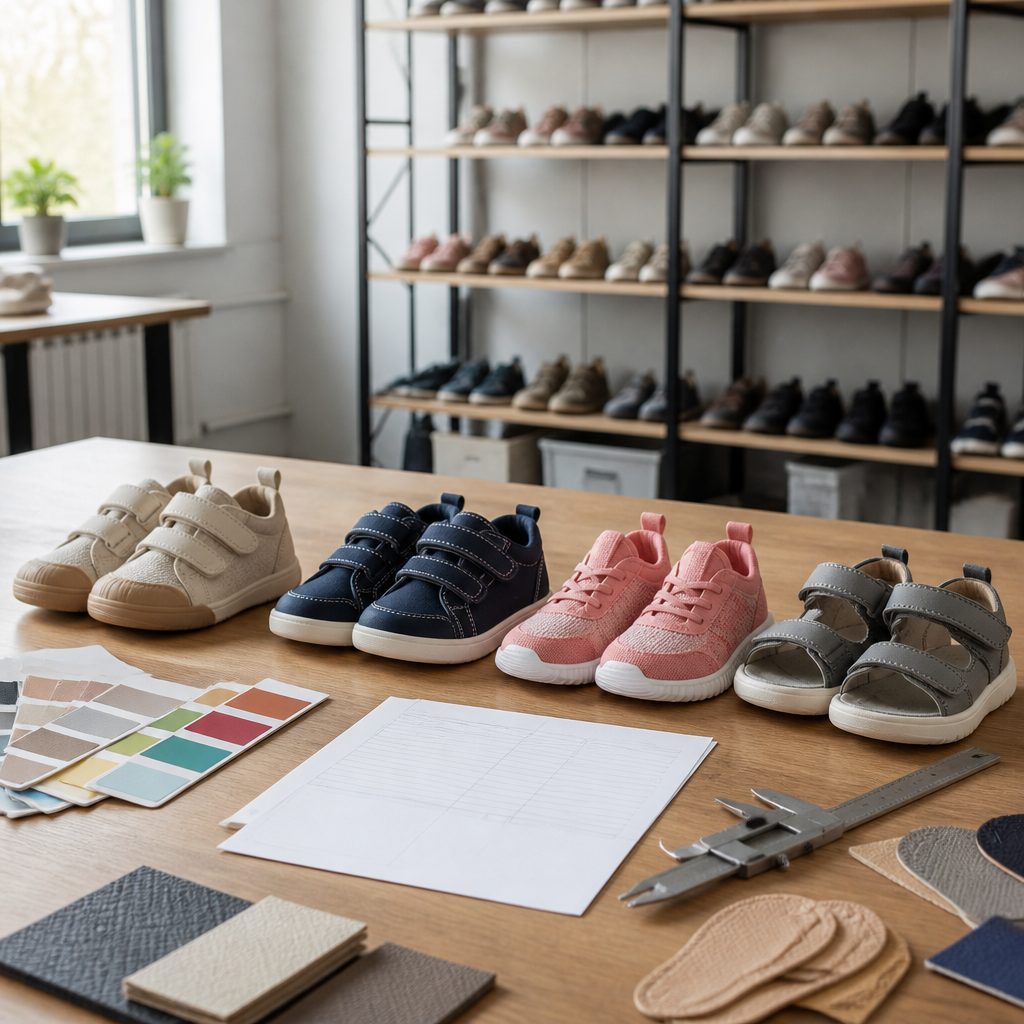
Canada-focused buyers often reach for a single upper word—mesh—when the real job is narrower. Before anyone treats that word as a finished product definition, the brief has to say what material language you want checked. Call that the wholesale kids sneakers Canada mesh upper specification decision if you need a procurement label for the file: separate a product-page breathable-mesh or PU build from the materials page’s engineered-mesh description, then ask which development, sampling or quotation options may apply to the wording you actually write.
On the kids’ sneakers product family, the build line is broad: breathable mesh or PU upper, with custom colorway, logo, closure and outsole texture. The page frames kids’ sneakers as a starting point for private-label and retail orders, popular with brands that want casual wear, school use and a wide color story, and best for daily wear and school retail. On the materials page, engineered mesh is a narrower option: light, breathable, knit-style uppers for warm-weather and active styles, tagged breathable, lightweight and quick-dry, and listed for kids’ sneakers, sports runners and sandals. Those two scopes are not interchangeable. As an editorial recommendation for buyers, keep the labels separate until the project confirms wording, proof needs and path.
When should the upper wording land in the brief?
The quality page already shows a useful clock. Under material control, upper, lining, outsole and adhesive choices are confirmed before the sample stage, with the stated buyer benefit of fewer surprises after sample approval. Later, at the incoming-materials checkpoint, upper, lining, outsole, label and adhesive samples are aligned to the brief. Sample review is a separate stage: fit, comfort, logo placement, finish and closure are reviewed together.
That order is a checkpoint sequence, not a promise that every proposed material will pass or that every attribute you care about is already written into default checks. As an editorial recommendation for the buyer, put the proposed upper term in the brief before sample work so incoming material samples have something concrete to align against, and so sample review can judge logo placement, finish and closure against the same written package rather than a loose “mesh” note that drifted after cutting started.
- Name the product family as kids’ sneakers. If the program is daily-wear or school-retail, say so; that role is how the product page positions the category.
- Write the proposed upper wording exactly: breathable mesh, engineered mesh, PU, or another term your team uses.
- Flag term collisions. If marketing says engineered mesh and the tech pack only says mesh, record the conflict in the brief.
- List custom elements already known at product-page level: colorway, logo, closure and outsole texture.
- Hold sample work until upper, lining, outsole and adhesive choices are the ones you want checked against the brief.
Product-page mesh is not materials-page engineered mesh
The mismatch is scope, not marketing preference. The product page lists breathable mesh as one possible sneaker upper build beside PU. It does not, by itself, name a knit construction, a quick-dry claim or an engineered-mesh grade.
The materials page is more specific. Engineered mesh is framed as light, breathable, knit-style uppers for warm-weather and active styles, with breathable, lightweight and quick-dry attributes, used in kids’ sneakers, sports runners and sandals. That description is useful when those attributes belong on the table. It does not prove that every breathable-mesh sneaker upper on the product page is engineered mesh, or that a finished shoe inherits materials-page attributes without project-level confirmation.
If you are scoping engineered mesh kids sneakers wholesale work around those materials-page attributes, write engineered mesh as the proposed term and ask whether the program will use that material. If the design board only says mesh, ask whether that means the product-page breathable-mesh build, engineered mesh as described on the materials page, or another construction your team has not defined yet. Treat the product-page line as a build fork and the materials-page line as a named material option with its own attribute set.
Why PU cannot finish a mesh-versus-PU ranking yet
Many RFQs jump to “mesh versus PU” as if both sides already have a full attribute profile. The evidence does not support that. PU appears only as a possible kids’ sneaker upper build next to breathable mesh. No supplied excerpt assigns comfort, breathability, weight, finish, wear performance or seasonal suitability to PU. Ranking mesh above PU, or the reverse, would invent a performance comparison the pages do not provide.
| Upper language in evidence | What is documented | What remains open |
|---|---|---|
| Breathable mesh (product page) | Possible kids’ sneaker upper build; custom colorway, logo, closure and outsole texture listed for the category | Whether the mesh is engineered mesh; finished-shoe performance; suitability for a specific Canadian season or channel |
| Engineered mesh (materials page) | Light, breathable, knit-style, quick-dry material used in kids’ sneakers, sports runners and sandals | Whether a given sneaker program will use this exact material; how attributes transfer into the finished sample; project-specific proof |
| PU upper (product page) | Possible kids’ sneaker upper build | Comfort, breathability, weight, finish, wear life, seasonal role and any mesh-versus-PU ranking |
Use the table as an evidence-depth map, not as a shortlist that implies equal data on every row. If you prefer PU for a school-retail look, a logo panel or a finish, state that as a design preference and list the performance questions still unanswered. Do not treat the product-page “or” as proof that both materials have already been compared on wear or climate.
Incoming materials, sample review, and proof are three different jobs
Checking material samples against written brief language is not the same job as reviewing a sample shoe, and neither job is the same as proving breathability, quick-dry behavior, wear life or Canadian-market suitability. Keep the quality page’s stages separate.
- Material control (pre-sample)
- Upper, lining, outsole and adhesive choices are confirmed before the sample stage. Stated buyer benefit: fewer surprises after sample approval.
- Incoming materials
- Upper, lining, outsole, label and adhesive samples are aligned to the brief. Stated buyer benefit: fewer surprises after sample approval.
- Sample review
- Fit, comfort, logo placement, finish and closure are reviewed together. Stated buyer benefit: a better chance that the bulk run matches the approved sample.
- Evidence preference
- The quality page prefers inspection photos, measured samples and the test reports a project actually requires over certifications unrelated to the order. That preference describes how proof can be discussed. It does not promise a particular photo set, measurement package, test method or successful result for every project.
As an editorial recommendation for the buyer, keep three columns in your notes:
- Incoming-material alignment. Do upper, lining, outsole, label and adhesive samples match the material choices written in the brief?
- Sample review. Do fit, comfort, logo placement, finish and closure match the approved sample intent?
- Performance proof. Do you need measured samples, inspection photos or project-required test reports to support claims such as light weight or quick-dry behavior? Those sit with the quality page’s evidence preference and with whatever the project requires. They are not automatic outputs of naming engineered mesh on a materials page.
If engineered mesh attributes matter commercially, write them as attributes you want confirmed on the actual material and sample, not as properties already proven for every kids’ sneaker that mentions mesh. For broader RFQ structure around sneaker programs, the site’s wholesale children’s sneakers RFQ brief can sit beside this upper-definition work without replacing it.
Which Canada requirements stay unconfirmed?
None of the supplied first-party excerpts state a Canadian footwear rule, chemical limit, test criterion, certification, labeling obligation or importer requirement. Market-specific material notes, third-party test coordination and document requests from an importer or retailer appear only as topics the quality page says the company can align around, alongside buyer-specific packing labels and inspection photo requests. Alignment is not automatic inclusion, ownership of regulatory interpretation or a promise that a given Canadian retailer pack will be produced without project confirmation of responsibility and deliverables.
- Ask which market-specific material notes, if any, apply to this Canada program.
- Ask whether third-party test coordination is needed for the upper or finished shoe, and who supplies the test plan.
- Ask which importer or retailer documents must be listed before sampling or bulk.
- Do not invent compliance language to fill the gap. Leave Canadian criteria as open questions until a qualified source for your channel confirms them.
- Keep packing labels and inspection photo requests in the same confirmation list rather than assuming they travel with every mesh sneaker inquiry.
This keeps the Canada focus honest: market intent can shape the brief, while legal and retailer details remain project-specific.
Kids sneaker upper material specification for the current inquiry
When you move from terminology to a request, send a bounded definition rather than a single word such as mesh. The goal is a current product description the other side can check against development, sampling or quotation options that may apply to the project, not a claim that every option is already priced or promised. A private label kids sneaker sampling brief is a useful container for that definition when you are still at the private-label starting point the product page describes.
- Category: kids’ sneakers (do not broaden this block to school shoes, rain boots, canvas shoes or toddler footwear unless those are separate lines).
- Intended role, if known: daily wear, school retail or another channel note your team owns.
- Proposed upper wording: breathable mesh, engineered mesh, PU, or a dual option you want compared only after attributes are defined.
- Explicit question: is the proposed mesh engineered mesh as described for kids’ sneakers on the materials page, or a different mesh construction?
- Custom requests already supported at product-page level: colorway, logo, closure, outsole texture.
- Open PU questions: comfort, breathability, weight, finish, wear and season remain unknown unless later evidence or testing fills them.
- Proof requests: state whether you need inspection photos, measured samples or project-required test reports, without treating any one package as automatic.
- Canada column: list market-specific material notes, third-party testing and importer or retailer documents as alignment topics to confirm, not as assumed deliverables.
- Commercial ask: which development, sampling or quotation options may apply to this definition.
Share that block through the request a quote path when you want a response tied to the current definition. Keep unknown attributes marked as questions so the first sample conversation starts from language both sides can inspect, not from a collapsed mesh label the published pages do not treat as interchangeable.
Sources and verification
- Children's Footwear Products | KidsShoeWorks First-party site source
- Kids' Shoe Materials | Mesh, PU, Canvas, Rubber & EVA | KidsShoeWorks First-party site source
- Quality Control for Children's Shoes | KidsShoeWorks First-party site source
Share the current children's footwear definition and ask which development, sampling or quotation options may apply to the project.
Send your project brief