Product Development
Custom Infant Shoes Testing Documentation: Inquiry Scope
A procurement framework for separating buyer requirements, product references, documented quality checkpoints and unresolved test-document questions.
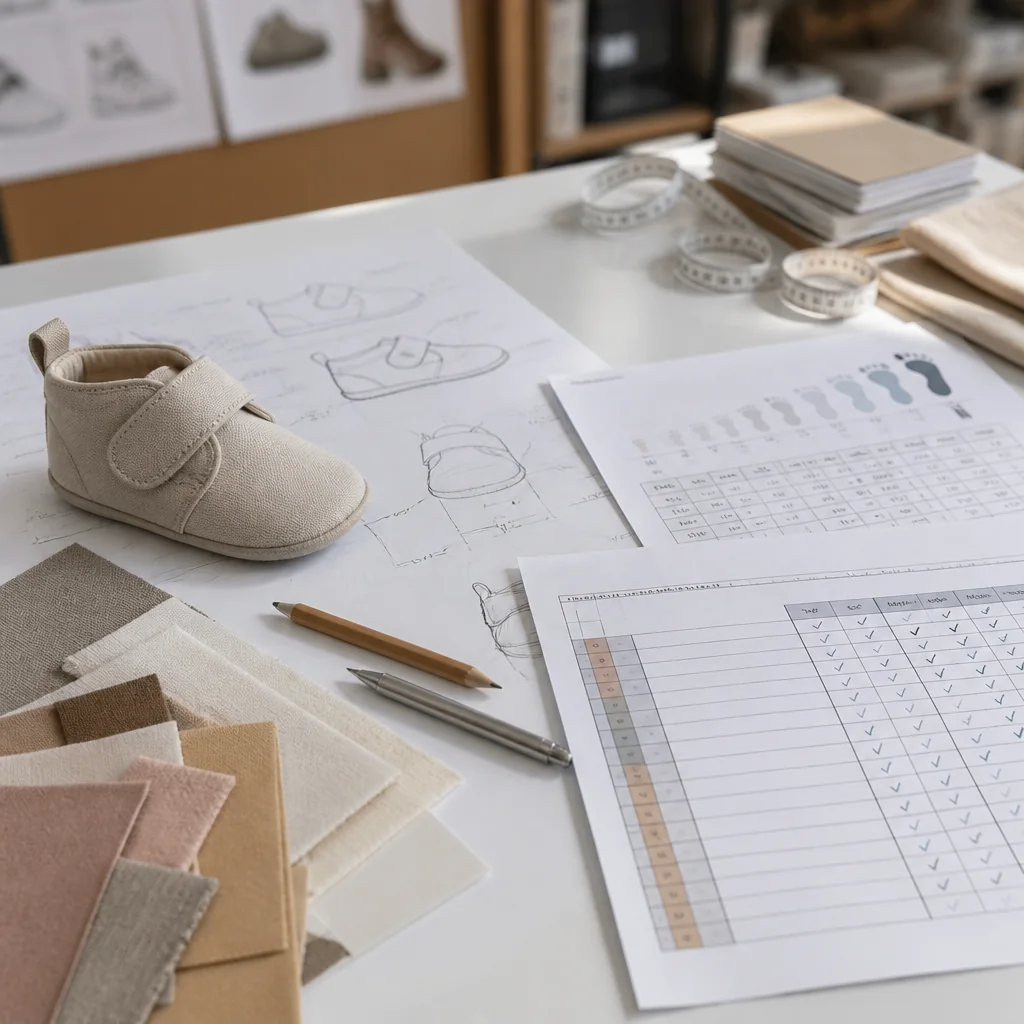
A buyer can place a footwear brief, a kids' sneaker page and a test-document question in the same project file. Once those inputs are merged, the file can appear to show an accepted supplier scope even though each item has a different source and status. For custom infant shoes testing documentation, the first procurement task is to separate what the buyer submitted, what the website actually says and what still requires a project answer.
The framework below is an editorial recommendation for the buyer's working file. It organizes requirement ownership and timing without treating an inquiry topic as a confirmed service, test, report or infant-footwear capability.
Separate the file before deciding scope
Three records give the product team a clearer basis for discussion. The buyer brief states the proposed project. The published product reference shows only the language available on the cited page. The evidence inquiry records questions that remain open.
Recommended separation of project inputs
| Record | Content | How the buyer should use it |
|---|---|---|
| Buyer project brief | Style, size range, target market, quantity, logo and packing notes sent for the current project. | Present these as buyer-supplied requirements. Their inclusion does not establish category fit, manufacturability, testing scope or commercial terms. |
| Published product reference | The exact kids' sneaker language selected from the product overview. | Label the page as a discussion reference. Keep its product category and listed attributes attached to that source. |
| Evidence and document inquiry | The requesting actor, requested item, target market, requested decision point and confirmation status. | Use this record for unanswered document and coordination questions. Applicability, responsibility and timing remain open until confirmed for the project. |
This arrangement preserves the history of a revision. A new size range changes the buyer brief. A question about a sneaker-page option changes the reference record. A document request from an importer or retailer belongs in the evidence inquiry. The records can refer to one another without being presented as one accepted specification.
Record where each request came from
The KidsShoeWorks brief description says the buyer sends the style, size range, target market, quantity, logo and packing notes. Those fields can therefore be marked as buyer-originated inputs in the project register.
Document ownership requires a separate entry. When a request comes from an importer or retailer, the buyer's record should identify that organization as the requesting actor and retain the request's wording. Forwarding the request establishes its origin; it does not establish supplier acceptance, report availability or acceptance by the receiving party.
For internal tracking, the buyer may adopt statuses such as requested, under clarification, confirmed as applicable and not applicable. These are editorial status choices, not published KidsShoeWorks process labels. Each status should be supported by the current project correspondence.
Limit the sneaker page to a reference
The published product excerpt is scoped to kids' sneakers. It describes a breathable mesh or PU upper. In a separate customization list, it names colorway, logo, closure and outsole texture.
That page can identify the sneaker language the product team wants to discuss. It does not document infant category fit, infant sizing, infant lasts, infant construction or infant-specific material availability. It also does not confirm that the listed customization fields apply to the proposed infant footwear definition.
A buyer-created reference note can state that the kids' sneaker page is being supplied for terminology or visual direction, with applicability to the current project awaiting confirmation. This keeps mesh, PU, closure and outsole texture in the reference record rather than turning them into approved infant specifications.
Put documented checkpoints on the timeline
The quality overview assigns particular checks to particular stages. Those statements can anchor part of the buyer's timeline. The recording actions in the final column are editorial recommendations for the project file.
Published checkpoints and recommended buyer records
| Published stage | Checks named by KidsShoeWorks | Buyer recording decision |
|---|---|---|
| Before the sample stage | Upper, lining, outsole and adhesive choices are confirmed. | Record the material terms under discussion, the current decision status and any unresolved questions. |
| Sample review | Fit, comfort, logo placement, finish and closure are reviewed together. | Separate review observations, revision requests and approval status. KidsShoeWorks describes this review as providing a better chance that the bulk run matches the approved sample, rather than a guarantee. |
| During production | Assembly, stitching, bonding, flex and stability are covered by in-line checks. | Connect each buyer question to the written product definition and identify any evidence request separately. |
| Before shipment | Carton counts, inner packing, labels and outer cartons are checked at final packing. | Maintain packing questions and evidence apart from product-testing or material-document questions. |
The timing above belongs only to the checks named at each stage. Buyers preparing a more detailed production record can use the related infant shoe inspection-plan guide. The separate fit-review scope can hold size-band and fit definitions without expanding the test-document register into another project specification.
Give test coordination its own open line
KidsShoeWorks lists market-specific material notes as a topic it can align around. The same quality page separately lists inspection photo requests, third-party test coordination and document requests from an importer or retailer. These statements support raising the topics in a project inquiry.
The source does not assign third-party test coordination or document delivery to the material, sample, production or pre-shipment checkpoints. A buyer can add a requested decision point to the register, but the date should remain identified as a buyer or requesting-actor request until timing is confirmed through project correspondence.
The quality page also favors evidence relevant to the project over certifications unrelated to the order. It refers to inspection photos, measured samples and test reports a project actually requires. These are named evidence categories, not a documented package supplied with every order. The inquiry still has to establish relevance, availability, responsibility and the receiving party's acceptance criteria.
Build the request around unanswered fields
For an infant shoe test document request, the buyer's register should make uncertainty visible. The following fields are editorial recommendations for preparing that request.
- Footwear definition
- Enter the proposed style and size range from the buyer brief. Mark infant category fit as awaiting confirmation.
- Target market
- Record the market named by the buyer without adding an unsupported standard, test method or legal conclusion.
- Requesting actor
- Identify whether the request came from the buyer, an importer or a retailer. Preserve the original description where practical.
- Evidence description
- State the requested item as precisely as the requesting actor can support. Inspection photos, measured samples and a project-required test report are evidence types named on the quality page, but their applicability remains project-specific.
- Requested decision point
- Record when the requesting actor wants an answer and label that timing as requested until another party confirms it.
- Responsibility
- Track preparation, coordination, review and acceptance separately. Listing third-party test coordination as an inquiry topic does not assign all of those responsibilities to KidsShoeWorks.
- Confirmation status
- Show whether applicability, format, timing and responsible party are open, under clarification or confirmed in writing.
This structure lets a custom infant shoe supplier inquiry proceed even when the requesting actor has not supplied an exact test name or document format. It also shows whether a question is a buyer preference or a document request from an importer or retailer without converting either into a supplier promise.
Keep two decisions open for project assessment
Infant category and development
The supplied product excerpt covers kids' sneakers. It cannot establish an available infant size range, last, construction, material or customization path. The buyer can submit the proposed style, intended size range, target market, quantity, logo and packing notes, then ask which development or sampling options may apply.
Testing and documents
The supplied excerpts do not identify an infant-specific standard, test method, laboratory, acceptance threshold, certification or mandatory report set. They also provide no deadline for third-party coordination or document delivery. The project inquiry should therefore ask which market-specific material-note questions, inspection photo requests, third-party test coordination topics or document requests from an importer or retailer may apply to the defined footwear project.
Route the definition for a bounded answer
The inquiry package should contain the buyer brief, the clearly labeled kids' sneaker reference, the evidence-request register and the two open decision groups. This is an editorial recommendation for routing the project; it is not a statement that a particular infant product, test or report is available.
Send the current definition through the project inquiry form. Ask which development, sampling or quotation options may apply, and include the outstanding evidence questions so each can be answered within its actual project scope.
Sources and verification
- About KidsShoeWorks | Kids' Shoe Manufacturing Partner First-party site source
- Children's Footwear Products | KidsShoeWorks First-party site source
- Quality Control for Children's Shoes | KidsShoeWorks First-party site source
Share the current children's footwear definition and ask which development, sampling or quotation options may apply to the project.
Send your project brief