Sourcing Guides
Custom children's shoe size range brief from inquiry to sample
A buyer-owned size-range definition keeps style, requested sizes and target market distinct from inquiry through sample review, and makes unsupported assumptions about availability, grading and range-wide fit easier to flag.
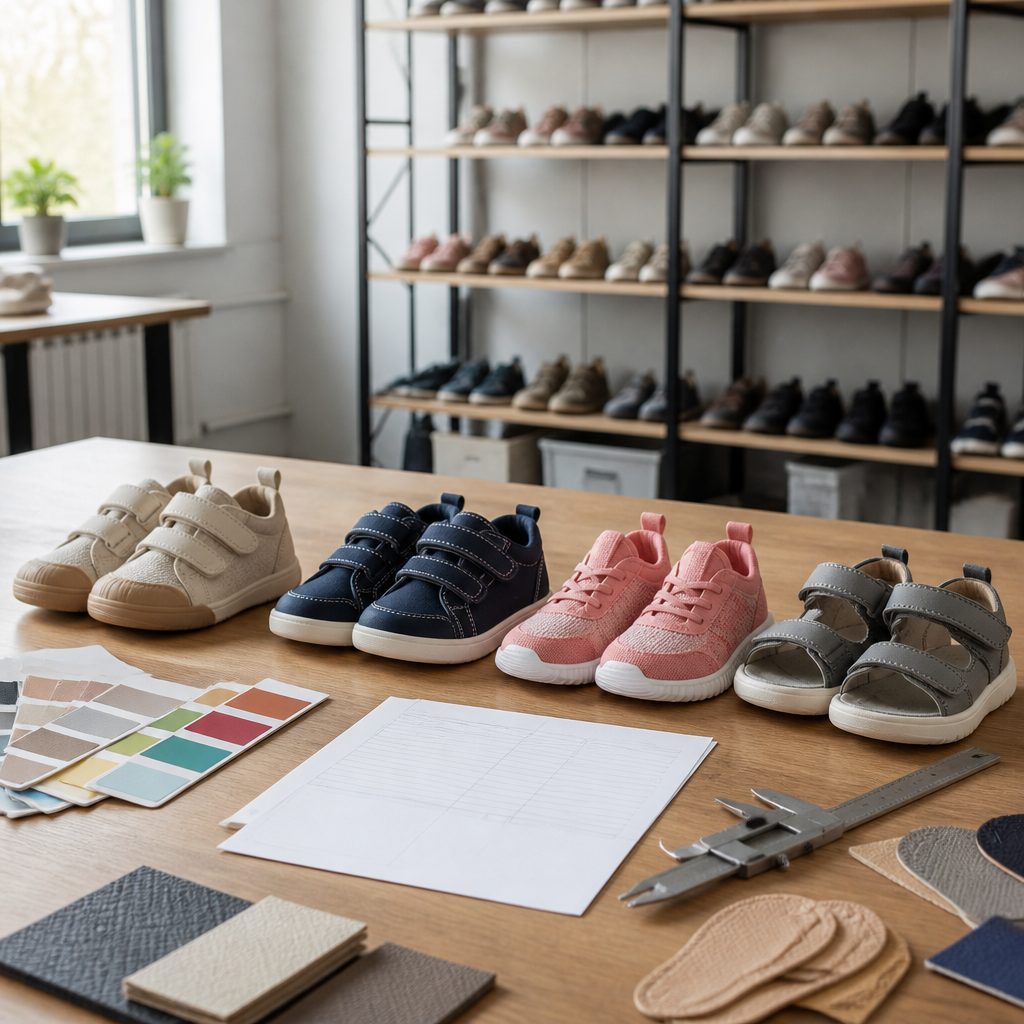
When a product team pastes one range label into a sample record without naming the sizing system or the target-market context, the fit discussion no longer matches the inquiry that started the project. A custom children's shoe size range brief keeps style, requested sizes and target market as separate buyer-owned fields so later review can still refer to the same definition. At the inquiry stage the buyer's task is not to predict tooling or convert between undocumented size systems. It is to record one clear definition that can remain unchanged, or be revised visibly, through development and sample review.
KidsShoeWorks describes the initial buyer brief as containing style, size range, target market, quantity, logo and packing notes. That establishes the fields the buyer is asked to send. It does not establish a standard sizing template, a predefined range or availability for a particular project. As an editorial practice for the buyer, keep the size definition buyer-owned and leave unanswered points open for project-specific inquiry.
Three inputs, not one range label
The KidsShoeWorks brief description separates style, size range and target market. Preserve that separation because each field answers a different procurement question.
- Style
Identify the footwear product being developed or quoted. This is the product reference against which the requested range will be discussed.
- Requested size range
State the sizes the project is intended to cover, using an unambiguous notation the buyer selects. Do not replace this field with a broad product or consumer label.
- Target market
Name the market context against which sizing and fit decisions should be interpreted. This field supplies context; it does not itself prove fit, compliance or commercial suitability.
When these inputs are collapsed into one phrase, an unanswered question can look like an agreed requirement. A style name does not define included sizes. A target-market description does not supply a conversion table. A requested range does not prove that every size is available, sampled or validated.
Build the buyer-owned range definition block
The following table is an editorial tool for a kids shoe size range brief, not a KidsShoeWorks template. Its purpose is to separate the range definition from related commercial and presentation inputs while keeping all six buyer-supplied brief fields visible. The extra sizing-system and exclusion rows are buyer-entered controls for the same editorial purpose; they are not factory requirements.
| Position | Field | What the buyer records |
|---|---|---|
| Range definition | Style | One precise product or style reference for the current inquiry. |
| Range definition | Requested size range | Every included size, or an unambiguous start and end notation, in the buyer's chosen system. |
| Range definition | Sizing system | The size system or notation the range uses, recorded so later notes do not rely on an implied conversion. |
| Range definition | Exclusions or gaps | Any excluded or nonconsecutive sizes inside a stated span, if the project is not a continuous run. |
| Range definition | Target market | The market context to which the range and later fit decision are intended to apply. |
| Range definition | Unresolved size points | Questions that must remain open until project-specific information is supplied. |
| Adjacent brief field | Quantity | The buyer's quantity requirement, recorded separately from size coverage. |
| Adjacent brief field | Logo | The current branding requirement, kept outside the sizing decision. |
| Adjacent brief field | Packing notes | The current packing requirement, kept outside the range definition. |
As an editorial control, add a revision marker to the complete block whenever the style, requested range, sizing system or target market changes. That helps prevent an earlier range from remaining in a quotation request, sample note or approval record after the requirement has moved.
Customization fields are not size availability
Within the published kids' sneaker entry, KidsShoeWorks identifies colorway, logo, closure and outsole texture as customization fields. The supplied source text does not publish a sneaker size range.
Read that omission narrowly. It neither confirms nor rules out any requested size. The four named customization fields are evidence only for the visual and component options they name. Keep the requested range as a separate project question, and do not infer lasts, molds, grading rules, width systems or conversion coverage from those options.
The same separation improves change control. A revised closure or outsole texture may affect the product definition without rewriting the requested sizes. A range revision should still be recorded even when the colorway, logo, closure and outsole texture remain unchanged.
What the three fit contexts establish
The quality-control page names toddler, little kid and big kid sizing within its fit-and-comfort review. It describes the buyer benefit in limited terms: a better chance of matching the target market.
| Named context | What the source establishes | What the source does not establish |
|---|---|---|
| Toddler | A named fit-review context. | No ages, numerical bands, international conversions or width definitions. |
| Little kid | A separate named fit-review context. | No ages, numerical bands, international conversions or width definitions. |
| Big kid | Another named fit-review context. | No ages, numerical bands, international conversions or width definitions. |
For a children's footwear fit review, use the relevant context only as a category reference. Populate the requested size-range field from the buyer's actual requirement, not from an assumed age mapping. Target-market identification remains useful because it tells reviewers which market the fit decision is intended to address, but that role is contextual only.
Carry the definition into sample review
KidsShoeWorks states that fit, comfort, logo placement, finish and closure are reviewed together at the sample-review checkpoint. The source does not state how many sizes are sampled or whether approval of one reviewed sample validates the complete requested range.
- Before the checkpoint. Attach the current range definition block to the sample record. Confirm that its style, requested size range, sizing system and target market match the latest inquiry. Keep the block beside any broader sample-review notes so the fit decision is not separated from its intended scope.
- On the review record. Record the size identification of the physical sample being considered and the version of the range definition used for that review. This is buyer-side documentation guidance. It should not be read as evidence that KidsShoeWorks reviews a particular number of sizes or follows an undocumented range-validation procedure.
- After a decision. State what the fit observation covered. Leave other sizes open unless project evidence supports a broader conclusion. If the requested range changes after review, reopen the affected fit question instead of carrying the earlier decision forward without qualification.
The same discipline applies to the other sample-review fields. Recording fit and comfort alongside logo placement, finish and closure does not make those decisions interchangeable. Each conclusion should remain tied to the feature actually examined.
Fit decisions stay outside other checkpoints
The quality-control page presents incoming materials, sample review, in-line checks and final packing as distinct checkpoints. Keeping them separate prevents a fit observation from being treated as proof of material, construction or packing status.
| Checkpoint | Items named by KidsShoeWorks | Buyer-side boundary |
|---|---|---|
| Incoming materials | Upper, lining, outsole, label and adhesive samples are aligned to the brief. | Do not use a fit observation as evidence that these material items have been resolved. |
| Sample review | Fit, comfort, logo placement, finish and closure are reviewed together. | Document the conclusion for each reviewed feature without extending it to unreviewed sizes. |
| In-line checks | Assembly, stitching, bonding, flex and stability are checked during production. | Keep construction findings distinct from the earlier fit decision. |
| Final packing | Carton counts, inner packing, labels and outer cartons are checked before shipment. | Do not treat sample fit as packing approval or receiving evidence. |
This separation matters when approval language is brief. A note such as fit accepted should identify its sample and range context. It should not be expanded into a general statement that materials, construction, labels or cartons have also passed their respective checkpoints.
Turn open size points into applicability questions
An unresolved field is not a defect in the brief when the available evidence cannot answer it. Mark it clearly and turn it into a project-specific question. The topics below are inquiry prompts, not claims about documented KidsShoeWorks capabilities or terms.
- Range applicability: Which parts of the requested size range, if any, can be considered for the stated style and target market?
- Sample coverage: Which sizes would be represented in any sampling option that may apply to the project?
- Grading: What grading information, approach or limitations could be discussed for the requested range?
- Tolerances: What fit or measurement tolerances, if any, could be documented for review?
- Evidence: What measured-sample information, inspection photos or project-specific proof may be relevant to the requested decision?
- Commercial scope: Which development, sampling, MOQ, packing or quotation information applies to this inquiry?
A compact submission format
- Current definition
State the style, requested size range, sizing system, any exclusions and the target market exactly as they should appear in the project record.
- Adjacent information
Add the current quantity, logo and packing notes without merging them into the sizing definition.
- Applicability questions
List unresolved points about available ranges, sample coverage, grading, tolerances and proof as questions that need a project-specific response.
Share the current definition through the request page and ask which development, sampling or quotation options may apply. Keep every unresolved sizing point visible until the project supplies enough evidence to revise the block or close the question.
Sources and verification
- About KidsShoeWorks | Kids' Shoe Manufacturing Partner First-party site source
- Children's Footwear Products | KidsShoeWorks First-party site source
- Quality Control for Children's Shoes | KidsShoeWorks First-party site source
Share the current children's footwear definition and ask which development, sampling or quotation options may apply to the project.
Send your project brief