Product Development
Custom Children's Sneaker Sample Review: What to Check
A custom children's sneaker sample review is clearer when the current brief, product fields, material timing, sample observations, and later checkpoints remain separate.
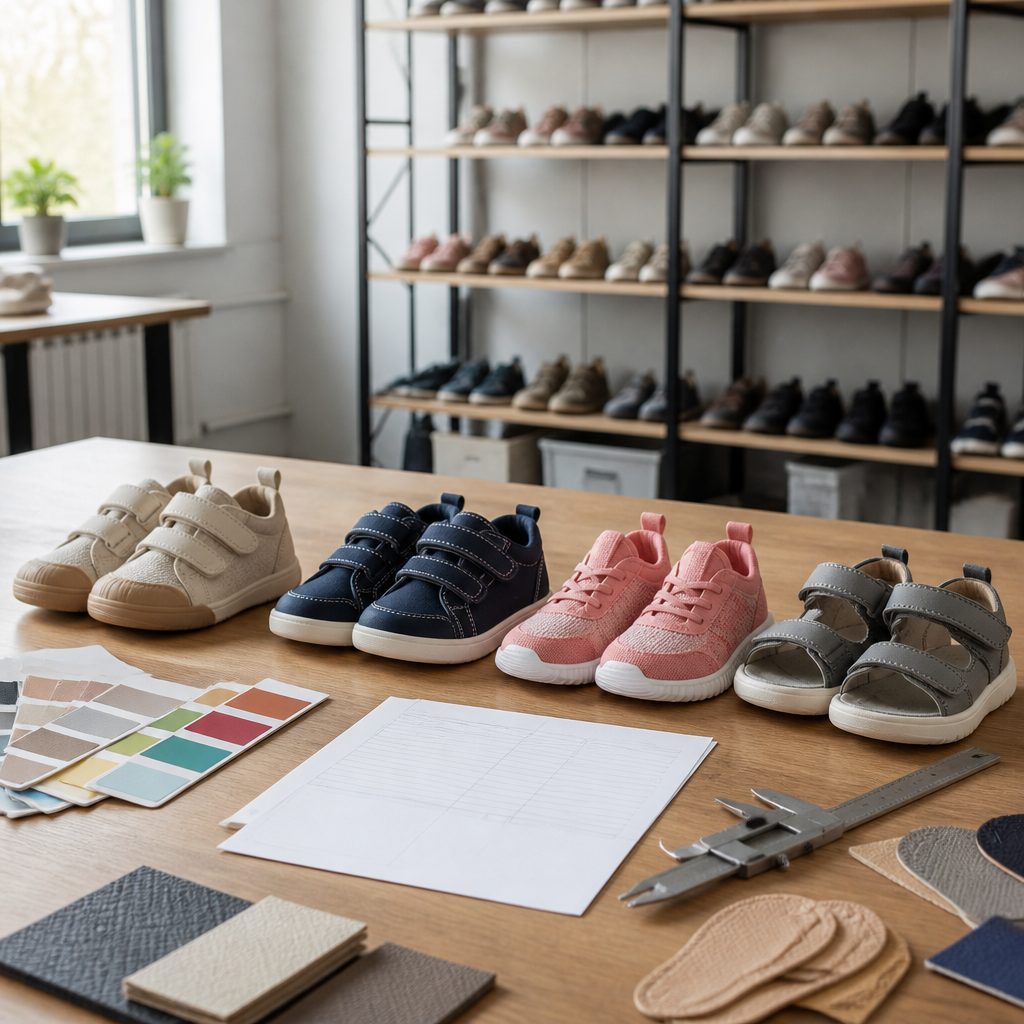
A custom children's sneaker sample review is not a single visual decision. The published sneaker information identifies colorway, logo, closure, and outsole texture as custom fields. Separately, the quality information says sample review covers fit, comfort, logo placement, finish, and closure together. Those lists describe different parts of the project, even where the terms are related.
A buyer can keep the discussion focused by recording each item in the place it belongs. The recordkeeping suggestions in this article are buyer-side recommendations, not a published approval procedure or a factory commitment. The available pages identify product fields, review points, and checkpoints, but they do not set a universal pass-or-fail standard for every children's sneaker program.
Start with the current brief
The published KidsShoeWorks process description says a buyer sends a brief containing style, size range, target market, quantity, logo, and packing notes. Put the current version of those inputs beside the sample before comments begin. The page lists them as brief inputs; it does not say they are a required or complete template for every project.
- Style
- Use the current style description to identify the sneaker under review. This helps keep a comment tied to the relevant sample rather than a previous reference.
- Size range
- Keep the stated range with fit comments. The range provides the project context for a question about sizing.
- Target market
- State the target market as part of the current project definition. A sample observation does not establish a market requirement or a test need.
- Quantity
- Retain the quantity information with the same brief when commercial questions are discussed. The published process does not state a price, minimum order quantity, or quotation outcome.
- Logo and packing notes
- Record logo instructions and packing notes in separate fields. They are separate inputs in the published brief description.
For custom kids sneaker development, this creates a reference point without treating the brief as proof that every detail has been finalized. It also makes it easier to distinguish a requested change from a comment about the particular sample in hand.
Read product fields separately from sample observations
The Kids' sneakers product information lists colorway, logo, closure, and outsole texture under customization. It describes the sneaker build as a breathable mesh or PU upper. A useful buyer record gives each published field its own line instead of turning all visible details into a general appearance comment.
| Published sneaker detail | Buyer-side review record |
|---|---|
| Colorway | Compare the visible colorway with the current project reference and record any unresolved choice as a colorway item. |
| Logo | Record the selected logo as a product-definition field. |
| Closure | Record the intended closure as its own product-definition field. |
| Outsole texture | Record the outsole texture separately from other appearance comments. |
| Upper description | Identify whether the sample discussion concerns the published breathable mesh or PU upper description. |
The published wording does not make breathable mesh or PU a universal material menu, and it does not confirm that every listed custom field applies to every sneaker project. In a private-label children's sneaker review, a logo choice is also distinct from logo placement. The product page uses the first term, while the quality page names the second during sample review.
Material control comes before the sample stage
The quality page places material control before sample review: upper, lining, outsole, and adhesive choices are confirmed before the sample stage. Its incoming-materials checkpoint separately says upper, lining, outsole, label, and adhesive samples are aligned to the brief.
That timing should remain visible in the project record. Do not place material control in a general post-sample category alongside construction or packing questions. A buyer can instead note the relevant material point under the pre-sample material-control discussion, then keep sample observations in the sample-review section.
The source does not state material specifications, testing methods, performance results, or a universal material-selection process. When a material point is unresolved, ask how it should be defined for the individual sneaker brief rather than assuming a published option or result.
The documented sample-review checkpoint
The quality-control information says fit, comfort, logo placement, finish, and closure are reviewed together at sample review. These five headings provide a bounded way to record observations from the sample. The page describes a review activity, not a published test protocol, measurement tolerance, approval rule, or promised outcome.
| Published review point | Question to keep distinct |
|---|---|
| Fit | What fit point is being observed for the stated size range? |
| Comfort | What comfort observation needs further project discussion? |
| Logo placement | Does the comment concern logo location rather than the logo choice itself? |
| Finish | What visible finish point should remain open in the review record? |
| Closure | Does the observation concern the closure on the sample rather than a change to the selected closure field? |
Specific wording matters. A note about logo placement does not by itself request a different logo. Likewise, an observation about the closure does not by itself replace the closure identified in the sneaker definition.
Fit comments need their size context
The quality page refers to fit review for toddler, little kid, and big kid sizing. The process page separately lists size range in the buyer brief. Together, those published references support keeping the stated range beside a fit comment, while leaving the two source statements distinct.
The pages do not provide a size chart, age definition, grading rule, measurement method, tolerance, or fit-test result. A buyer with an open fit question can state the relevant toddler, little kid, or big kid range and ask what information should be considered for that project.
Construction and packing have their own checkpoints
Sample review should not stand in for the later checks described on the quality page. In-line checks are listed during production, while final-packing checks are listed before shipment. They should remain separate from both the pre-sample material-control discussion and the sample-review notes.
| Checkpoint | Published scope | Buyer-side follow-up |
|---|---|---|
| In-line checks | Assembly, stitching, bonding, flex, and stability are checked during production. | Keep any construction question tied to the relevant assembly, stitching, bonding, flex, or stability point. |
| Final packing | Carton counts, inner packing, labels, and outer cartons are checked before shipment. | Compare packing notes in the brief with the packing point that still needs discussion. |
The quality page does not state an inspection frequency, production schedule, release condition, or defect-prevention guarantee. A favorable sample observation is therefore not confirmation of an in-line construction check or a final-packing check.
Turn open points into a scoped inquiry
Once the records are separated, send the current sneaker definition and the unresolved questions through the project inquiry form. The questions below are a buyer-side format for asking which development, sampling, or quotation arrangements may apply. They do not assume that any option, document, or coordination activity is included for every project.
Here are the current style, size range, target market, quantity, logo, and packing notes. Which details should be treated as the active sneaker definition?
For material control before the sample stage, how should the relevant upper, lining, outsole, label, or adhesive details be reflected in this project brief?
Which fit, comfort, logo-placement, finish, or closure points from the reviewed sample need further discussion?
Which development, sampling, or quotation options may apply to this sneaker project?
For production, which assembly, stitching, bonding, flex, or stability point needs project-specific clarification?
For final packing, which carton count, inner-packing, label, or outer-carton note should remain visible?
Are buyer-specific packing labels relevant to the project?
Are market-specific material notes relevant to the project?
Can an inspection-photo request be discussed for the project?
Is third-party test coordination a topic that may apply to the project?
Are documents requested by the buyer's importer or retailer relevant to the project?
The final five questions reflect documentation topics that the quality page says it can align around. They are inquiry topics, not automatic deliverables, test reports, or evidence of compliance for a particular market.
Sources and project verification
The Kids' sneakers product information supports the sneaker customization fields and the published upper description. The quality-control information supports the material-control timing, sample-review points, sizing references, in-line checks, final-packing checks, and documentation topics. The process description supports the brief inputs.
Market requirements, requested proof, and documentation needs must be defined for the individual project. The cited pages describe what is published about the product and review process; they do not establish a universal approval route, material result, test result, or bulk-production outcome for every custom children's sneaker.
Sources and verification
- Children's Footwear Products | KidsShoeWorks First-party site source
- Quality Control for Children's Shoes | KidsShoeWorks First-party site source
- About KidsShoeWorks | Kids' Shoe Manufacturing Partner First-party site source
Share the current children's footwear definition and ask which development, sampling or quotation options may apply to the project.
Send your project brief