Footwear Development
Children's Shoe Sample Approval Checklist: What Must Stay Open
Sample approval is useful only when the record shows which fields were reviewed on the sample and which checks remain open for later checkpoints. This guide helps buyers own that boundary.
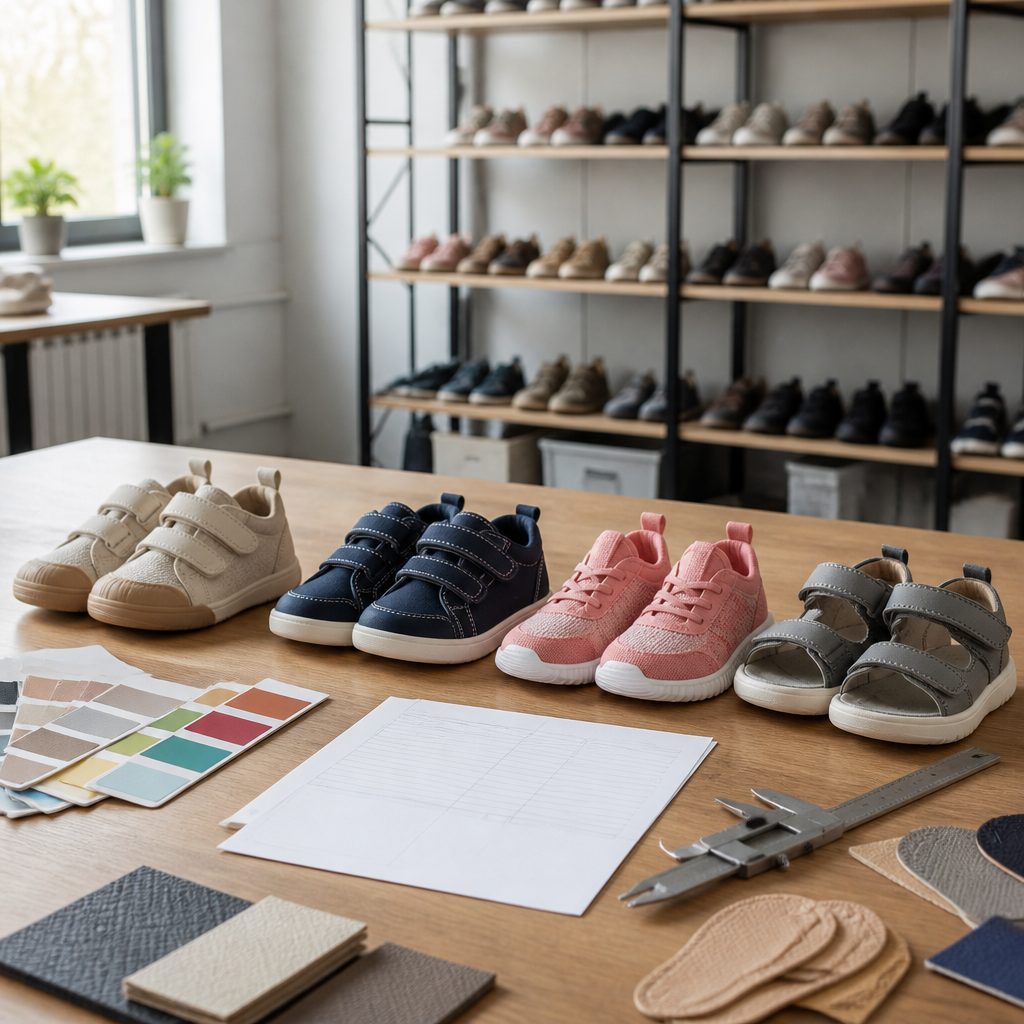
Product teams sometimes treat a visual sign-off as if every later production and packing result is already settled. A children's shoe sample approval checklist works when it names the fields covered at the sample checkpoint, carries earlier material references forward, and leaves production and packing explicitly open. Without those distinctions, “approved” can outrun what the sample actually supports.
The KidsShoeWorks quality process separates incoming-material alignment, sample review, in-line production checks and final packing. Treat the sample record as a buyer-owned boundary document rather than a blanket quality verdict. The structure below is an editorial recommendation for the buyer; it is not a claim that KidsShoeWorks automatically issues a formal sign-off form for every project.
Anchor the review to one current shoe definition
Begin with one identifiable product definition so later dispositions attach to a single object. The children's footwear product page presents kids' sneakers for daily wear and school retail, with mesh or PU listed as upper options. It also lists colorway, logo, closure and outsole texture as customization categories. Whether any particular option or combination applies still needs project confirmation.
- Product family
- State the current shoe type, such as a kids' sneaker.
- Project reference
- Use the buyer's style code, revision name or other unambiguous identifier.
- Intended use
- Record the market and use case defined by the buyer.
- Size coverage
- Name the size range or size band under review without inventing a fit tolerance.
- Upper selection
- Identify the current mesh, PU or other project-confirmed reference.
- Customization definition
- List the current colorway, logo, closure and outsole-texture decisions separately.
- Sample identity
- Record the sample revision and review date used by the buyer.
- Decision owner
- Name the person or team authorized to accept, reject or request revision.
The materials page identifies engineered mesh as a knit-style upper used in kids' sneakers. That description can identify the intended material family. It should not be converted into an unsupported performance result or assumed for every sneaker project.
Three states for a usable sample record
A practical record divides information into three states. The wording in the final column stops an earlier choice from silently closing a later inspection field.
| Record state | What belongs here | Decision language |
|---|---|---|
| Carried into review | Material and component choices addressed before sampling | Identify the current reference without claiming that the sample revalidates composition or performance. |
| Reviewed on the sample | Fit, comfort, logo placement, finish and closure | Record the observed result against buyer-defined criteria. |
| Still open | Production construction, packing outcomes and customization fields without an assigned review point | Name the later checkpoint or ask when the decision will be made. |
Keeping those three states separate makes a children's footwear sample sign off usable for production and inspection teams once the sample stage is finished.
Material references that travel with the sample
In the quality sequence, upper, lining, outsole and adhesive choices are confirmed before the sample stage. The buyer's record can carry those references forward so reviewers know which definition the sample is intended to represent.
| Material field | What to record | What not to infer |
|---|---|---|
| Upper | The current material reference, color reference and revision status | Unstated composition, test performance or universal availability |
| Lining | The agreed project reference and any unresolved specification point | Comfort or wear performance that has not been evaluated |
| Outsole | The current material or component reference | Bulk flex, bonding or stability results |
| Adhesive | The choice carried from the pre-sample material decision | Future production bonding conformity |
The purpose is traceability, not reclassification. If a material detail remains uncertain, mark it open and ask what evidence or development step may apply rather than treating a finished sample as proof.
The five fields the sample checkpoint actually names
The sample checkpoint names five fields reviewed together: fit, comfort, logo placement, finish and closure. No measurements, tolerances or pass-fail thresholds appear in the evidence, so acceptance criteria must come from the project brief.
As an editorial recommendation for the buyer, teams doing a kids sneaker sample review can record each field as accepted, revision required or still open, if the buyer defines what those statuses mean. Those dispositions are buyer-owned entries. They are not a documented KidsShoeWorks approval system, and naming a field for review does not by itself complete an approval decision.
| Review field | Buyer-defined criterion | Record after review |
|---|---|---|
| Fit | Identify the reviewed size, intended wearer profile and agreed evaluation method. | State what was reviewed and any correction requested. Do not add an unsupported tolerance. |
| Comfort | Define the wear or handling observations that matter to the project. | Record observations without turning a limited review into a durability or long-term wear claim. |
| Logo placement | Specify location, orientation, scale and the approved artwork reference. | Note whether the physical placement matches that reference. |
| Finish | Define the visible surfaces, edges and workmanship points to be assessed. | List accepted details and exact revisions instead of writing only “finish approved.” |
| Closure | Identify the closure type and the operation, position or adjustment points to review. | Record the sample observation and any project-specific correction. |
Keep comments attributable. A dated entry with a named owner is more useful than an unqualified approval message when several teams share private label children's shoe sampling across product, quality and sourcing roles.
Customization rows still without an assigned checkpoint
The sneaker product information and the quality sequence overlap only in part. Logo and closure appear in the product-page customization list and among the named sample-review fields. Colorway and outsole texture are also listed as customization categories, but the quality evidence does not assign them to the sample checkpoint.
| Customization field | Documented position | Buyer question |
|---|---|---|
| Logo | Customization category; logo placement is named in sample review | Which artwork reference and placement details are being accepted? |
| Closure | Customization category and named sample-review field | Which closure definition and operation criteria apply? |
| Colorway | Customization category with no explicit sample checkpoint in the supplied quality evidence | When and against which reference will color be reviewed? |
| Outsole texture | Customization category with no explicit sample checkpoint in the supplied quality evidence | At which development or inspection point should texture be confirmed? |
Leaving the last two rows open is more precise than placing them inside sample approval by default. Confirm their timing during the project inquiry. If the buyer deliberately assigns color execution to the finish review, state that assignment on the record; otherwise keep colorway open.
Construction and packing stay outside this sign-off
Assembly, stitching, bonding, flex and stability sit in the in-line production stage. Final packing covers carton counts, inner packing, labels and outer cartons before shipment. A shoe sample can supply a visual or physical reference, but it does not approve those later results.
| Field group | Documented checkpoint | Language for the sample record |
|---|---|---|
| Construction: assembly, stitching, bonding, flex and stability | In-line production checks | Note any observation on this sample only; bulk construction remains open. |
| Packing: carton counts, inner packing, labels and outer cartons | Final packing before shipment | Reference buyer packing requirements if needed; leave status open until the packing review. |
- Sample stitching can be described as an observation on that sample.
- Bulk stitching remains an in-line production inspection field.
- Sample bonding does not establish the result across a future production run.
- Flex and stability stay with the checkpoint assigned to them.
- Any acceptance method or threshold belongs in the project inspection plan, not in an unsupported sample note.
For a broader inspection layout, see the children's sneaker inspection plan guide. In the sample record itself, a short note that construction and packing are not approved at this checkpoint is enough to preserve the boundary.
Convert open rows into the project inquiry
The handoff should contain the current definition, buyer-recorded dispositions for the five review fields, and only the questions that remain open. As an editorial recommendation for the buyer, a concise project inquiry can cover three blocks:
- Current shoe definition: product family, intended use, size coverage, upper reference, customization choices and sample revision.
- Sample review dispositions: the buyer-recorded outcome for fit, comfort, logo placement, finish and closure, including any requested revisions.
- Open scope: material questions, unassigned customization fields, production checks, packing requirements and the documentation topics the buyer wants to discuss.
Keep documentation lists separate. The quality page says it can align around inspection photo requests and third-party test coordination, along with buyer-specific packing labels, market-specific material notes and document requests from an importer or retailer. Inspection photos and checklist alignment also appear under buyer documents. Separately, the page expresses a preference for sending the inspection photos, measured samples and test reports a project actually requires rather than unrelated certifications. Ask which of those topics may apply; none of them should be treated as automatic deliverables for every order.
Share the unresolved rows through the project inquiry form and ask which development, sampling, documentation or quotation options may apply. The conversation then stays on fields that still need an owner, instead of reopening rows the sample review has already addressed.
Sources and verification
- Quality Control for Children's Shoes | KidsShoeWorks First-party site source
- Children's Footwear Products | KidsShoeWorks First-party site source
- Kids' Shoe Materials | Mesh, PU, Canvas, Rubber & EVA | KidsShoeWorks First-party site source
Share the current children's footwear definition and ask which development, sampling or quotation options may apply to the project.
Send your project brief