Quality Control
Wholesale Children's Sneaker Inspection Plan by Stage
Map sneaker requirements to four documented quality stages while keeping unassigned timing, review methods and evidence requests open for project confirmation.
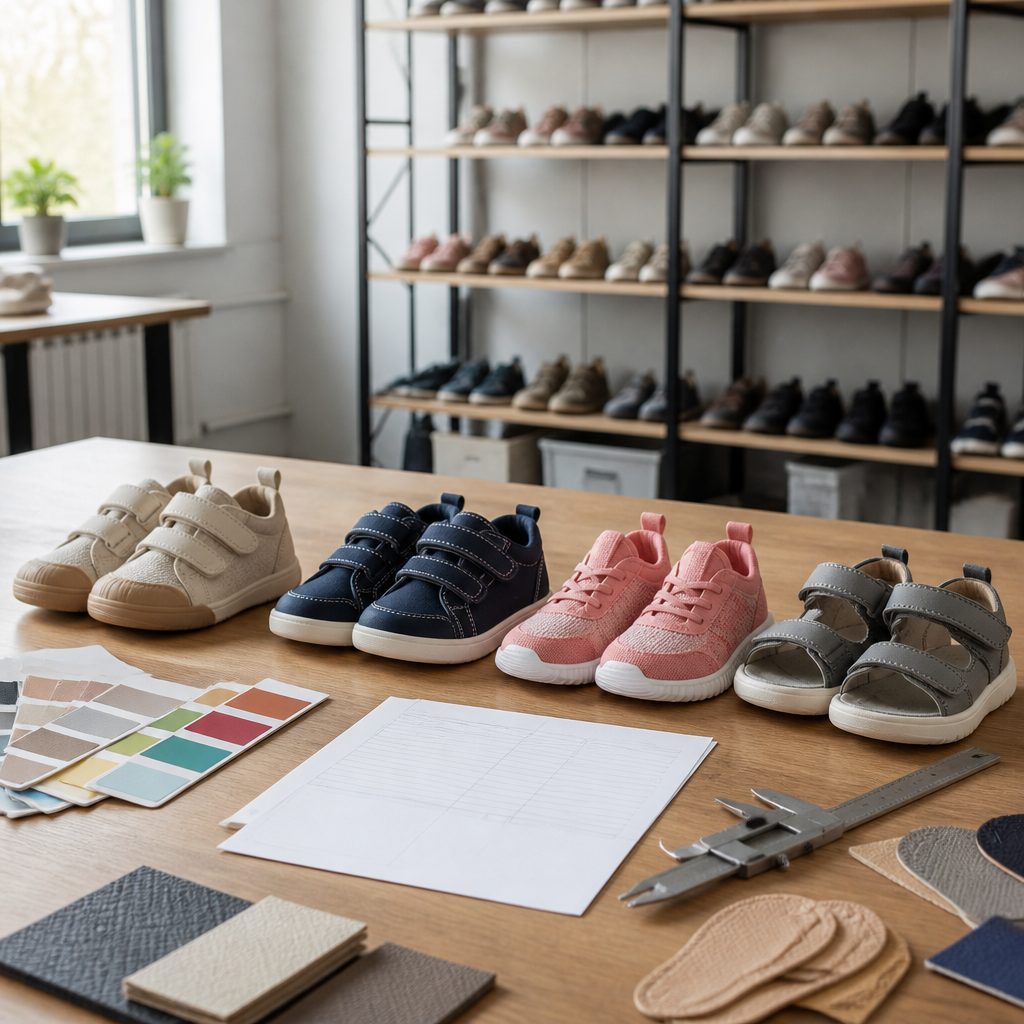
A wholesale children's sneaker inspection plan should show when each requirement enters review. KidsShoeWorks lists four checkpoints: incoming materials, sample review, in-line checks and final packing. It also states that inspection starts before bulk production, with checkpoints aligned to the product brief and written inspection plan. The practical buyer task is not to collect one long checklist, but to place each field at the earliest stage supported by that sequence.
The mapping below stays within that evidence boundary. Where the supplied pages name a field but do not state its review timing, the plan marks it for confirmation. Buyers sometimes call this document a kids sneaker quality control checklist; its useful feature is the timing column. Suggested buyer inputs, record fields and questions are editorial recommendations, not documented factory deliverables.
Build the four-stage control matrix
Buyers can give each requirement its own row, checkpoint, input and status. Separate rows are particularly important when two related fields have different evidence, such as outsole material and outsole texture.
Checkpoint placement for a children's sneaker program
| Requirement | Checkpoint | Suggested buyer input | Confirmation status |
|---|---|---|---|
| Upper, lining, outsole, label and adhesive samples | Incoming materials | Intended material names, references and relevant label files | Checkpoint named; project details to confirm |
| Fit, comfort, logo placement, finish and closure | Sample review | Target fit group, buyer size reference, artwork, finish reference and closure definition | Checkpoint named; project details to confirm |
| Assembly, stitching, bonding, flex and stability | In-line checks | Any buyer-required construction criteria or review references | Checkpoint named; project details to confirm |
| Carton counts, inner packing, labels and outer cartons | Final packing | Any project-specific packing and label requirements | Checkpoint named; project details to confirm |
| Colorway | Not assigned in the supplied evidence | Color reference and a request to confirm its review stage | Timing open |
| Outsole texture | Not assigned in the supplied evidence | Texture reference and a request to confirm its review stage | Timing open |
Buyers can add columns for revision, decision owner, result and unresolved action. A named checkpoint should not be treated as confirmation of a project-specific method, tolerance, responsibility or evidence format. Record those details separately and ask the project team to confirm them.
Place material choices before sample review
KidsShoeWorks' quality framework places upper, lining, outsole and adhesive choices before the sample stage. Its incoming-material checkpoint also lists upper, lining, outsole, label and adhesive samples aligned to the brief. For children's footwear pre-bulk quality checks, buyers can record each field separately rather than using a broad entry such as “materials approved.”
The kids' sneaker product page names breathable mesh or a PU upper as build options. The materials page separately describes engineered mesh as breathable, lightweight and quick-dry and lists kids' sneakers among its uses.
Evidence-bounded upper wording
| Upper term | Source scope | Buyer planning note |
|---|---|---|
| Breathable mesh | Named as a kids' sneaker upper option | State the intended mesh and reference without borrowing additional engineered-mesh properties |
| PU upper | Named as a separate kids' sneaker upper option | Keep it separate from the breathable, lightweight and quick-dry descriptions attached to engineered mesh |
| Engineered mesh | Described as breathable, lightweight and quick-dry; kids' sneakers are listed among its uses | Use these descriptions only when engineered mesh is the intended material term |
Outsole choice and outsole texture also need separate records. The quality framework treats outsole choice as a material-control field. The product page names outsole texture as a customization field, but the supplied evidence does not assign texture to an inspection checkpoint.
What the documented sample review covers
The quality framework states that fit, comfort, logo placement, finish and closure are reviewed together at sample review. That is the supported scope. It does not say that this stage necessarily settles every field or establishes a controlling reference for the project.
The fit-review scope names toddler, little kid and big kid groups without giving numerical size ranges. Buyers can identify the applicable group and provide their own market or size reference.
- Fit and comfort: identify the relevant fit group, then state the buyer's own fit or size reference.
- Logo placement: provide the intended artwork revision and location.
- Finish: include a visual or written reference for the requested appearance.
- Closure: define the closure and configuration instead of relying on a general sneaker description.
The product page separately lists colorway, logo, closure and outsole texture as customization fields. The quality framework places logo placement and closure in sample review. The supplied evidence does not assign colorway to a checkpoint. It also does not assign a checkpoint to outsole texture. Buyers can ask how each unassigned field will be reviewed and what reference, if any, should apply.
Put construction checks into production
The in-line stage covers assembly, stitching, bonding, flex and stability during production. Placing these checks in-line can catch problems before the order is fully packed. The supplied source does not define a test method, defect threshold, acceptance rule or guaranteed result for those fields.
- Sample review
- The source lists fit, comfort, logo placement, finish and closure at this checkpoint.
- In-line checks
- The source lists assembly, stitching, bonding, flex and stability during production.
- Final packing
- The source lists carton counts, inner packing, labels and outer cartons before shipment.
If a buyer requires a particular method, tolerance or evidence format, it should be written as a buyer requirement or confirmation question. It should not be presented as part of the documented process until its project scope is confirmed.
Reserve final packing for packing checks
The final-packing checkpoint covers carton counts, inner packing, labels and outer cartons before shipment. Buyers can provide packing instructions and ask which approved references will be used for those checks. As a buyer-side planning rule, material, fit and construction reviews should not be postponed until this stage.
Labels appear at two points in the quality sequence. Incoming materials include label samples, while final packing includes labels on the packed order. Buyers can maintain separate records for those checks unless the project team confirms that they follow the same reference and review path.
Run a timing-mismatch audit
Before bulk production, buyers can review the matrix for fields placed later than the source supports or assigned to a stage that the evidence does not name.
Buyer-side timing audit
| Question | Evidence-bounded correction |
|---|---|
| Do upper, lining, outsole or adhesive choices first appear at sample review? | Move those choices to pre-sample material control. |
| Has colorway automatically been assigned to sample review? | Leave the timing open and ask the project team to confirm it. |
| Are outsole material and outsole texture combined in one row? | Separate them because their documented scopes differ. |
| Are assembly, stitching, bonding, flex or stability left until final packing? | Place those fields at the in-line checkpoint. |
| Is a photo, test or document request marked as an automatic deliverable? | Give the request a separate confirmation status until its project scope is agreed. |
Track evidence requests separately
The quality page says KidsShoeWorks can align around buyer-specific packing labels, market-specific material notes, inspection photo requests, third-party test coordination and document requests from an importer or retailer. These are project discussion topics. The wording does not establish that a document, photograph, test or label deliverable is supplied automatically.
Evidence and documentation questions for project confirmation
| Alignment topic | Buyer question |
|---|---|
| Buyer-specific packing labels | Which label files and review points would apply to this project? |
| Market-specific material notes | What note is being requested, and which party is responsible for its content? |
| Inspection photo requests | Which checkpoint and product details should the requested photos cover? |
| Third-party test coordination | What test scope is being requested, and what coordination may apply? |
| Importer or retailer document requests | Which exact documents are requested, when are they needed and which party is responsible? |
In the buyer's own record, each topic can be marked requested, under discussion, confirmed or not applicable. This keeps an inquiry separate from a promised deliverable or completed test.
Send a checkpoint-alignment inquiry before bulk
The completed wholesale children's sneaker inspection plan should make both assigned stages and unresolved questions visible. Buyers can adapt the following inquiry structure:
- Current product definition: identify the children's sneaker, intended use and target market.
- Upper: state breathable mesh or PU upper within the product-page scope. If engineered mesh is intended, name it separately.
- Other material fields: list the intended lining, outsole and adhesive choices, plus any relevant label reference.
- Fit group: identify toddler, little kid or big kid as applicable, together with the buyer's own size reference.
- Customization: provide the colorway, logo, closure and outsole-texture definitions. Keep outsole texture separate from outsole material.
- Checkpoint mapping: ask the project team to confirm incoming-material, sample-review, in-line and final-packing placement, including any exceptions.
- Review criteria: state any buyer-required method, tolerance, acceptance rule or evidence format as a request for confirmation.
- Evidence questions: list any packing-label, material-note, inspection-photo, third-party-test or importer-document requests.
- Open items: identify fields whose timing, method, responsibility or evidence format remains unresolved.
Share the current definition through the project inquiry form and ask which development, sampling or quotation options may apply to the project.
Sources and verification
- Children's Footwear Products | KidsShoeWorks First-party site source
- Quality Control for Children's Shoes | KidsShoeWorks First-party site source
- Kids' Shoe Materials | Mesh, PU, Canvas, Rubber & EVA | KidsShoeWorks First-party site source
Share the current children's footwear definition and ask which development, sampling or quotation options may apply to the project.
Send your project brief