Sourcing and Development
Sign-Off Record: Wholesale Kids Sneaker Sample Approval Checklist
An editorial buyer record for separating visible sneaker choices, quality-review notes, open requirements, and project-specific proof requests.
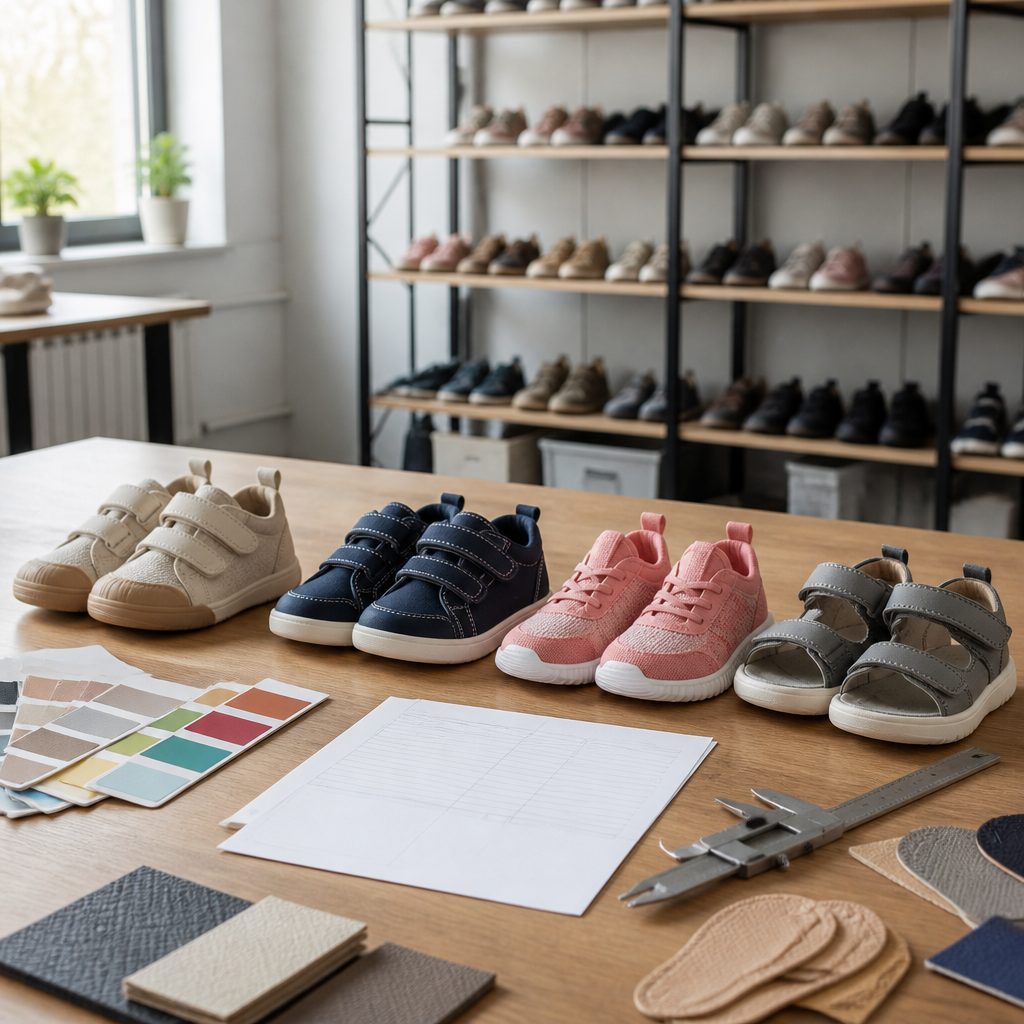
A sample can look ready in a photo while the review note still leaves essential decisions unclear. A wholesale kids sneaker sample approval checklist gives a private-label kids sneaker sample review a usable record: identify the version seen, capture the buyer's decision, keep unresolved matters visible, and name any project-specific proof separately.
This article offers editorial guidance for the buyer. The record below is not a KidsShoeWorks approval form, a production commitment, or confirmation that a future bulk order, document, test, or service will apply. Its purpose is to make the next project conversation narrower and easier to follow.
Why sign-off starts before approval
An unqualified note such as "approved" does not tell a product team what was accepted. It may leave the sample version unknown, combine a color decision with a logo-placement concern, or conceal a proof request behind a visible observation.
Start by identifying the model or reference, the sample version, and the review date. Then use the same field name whenever the buyer returns to a point. That lets the record distinguish what was seen on this version from what still needs discussion for the project.
Three statuses for each review line
For every field other than sample identity, use the last three columns in the record. They are editorial status labels for the buyer, not documented KidsShoeWorks stages.
- Buyer decision recorded
- Use this column for a choice the buyer has stated for the identified sample version.
- Question still open
- Use this column where a choice, clarification, or requirement has not yet been settled.
- Project-specific proof to request
- Use this column to name evidence the project may need beyond what the buyer can see in the sample.
A decision and a proof request can both be relevant to one field. Keeping them in separate columns prevents a selected feature from being mistaken for evidence that a separate requirement has been addressed.
The buyer decision record
Editorial buyer decision record for one identified sneaker sample. Fill the cells with the current project notes rather than treating the prompts as pre-approved answers.
| Review field | Observed sample version | Buyer decision recorded | Question still open | Project-specific proof to request |
|---|---|---|---|---|
| Sample identity and published sneaker fields | ||||
| Sample reference / version | [Model or reference, version, review date] | [Not a status field] | [Not a status field] | [Not a status field] |
| Intended use context | [Use context noted by buyer] | [Context selected] | [Use question] | [Evidence topic, if needed] |
| Upper option | [Breathable mesh or PU shown, if identifiable] | [Upper choice] | [Upper question] | [Material evidence topic, if needed] |
| Colorway | [Colors and shoe areas seen] | [Colorway decision] | [Color question] | [Color-related evidence topic] |
| Logo | [Logo treatment seen] | [Logo decision] | [Logo question] | [Logo-related evidence topic] |
| Closure | [Closure shown] | [Closure decision] | [Closure question] | [Closure-related evidence topic] |
| Outsole texture | [Texture seen] | [Texture decision] | [Texture question] | [Outsole-related evidence topic] |
| Quality-review fields named on the public quality page | ||||
| Fit and comfort | [Size range and buyer observation] | [Fit or comfort decision] | [Size-range or review question] | [Fit-related evidence topic] |
| Logo placement | [Placement seen] | [Placement decision] | [Placement question] | [Placement-related evidence topic] |
| Finish | [Finish observation] | [Finish decision] | [Finish question] | [Finish-related evidence topic] |
| Closure review | [Closure review note] | [Review decision] | [Review question] | [Closure-review evidence topic] |
| Stitching | [Location and observation] | [Stitching decision] | [Stitching question] | [Stitching evidence topic] |
| Bonding | [Location and observation] | [Bonding decision] | [Bonding question] | [Bonding evidence topic] |
| Flex point | [Location and observation] | [Flex-point decision] | [Flex-point question] | [Flex-point evidence topic] |
| Outsole stability | [Observation] | [Stability decision] | [Stability question] | [Stability evidence topic] |
The table is deliberately bounded. It organizes published product fields and published review areas, while leaving the buyer's own requirements, observations, and evidence needs open for the project.
What the public sneaker entry establishes
The kids' sneaker product entry describes the category as a strong starting point for private-label and retail orders. It lists daily wear and school retail under "Best for." It identifies a breathable mesh or PU upper.
Colorway appears as a custom field. Logo appears as a custom field. Closure appears as a custom field. Outsole texture appears as a custom field. Those entries supply practical headings for the record, but they do not amount to a complete specification for a new sneaker brief.
Choice-by-choice notes
Keep the four custom choices on separate lines even when the sample is reviewed in one meeting. A single approval comment should not force a later reader to infer whether it applies to colorway, logo, closure, or outsole texture.
- Colorway: Note the colors and shoe areas shown in the sample version. Put any remaining color reference or selection issue in the open-question column.
- Logo: Record the treatment that is visible. The public quality description separately includes logo placement in sample review, so placement belongs on its own quality-review row.
- Closure: State the closure visible on the sample and place any remaining selection issue in its own cell. The quality page also lists closure within sample review.
- Outsole texture: Describe the texture seen. Do not convert that visible feature into an unstated performance conclusion; the product entry identifies texture as a custom field.
This separation makes a later custom kids sneaker development inquiry more specific. It also avoids reopening an entire sample when only one recorded choice remains unsettled.
When engineered mesh is under consideration
The product entry's upper description is limited to breathable mesh or PU. The materials page separately describes engineered mesh as light and breathable. It also describes engineered mesh as knit-style and quick-dry. Kids' sneakers appear among the uses listed for engineered mesh.
For the buyer record, note whether the sample is identified as engineered mesh or whether the upper remains an open question. The published excerpts do not state that every breathable-mesh upper is engineered mesh. They also do not assign the engineered-mesh characteristics to PU, so a buyer should write any additional material need as a project question rather than as a confirmed sample property.
Fit and construction entries
The quality page puts toddler, little kid, and big kid sizing in its fit-review description. It lists fit, comfort, logo placement, finish, and closure together for sample review. For construction review, it names stitching, bonding, flex point, and outsole stability.
- Fit and comfort
- Record the size range being considered alongside the buyer's observation. A comment on one size range should not stand in for a decision about every size range.
- Logo placement and finish
- Use distinct rows for placement and finish. This preserves the source's separate review areas and gives the buyer a place to record either a decision or an unresolved point.
- Construction fields
- Place each observation under stitching, bonding, flex point, or outsole stability. Include the location observed so a general construction note does not hide the subject of the question.
These are editorial ways to capture review notes. The public quality description identifies the areas under review; it does not establish a result for a particular sneaker project.
Proof is its own record
What a buyer sees in a sample and what a project needs as proof are different matters. The quality page identifies buyer-specific packing labels as a documentation topic. It separately identifies market-specific material notes. It names inspection photo requests, third-party test coordination, and document requests from an importer or retailer.
Its evidence-over-badges statement says it would rather send inspection photos, measured samples, and test reports a project actually requires than provide certifications unrelated to the order. That statement does not specify which photos, samples, reports, coordination, labels, or documents will apply to a new inquiry.
- In the proof-request column, identify the exact question the evidence should answer.
- Where a measured sample is relevant, name the measurement or size point the buyer needs to discuss.
- Keep packing-label, material-note, importer, retailer, and document topics separate from visual sample comments.
- For a kids footwear inspection plan, write third-party test coordination as a project discussion topic rather than an assumed deliverable.
That distinction keeps visible design observations from carrying more weight than they can support.
Moving unresolved fields into an inquiry
Use the project inquiry form to share the sample reference and the lines that remain open. Include the intended use context, selected or open upper choice, colorway, logo, closure, and outsole-texture status. Add the applicable size-range question and any packing-label, material-note, importer, retailer, or document topic that needs discussion.
Ask which development, sampling, or quotation options may apply to the project. The site's private-label sneaker program page is labeled as an example of how KidsShoeWorks scopes, samples, and runs a program. It may help as a published stage example, but it is not a completed customer outcome or a commitment that comparable terms apply to another project. A concise record gives the next conversation a defined sample version, named decisions, and a short list of unresolved fields.
Sources and verification
- Children's Footwear Products | KidsShoeWorks First-party site source
- Quality Control for Children's Shoes | KidsShoeWorks First-party site source
- Kids' Shoe Materials | Mesh, PU, Canvas, Rubber & EVA | KidsShoeWorks First-party site source
- Kids' Shoe Programs: Case Study Format | KidsShoeWorks First-party site source
Share the current children's footwear definition and ask which development, sampling or quotation options may apply to the project.
Send your project brief