Sourcing Guides
Wholesale Kids School Sneakers UK: Define Role First
For UK wholesale kids school sneakers, fix program role, upper class, fit bands and colorway/logo/closure/outsole fields before sampling so offers describe the same product.
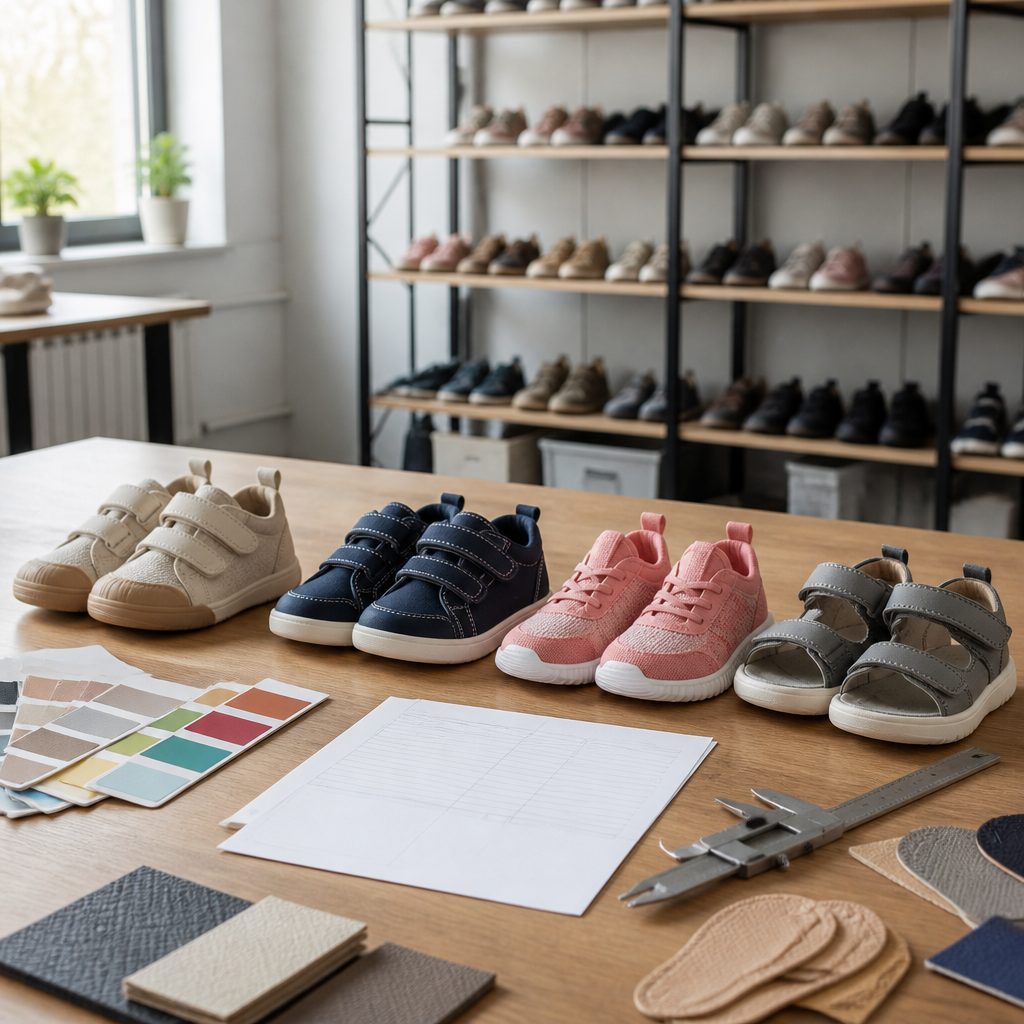
UK kids and family brands, school-retail buyers, and importers often open a children's shoes wholesale inquiry with a short category name only. School retail versus daily wear, mesh versus PU, and which age bands belong in the run stay unresolved. Offers then describe different shoes, and samples cannot be compared on equal terms.
For wholesale kids school sneakers UK programs, lock the product definition before sampling. This brief stays inside the published kids sneaker family on KidsShoeWorks: school and daily-wear role, mesh or PU upper language, toddler through big-kid fit review, and four custom fields (colorway, logo, closure, outsole texture). Packing handoffs, timed QC ladders, and stock-versus-custom model choice sit outside this article. The public pages used here do not include UK statutory detail, numeric size runs, or filled case metrics, so those items are not invented.
School retail is a product decision, not a label on the RFQ
Calling a line “kids sneakers” does not fix how it will be sold or worn. On the children’s footwear products page, kids sneakers are framed as a strong starting point for private-label and retail orders, popular with brands that want casual wear and school use, and best for daily wear and school retail. That is program-role language, not a tag you can paste onto any athletic-looking upper.
When school retail is in scope, write it into the definition before anyone quotes materials or samples a colorway. Editorial recommendation for the buyer: state role first (school retail and/or daily wear), then build language. Keep rain boots, sandals, canvas, and infant-only programs out of this brief unless they truly share the same sneaker family and use case.
Read the published kids sneaker family at its actual scope
The documented ceiling for this family is short. Use it as the boundary when you write children’s sneakers product definition wholesale language for UK school-retail programs. It is not a claim that every order must use every custom field, or that mesh and PU are interchangeable without a written choice.
- Strong starting point for private-label and retail orders
- Associated with casual wear and school use
- Best for daily wear and school retail
- Build options: breathable mesh or PU upper
- Custom fields: colorway, logo, closure, and outsole texture
Write the upper boundary before anyone samples: mesh or PU
Upper class belongs in the first draft, not as a sample-stage surprise. The products page states the sneaker build as breathable mesh or PU upper.
Separately, the materials page describes engineered mesh as light, breathable knit-style uppers for warm-weather and active styles, with breathable, lightweight, and quick-dry attributes. That same materials excerpt notes use in kids’ sneakers, sports runners, and sandals. Keep those statements separate. Mesh is documented for warm-weather and active styles. PU is the other upper class on the sneaker product card, without further material attributes in the same excerpts.
| Upper class | What public pages support | Buyer definition task |
|---|---|---|
| Breathable / engineered mesh | Sneaker build option; mesh framed as light, breathable, warm-weather and active | State mesh when school-and-daily sneakers need that use-case language |
| PU upper | Listed as the other sneaker upper option on the products page | Name PU explicitly if that is the intended class; do not assume mesh attributes apply |
For mesh upper kids sneakers wholesale inquiries aimed at school and daily wear, put the upper class in the inquiry draft. Do not merge mesh attributes onto PU. Do not add canvas, leather, or other materials as sneaker defaults unless a different product family and evidence set are in play. On the quality page, material control confirms upper, lining, outsole, and adhesive choices before the sample stage, which is another reason to treat upper class as pre-sample work.
Fit bands that change the brief: toddler, little kid, big kid
Size is not a late commercial detail for school-and-daily programs. Quality content lists fit review across toddler, little kid, and big kid sizing as a wearability checkpoint, with the buyer benefit framed as a better chance of matching the target market. Fit and comfort appear again at sample review alongside logo placement, finish, and closure.
| Fit band named in quality content | Why it belongs in product definition |
|---|---|
| Toddler | Name the band if the program includes it so fit review has a clear target |
| Little kid | Name the band if it is in the school/daily program so fit review has a clear target |
| Big kid | Name the band if it is in the school/daily program so fit review has a clear target |
Numeric UK size runs and grade rules are not published in the excerpts used here. Name which bands are in scope and ask how fit review will be handled for those bands. That is buyer definition work, not a claim of a fixed supplier size chart.
Four custom fields that belong in the product definition
The products page lists four custom fields for kids sneakers: colorway, logo, closure, and outsole texture. Treat them as product-identity fields. Keep them apart from packing labels, carton presentation, and export handoff topics covered under packing discipline and buyer documents on the quality page.
| Custom field | Role in the definition | Keep separate from |
|---|---|---|
| Colorway | Visual story for school retail and daily wear | Carton stickers and export labels |
| Logo | Brand mark placement and identity | Importer paperwork fields |
| Closure | How the shoe fastens for the target age band | Inner packing counts alone |
| Outsole texture | Tread and character of the bottom | Outer carton presentation |
Sample review already groups logo placement, finish, and closure with fit and comfort. Lock these four fields in the product definition so sample review has a written target. Do not invent custom options beyond the four listed on the products page.
Documentation topics to ask about, without rewriting the QC plan
UK importers and school-retail buyers often need paperwork alignment without rewriting a full QC plan in the first email. The quality page lists topics the site can align around: buyer-specific packing labels, market-specific material notes, inspection photo requests, third-party test coordination, and document requests from the importer or retailer. Proof is framed as inspection photos, measured samples, and the test reports a project actually requires, not badges unrelated to the order.
- Which market-specific material notes matter for this school-retail sneaker?
- Which inspection photos should sit on the sample or bulk plan?
- Is third-party test coordination required for this program, and who owns the brief?
- What documents will the importer or retailer request before receiving?
Ask these as alignment questions only. Do not treat them as automatic deliverables or as a substitute for order-specific proof. No UK regulation numbers or pass/fail claims appear in the source pages, so none are asserted here.
How a private-label sneaker program is scoped in public format
Private label kids sneakers school retail work needs a shared scoping format, not only a colorway sketch. The case study page publishes an example of how a private-label sneaker program is scoped, sampled, and run. It is presented as an example format, not a filled customer narrative. Pair that pointer with the products page positioning of kids sneakers as a private-label and retail starting point.
What you can take into the RFQ: there is a public example structure for program scoping and sampling. What you cannot take from those pages: completed UK school-program metrics, named retailers, or guaranteed outcomes. If a private-label path is intended, say so in the definition block and review the example format before bulk commercial assumptions harden.
One school-retail sneaker definition block for the UK wholesale inquiry
Use one reusable block so every supplier answers the same product. Hypothetical illustration only: a UK family brand defining school-retail mesh sneakers across little-kid and big-kid bands, with stated values for colorway, logo, closure, and outsole texture, plus a short list of documentation topics to align. Replace every field with your actual program.
- Program role: school retail and/or daily wear (state which apply).
- Product family: kids sneakers only, not mixed footwear families.
- Upper class: breathable mesh or PU (one primary choice for the first sample path).
- Fit bands in scope: toddler, little kid, and/or big kid as applicable.
- Four custom fields: colorway, logo, closure, outsole texture (values or options as known).
- Documentation topics to align: material notes, inspection photos, third-party tests, importer/retailer documents as needed.
With that block written, ask which development, sampling, or quotation options may apply rather than requesting a price against an undefined kids sneaker. When the definition is stable enough to discuss options, use the request a quote path and attach the same block to every parallel inquiry so replies stay comparable.
Sources and verification
Product-family role, mesh or PU build, and the four custom fields map to the products page. Engineered mesh attributes and warm-weather/active use map to the materials page only for mesh. Fit bands (toddler, little kid, big kid), material confirmation before sample, sample review items, and documentation alignment topics map to the quality page. The private-label sneaker program example format maps to the case-study page as a format pointer only.
Gaps to keep honest: no UK statutory text, standard numbers, or certification claims; no numeric MOQs, lead times, prices, or size-run percentages; no named customers or completed school-program results. Buyers should fill those from their own compliance advisors, commercial terms, and project files after the product definition is locked.
Sources and verification
- Children's Footwear Products | KidsShoeWorks First-party site source
- Kids' Shoe Materials | Mesh, PU, Canvas, Rubber & EVA | KidsShoeWorks First-party site source
- Quality Control for Children's Shoes | KidsShoeWorks First-party site source
- Kids' Shoe Programs: Case Study Format | KidsShoeWorks First-party site source
Share the current children's footwear definition and ask which development, sampling or quotation options may apply to the project.
Send your project brief