Sourcing Guides
Wholesale Children's Sneakers Size Bands: Lock Coverage First
Wholesale children's sneakers size bands must be named as program scope before sample fit review. Use toddler, little kid, and big kid as coverage fields, not post-approval QC jargon.
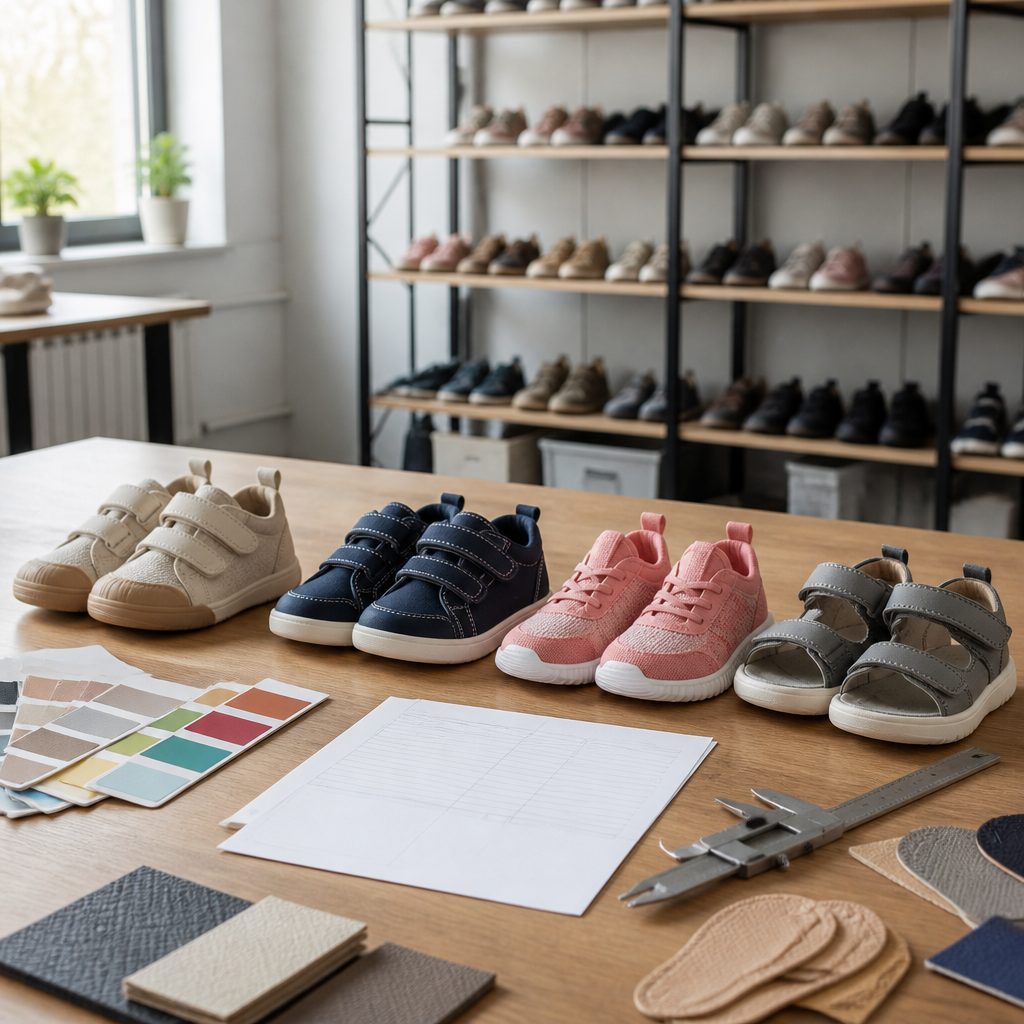
Buyers writing RFQs for wholesale children's sneakers size bands often treat “kids” as one continuous range. Materials, colorways, and closures get frozen while size coverage stays unspoken. Sample pairs then validate an undefined span, and bulk risk shows up after approval when the assortment is expected to serve more wearers than the review ever covered.
This brief treats three published fit-review labels (toddler, little kid, and big kid) as mandatory coverage fields that belong in the program definition before sample review. Role language, upper choices, and custom appearance fields stay important, but none of them replaces an explicit multi-band or single-band decision.
Undifferentiated “kids” sizing is a wholesale sneaker program risk
Commercial intent collapses when the order never states which fit bands it must cover. A retail buyer may assume little-kid and big-kid depth for school shelves. A brand may only need toddler and little kid for a launch capsule. If neither party writes those limits into the brief, later talk about comfort or finish has no scope boundary.
The failure mode is practical. Sample pairs can look correct for the sizes that happened to be sampled. The approved look then becomes the bulk reference even though the commercial plan still expects sizes that never entered fit review. Rework, assortment gaps, or a second sampling cycle then cost more than naming coverage at the RFQ stage would have.
Editorial guidance for buyers: write coverage as an in-scope / out-of-scope list before you freeze the color story. Treat any continuum that only says “kids sneakers” as incomplete until the bands are marked. Vague kids sneakers wholesale sizing is not a usable program definition.
Use the three published fit-review labels as coverage fields
On the quality control page, KidsShoeWorks lists fit review against toddler, little kid, and big kid sizing, and describes those bands as reviewed for day-to-day wearability. Those three labels are the published vocabulary available for program scope. They are not a size chart, not a year-of-age map, and not a US-size conversion table. The page also does not promise market-fit outcomes; it frames the review as a better chance of matching a target market when those bands are considered.
| Published fit-review label | How to use it in a wholesale brief | What not to invent from the label alone |
|---|---|---|
| Toddler | Mark in scope or out of scope for the sneaker program | Infant-category limits, foot-length mm, or age-in-years ranges |
| Little kid | Mark in scope or out of scope; state if it is the core band | School-grade mappings or numerical size runs |
| Big kid | Mark in scope or out of scope; note if it is deferred to a later drop | Youth performance claims or adult-adjacent sizing |
Force an explicit choice: one band only, two adjacent bands, or all three. A toddler little kid big kid sneaker program is only defined after each published label is marked in or out of scope. If a band is planned for a later season, write it as out of scope for this program rather than leaving it implied. Sample review cannot invent coverage that the brief never named.
Product role is not a substitute for size-band coverage
The kids' sneakers product listing positions the style as a starting point for private-label and retail orders, popular with brands that want casual wear, school use, and a wide color story. It names daily wear and school retail as the best-fit role. That language describes range purpose. It does not decide whether the wholesale program includes toddler only, little kid and big kid, or every published band.
Casual or school use can apply inside a single band or across several. Role copy helps product developers explain why the sneaker sits in the assortment. Coverage still has to be written as a separate field. When RFQs merge role and sizing into one sentence (“school sneakers for kids”), fit reviewers and factory teams inherit ambiguity that no sample pair can resolve alone.
Sample review validates wearability only for named bands
Quality materials describe sample review as checking fit, comfort, logo placement, finish, and closure together, so the bulk run has a better chance of matching the approved sample. Fit and comfort are also listed against the same toddler, little kid, and big kid labels used in fit review. Children's sneakers sample fit review applies to the bands you put in the brief. It does not expand the program to bands you never listed.
- List each in-scope band before sample request, using only the published labels.
- State which sample sizes represent each named band, without inventing a full chart the factory page does not publish.
- Review fit and comfort against day-to-day wearability for those bands only.
- Review logo placement, finish, and closure on the same sample set so appearance and wearability stay aligned.
- Refuse to treat sample approval as silent authorization for out-of-scope bands.
If commercial plans later add a band, treat that as a new scope decision and a new sampling question, not as an automatic extension of the prior approval.
Keep upper, colorway, logo, closure, and outsole on separate lines
Once coverage is named, build and appearance fields stay parallel rather than absorbing the size decision. The sneaker listing cites breathable mesh or PU upper as the build options, and lists colorway, logo, closure, and outsole texture as custom fields. On the materials page, engineered mesh is described as light, breathable, knit-style uppers for warm-weather and active styles, with breathable, lightweight, and quick-dry attributes. Engineered mesh is listed among materials used in kids' sneakers, and is also listed for sports runners and sandals. Keep those material statements separate from the fit-band choice.
| Field group | What the first-party pages support | Relation to size bands |
|---|---|---|
| Coverage | Toddler, little kid, big kid as fit-review labels | Primary program-scope decision |
| Upper build | Breathable mesh or PU; engineered mesh attributes where that material is specified | Parallel after bands are named |
| Custom appearance and hardware | Colorway, logo, closure, outsole texture | Parallel; do not use a logo or closure choice to imply band coverage |
A mesh upper decision does not tell the factory which bands ship. A logo placement does not decide big-kid inclusion. Write each line so sampling and quotation work can address the right unknown without conflating fields.
Construction and packing checkpoints stay adjacent to fit scope
Quality materials also describe construction review of stitching, bonding, flex point, and outsole stability checked before packing. Packing discipline covers carton counts, labels, stickers, and export presentation. Incoming materials alignment, in-line checks, and final packing appear in the same quality ladder. Documentation topics such as buyer-specific packing labels, market-specific material notes, inspection photo requests, third-party test coordination, and importer or retailer document requests appear as alignment topics rather than automatic inclusions for every order.
Those checkpoints matter for any wholesale children's sneaker program. They do not replace the toddler / little kid / big kid coverage decision. A clean carton plan cannot fix an assortment that never defined which bands were in scope. Construction checks on sampled sizes cannot certify wearability for bands that never entered sample review.
Keep construction and packing next to, not instead of, coverage. After coverage, role, and build lines are clear, ask which packing labels, inspection photos, or third-party test coordination may apply to the project. Do not treat every documentation topic as a committed package.
Fit-band definition block for development, sampling, or quotation
Before development, sampling, or quotation work proceeds, write a short definition block the factory and your internal team can share. The case-study page notes a private-label sneaker program example of how the company scopes, samples, and runs a program. Use that only as a prompt that program format can be discussed, not as a filled process map or customer outcome.
- Program role. State daily wear and school retail, casual wear, or another commercial role in your own words, aligned with the sneaker range purpose on the products page.
- Size bands in scope. Mark toddler, little kid, and big kid each as in or out for this program. If only one band is live, say so.
- Open fit questions. List unknowns limited to the named bands (for example, which sample sizes will represent each in-scope label).
- Separate material and custom unknowns. Mesh or PU upper, engineered-mesh intent if relevant, colorway, logo, closure, and outsole texture each get their own open line.
- Adjacent checkpoints. Note construction, packing, and document topics you may want aligned later, without using them as substitutes for band coverage.
With that block written, a buyer can share the current children's footwear definition and ask which development, sampling, or quotation options may apply to the project on the request-a-quote page. That invitation is an inquiry path, not a promise of MOQs, lead times, or service packages the evidence does not state.
Evidence boundaries for this size-scope brief
First-party pages support a limited set of statements. Staying inside those bounds keeps the RFQ honest and keeps sample review meaningful.
- Supported: toddler, little kid, and big kid as fit-review and fit-and-comfort labels for day-to-day wearability review; sample review topics of fit, comfort, logo placement, finish, and closure; sneaker role language for daily wear, school retail, casual wear, and color story; mesh or PU upper and custom colorway, logo, closure, and outsole texture; engineered mesh attributes and use in kids' sneakers; construction and packing checkpoints; documentation topics a buyer may ask to align; a private-label sneaker program as an example format for scoping and sampling.
- Not supported here: numerical size charts, US conversions, or age-in-years maps; guarantees of market fit, return-rate reduction, or school-uniform compliance; MOQs, prices, lead times, or order quantities; certifications, factory-visit narratives, or test results as general claims; expansion of toddler into infant-category product scope; sports performance or durability claims beyond published daily-wear and school-retail role language.
Where this article recommends writing coverage first or separating fields, that is editorial procurement practice for buyers, not a restatement of a factory guarantee. Keep wholesale children's sneakers size bands explicit, then let sample review and adjacent checkpoints do the work they are published to do.
Sources and verification
- Children's Footwear Products | KidsShoeWorks First-party site source
- Quality Control for Children's Shoes | KidsShoeWorks First-party site source
- Kids' Shoe Materials | Mesh, PU, Canvas, Rubber & EVA | KidsShoeWorks First-party site source
- Kids' Shoe Programs: Case Study Format | KidsShoeWorks First-party site source
Share the current children's footwear definition and ask which development, sampling or quotation options may apply to the project.
Send your project brief