Sourcing Children's Shoes
Receiving Checks for Wholesale Children's Sneakers
A receiving-focused guide to separating the sneaker specification, buyer packing instructions, published packing checkpoints and open project questions.
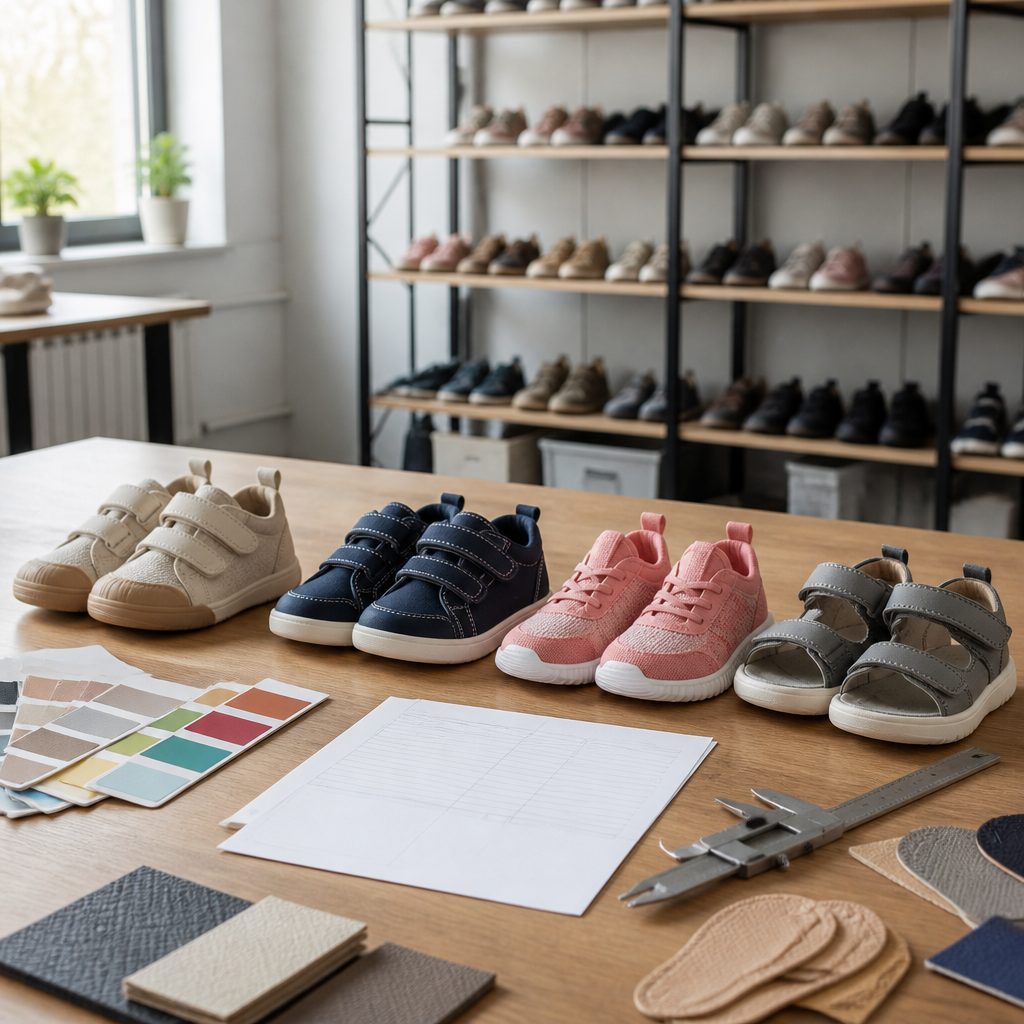
A useful way to plan wholesale children's sneakers is to begin at the receiving desk. What information will the warehouse, retailer or importer use to identify the shipment, review its packing and decide whether it meets the buyer's instructions?
That question is separate from product approval. KidsShoeWorks publishes sneaker choices covering the upper, colorway, logo, closure and outsole texture. Its quality page also names carton counts, inner packing, labels and outer cartons as final-packing checkpoints. Neither page specifies a standard carton size, pack configuration, barcode format or destination-specific label content.
For that reason, this guide recommends keeping three records visible throughout the project: the buyer's receiving instructions, the relevant KidsShoeWorks checkpoint and each detail that still needs project confirmation. The purpose is not to create a general footwear RFQ. It is to prevent an open receiving question from disappearing inside a product or price discussion.
What must receiving know?
Start with the party that will receive the goods. The buyer can ask its warehouse, retailer, importer or logistics contact which identifiers, files and packing details are required for the handoff. Depending on that party's process, inquiry topics might include pack contents, item and size references, carton marks, label placement, barcode data or routing instructions.
Those examples are buyer-side fields, not published KidsShoeWorks packing formats. The linked quality page describes what is checked at final packing, but it does not provide project-specific carton dimensions, barcode standards or receiving criteria.
| Receiving record | What belongs in it | Status to show |
|---|---|---|
| Buyer instruction | Requirements obtained from the receiving party, including any controlled label or packing files | Approved, draft or awaiting internal input |
| Published checkpoint | The relevant packing subject named by KidsShoeWorks | Available for discussion against the project brief |
| Open question | A carton, label, barcode, evidence or document detail that has not been confirmed | Confirm for the project |
This status distinction is an editorial recommendation for the buyer. It helps keep draft information from being presented as a final instruction.
Two specifications, one handoff
The shoe specification and the shipping-unit specification answer different questions. The KidsShoeWorks product overview identifies breathable mesh or PU as upper options for its kids' sneaker entry. It names colorway, logo, closure and outsole texture as customization topics. The entry associates the category with daily wear and school retail.
Those details can establish the current product direction, but they do not define children's sneaker packing requirements. The buyer still needs to provide or confirm the packing and receiving fields relevant to its own project.
| Product definition | Shipping-unit definition |
|---|---|
| Intended use and size segment supplied by the buyer | Requested inner-packing arrangement |
| Breathable mesh or PU upper under consideration | Carton specification and carton-marking instructions |
| Colorway, logo, closure and outsole texture | Label content, barcode data and destination instructions, where applicable |
The shipping-unit column is a list of inquiry inputs. It is not a list of standard configurations or confirmed services.
The materials page separately describes engineered mesh as light, breathable and quick-dry. It lists uses in kids' sneakers, sports runners and sandals. That material description does not identify every breathable mesh upper as engineered mesh or establish its suitability for every sneaker program.
The final-carton checkpoint
KidsShoeWorks states that carton counts, inner packing, labels and outer cartons are checked before shipment. This gives a buyer four published subjects around which to organize the receiving handoff. It does not by itself define how any of those subjects will be configured for an order.
| Published subject | Buyer input to prepare | Question to resolve |
|---|---|---|
| Carton counts | The data against which the receiving party expects quantities to be reconciled | What project instruction will be used for the check? |
| Inner packing | The requested grouping or presentation rules | Which arrangement, if any, can apply to the project? |
| Labels | Required content, artwork, placement and approval status | Which label files and placement instructions can be used? |
| Outer cartons | Any applicable destination, retailer, warehouse or transport constraints | Which carton details and marks remain to be confirmed? |
Barcode handling should remain a separate question. The published checkpoint names labels, but it does not specify barcode formats, encoded values, placement rules or verification methods. Buyers with barcode requirements should provide the applicable instructions and ask what can be considered for the project.
Earlier checkpoints can expose late questions
Receiving details become harder to discuss clearly when they first appear at final packing. The editorial recommendation is to place known label, packing and document questions beside the earlier product checkpoints, while keeping their approval status separate from the shoe sample.
KidsShoeWorks states that incoming upper, lining, outsole, label and adhesive samples are aligned to the brief. This is the point at which a buyer can identify which label information is final, which files are still drafts and which receiving requirements are not yet available.
The published sample review covers fit, comfort, logo placement, finish and closure. Product teams can review those subjects without treating sample approval as approval of carton marks, inner packing or receiving documents.
During production, the published in-line checks cover assembly, stitching, bonding, flex and stability. Packing questions should remain visible alongside that production discussion, but the page does not state that every requested packing instruction will be available or accepted.
- Before sample review: share controlled label or packing files that are ready, and identify drafts as drafts.
- At product review: record product decisions separately from shipping-unit questions.
- Before packing: confirm which instruction and file versions may apply.
- Before shipment: ask what evidence, if any, may be available for the relevant final-packing subjects.
Evidence requests are scoped questions
The KidsShoeWorks quality page identifies buyer-specific packing labels as an alignment topic. It separately identifies market-specific material notes as an alignment topic.
The same page names inspection photo requests and third-party test coordination. It also names document requests from an importer or retailer. These are subjects for project discussion, not promises that a particular photo set, test report, certification or importer document will accompany an order.
A precise request is easier to assess than a broad request for proof. For inspection photos, the buyer can name the subject it wants shown, such as visible label placement or carton marking, and ask whether those photos may be available. For a retailer or importer document, the buyer can provide the document name, required fields and issuing-party instructions. Where testing is relevant, the buyer can identify the applicable requirement and ask what third-party coordination may be discussed. KidsShoeWorks does not state that it performs third-party testing.
The receiving party should retain responsibility for deciding whether the resulting information meets its requirements. A factory packing checkpoint does not establish warehouse, retailer or importer acceptance.
A receiving-ready quotation comparison
A kids sneaker quotation can be difficult to compare when one response assumes only basic packing and another addresses buyer-provided labels or requested inspection evidence. The recommended comparison is narrow: record only the receiving-related scope included, excluded or still open in each response.
| Comparison field | What to record |
|---|---|
| Packing scope | Which inner-packing and outer-carton instructions were considered |
| Label inputs | Which buyer files, fields and placement instructions were reviewed |
| Requested evidence | Which inspection-photo or document requests may apply |
| Unresolved carton details | Dimensions, construction, marks or other specifications still awaiting confirmation |
| Acceptance responsibility | The buyer-side warehouse, retail, importer or product contact responsible for reviewing the answer |
Quantities, prices and timing may still be necessary commercial questions, but they are outside this receiving comparison and are not published in the cited pages. Keeping them in a separate commercial record preserves the receiving-handoff focus.
The receiving-ready inquiry
For private label kids sneakers, begin the inquiry with a short reference to the current product definition on the product page. Then provide the receiving material that is already available: packing instructions, approved or draft label files, destination constraints and the receiving party's review criteria.
Close with a compact list of open receiving questions. Ask which packing-label alignment topics may apply, whether the requested inspection-photo subjects can be discussed and what importer or retailer document coordination may be considered. Identify any carton, barcode, testing or file details that still require confirmation.
The quotation page can be used to share that current definition and ask which development, sampling, quotation and receiving-related options may apply. Keep the request bounded: product direction once, receiving inputs next and unresolved handoff questions last.
Sources and verification
- Children's Footwear Products | KidsShoeWorks First-party site source
- Quality Control for Children's Shoes | KidsShoeWorks First-party site source
- Kids' Shoe Materials | Mesh, PU, Canvas, Rubber & EVA | KidsShoeWorks First-party site source
Share the current children's footwear definition and ask which development, sampling or quotation options may apply to the project.
Send your project brief