Product Development
Which Upper Term for Private Label Kids Mesh Sneakers Wholesale?
Breathable mesh and engineered mesh appear on separate KidsShoeWorks pages. Keep that distinction open while defining the upper, other materials, and project evidence for sampling and quotation.
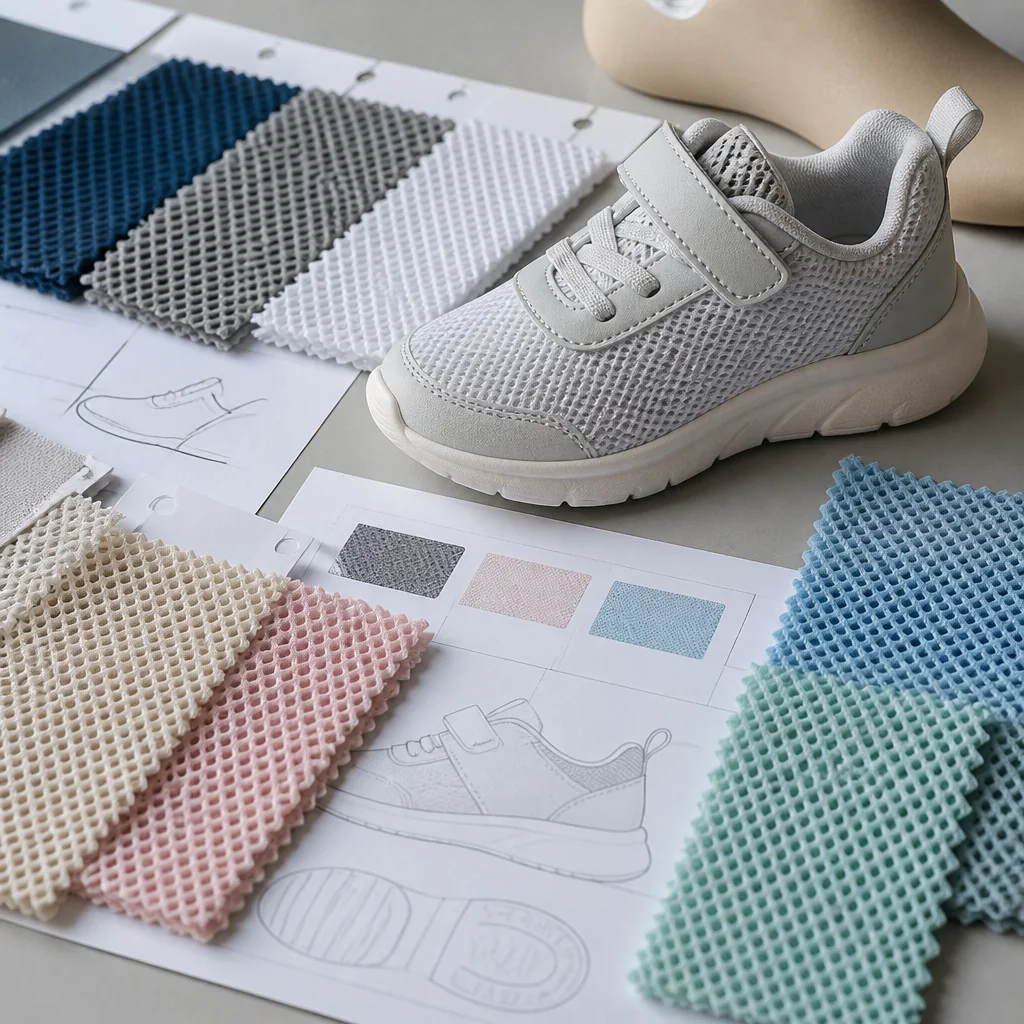
Before sampling or quotation for private label kids mesh sneakers wholesale, identify the upper term the project requires—or leave it explicitly open. KidsShoeWorks lists “breathable mesh or PU” as the upper build on its kids’ sneakers product entry. A separate materials page describes “engineered mesh.” The supplied evidence does not treat those phrases as interchangeable, and it does not confirm that either term fits every current sneaker program.
Until the project documents which wording applies, keep both statements at their published scope. A children's sneaker sampling brief should name the requested upper, or flag the mesh term as unresolved, instead of silently substituting one published phrase for the other.
What each published description actually covers
The product entry and the materials entry answer different questions. The kids’ sneakers entry presents a short product-family build: breathable mesh or PU as the upper option, with colorway, logo, closure, and outsole texture named as customization areas. It does not define mesh construction, composition, or performance thresholds for the word “breathable.”
The materials page treats engineered mesh as a material category. It describes light, breathable, knit-style uppers for warm-weather and active styles; applies breathable, lightweight, and quick-dry descriptors; and lists kids’ sneakers, sports runners, and sandals among uses. That use list does not prove engineered mesh applies to every sneaker, and it does not establish that “engineered mesh” is the same construction meant by “breathable mesh” on the product page.
| Source context | Published description | Unresolved project question |
|---|---|---|
| Kids’ sneakers product entry | Breathable mesh or PU is identified as the upper build. Colorway, logo, closure, and outsole texture are named as customization areas. | What material or construction does “breathable mesh” identify for the proposed sneaker? |
| Engineered mesh materials entry | Engineered mesh is described as a light, breathable, knit-style upper for warm-weather and active styles, with breathable, lightweight, and quick-dry descriptors. Kids’ sneakers, sports runners, and sandals are listed as uses. | Is engineered mesh applicable to this project, and what evidence supports any required property? |
Neither excerpt supplies composition, yarn or fiber details, knit structure, thickness, weight, test methods, acceptance thresholds, or a project-specific report. Unless the buyer already holds a controlled specification, those items stay inquiry fields.
Decision rows for a kids sneaker upper material specification
A practical kids sneaker upper material specification separates confirmed product choices from questions that still need an answer. The rows below are an editorial structure for the buyer’s brief, not a claim that every listed inquiry can be fulfilled.
| Decision row | What to record | Status to assign |
|---|---|---|
| Product family | Kids’ sneakers, plus the buyer’s intended product description and use context. | Confirmed by buyer or open |
| Requested upper wording | Use “breathable mesh,” “engineered mesh,” or the buyer’s own controlled material term. Do not substitute one published term for the other without confirmation. | Required, proposed, or unresolved |
| Mesh definition | Ask what construction and material identification correspond to the proposed upper wording. | Open inquiry |
| Colorway | Record the intended color direction and note details that still need development discussion. | Confirmed by buyer or open |
| Branding and closure | State the intended logo treatment and closure decision—both customization areas named in the kids’ sneakers entry. | Confirmed by buyer or open |
| Outsole texture | Keep the requested texture direction separate from the upper definition. | Confirmed by buyer or open |
| Performance language | List any buyer-required property as a requirement to discuss, including method and acceptance basis if the buyer already defined them. | Buyer requirement or open inquiry |
| Evidence request | Ask which material information, sample evidence, photographs, measurements, reports, or coordination options may apply to this project. | To be confirmed |
Recording status beside each row keeps a descriptive word from becoming an accidental approval when commercial, development, and quality reviewers read the same brief.
Upper choice is not a full material approval
Selecting a mesh label does not settle the whole shoe. The KidsShoeWorks quality overview states that upper, lining, outsole, and adhesive choices are confirmed before the sample stage. Keep those fields separate so approval of one does not imply approval of the others.
- Upper
- Record the exact requested term and whether its material definition has been confirmed for the project.
- Lining
- Enter the buyer’s requirement or mark the choice as open. Do not derive a lining choice from the mesh description.
- Outsole
- Keep the outsole material decision separate from the outsole texture customization point named in the product overview.
- Adhesive
- Record the choice as confirmed or unresolved according to the project documentation. The mesh label alone does not decide it.
A quotation request can still show a clear product direction while marking which material decisions need alignment before sampling.
Where material questions sit in the published sequence
The quality overview places related work at defined checkpoints. Upper, lining, outsole, and adhesive choices are confirmed before the sample stage.
Buyer action (editorial recommendation): Resolve the mesh upper term, or document it as unresolved with a clear question, before the sample stage so later alignment has a written brief to follow.
At incoming materials, upper, lining, outsole, label, and adhesive samples are aligned to the brief.
Buyer action (editorial recommendation): Treat incoming alignment as a check against the already written brief. Do not rely on that checkpoint as the first place to invent the mesh definition.
Sample review covers fit, comfort, logo placement, finish, and closure. Use that checkpoint for those stated review areas. The source does not present sample appearance or comfort review as a test of breathability, drying speed, or material weight. Keep any separate technical property tied to its own agreed evidence.
During production, published in-line checks cover assembly, stitching, bonding, flex, and stability. Those construction checks come after the pre-sample material decision. They should not postpone an unresolved upper definition, and they should not be read as proof of an unmeasured mesh property.
Light, breathable, and quick-dry are descriptions, not results
“Light,” “breathable,” and “quick-dry” are published descriptions associated with engineered mesh on the materials overview. The supplied evidence gives no test method, threshold, comparative result, or project-specific report for those descriptors. Do not convert them into measured guarantees in an RFQ, specification, or approval record.
If a property matters to the intended product, define the question in buyer-controlled terms: descriptive preference or required result. When it is a required result and the buyer already has a method, acceptance criterion, and documentation expectation, state them. When those items are not yet defined, ask what development or evidence options may apply instead of inventing a threshold.
An engineered mesh kids shoes OEM brief should make the same split visible. Naming a material category and requiring a verified outcome are different purchasing actions; the brief should show which action the buyer is taking.
Which project evidence may apply?
The quality overview identifies inspection photo requests, third-party test coordination, and document requests from an importer or retailer among the documentation topics KidsShoeWorks says it can align around. It also states a preference for project-relevant inspection photos, measured samples, and required test reports over certifications unrelated to the order.
That preference supports a precise question. It is not a guarantee that a particular photograph, sample, test, report, or coordination arrangement will be available for every mesh definition. Ask which evidence may apply to the current project and who would define methods, criteria, timing, and document format.
- For upper identity, ask what material description can be tied to the proposed sample.
- For a visible detail, ask which inspection photographs may be relevant.
- For a measured or tested requirement, provide the buyer’s existing method and acceptance basis, or ask which coordination options may apply.
- For importer or retailer documentation, state the actual request rather than referring generally to “compliance documents.”
How to structure a bounded sampling inquiry
Organize the inquiry into three blocks. First, state the current definition: kids’ sneaker product family; requested or unresolved upper term; intended colorway, logo, closure, and outsole texture. Second, keep lining, outsole material, and adhesive as separate decisions. Third, list the questions that need a project-specific response.
Useful questions include whether breathable mesh and engineered mesh refer to the same proposed construction, which term should appear in the sample brief, what material identification can be provided, and which development or sampling evidence may apply. The buyer may also ask which quotation information applies to the defined project without assuming an MOQ, price, sample charge, or lead time.
Use the quotation inquiry to share that bounded definition. Make current requirements visible, label unresolved terminology honestly, and ask for confirmation before either mesh term becomes part of an approved specification.
Sources and verification
- Children's Footwear Products | KidsShoeWorks First-party site source
- Kids' Shoe Materials | Mesh, PU, Canvas, Rubber & EVA | KidsShoeWorks First-party site source
- Quality Control for Children's Shoes | KidsShoeWorks First-party site source
Share the current children's footwear definition and ask which development, sampling or quotation options may apply to the project.
Send your project brief