Footwear Specifications
Resolve a UK wholesale kids' sneaker mesh upper brief
A buyer-focused method for clarifying published mesh terms, separating adjacent component choices and preparing a children's sneaker inquiry before sampling.
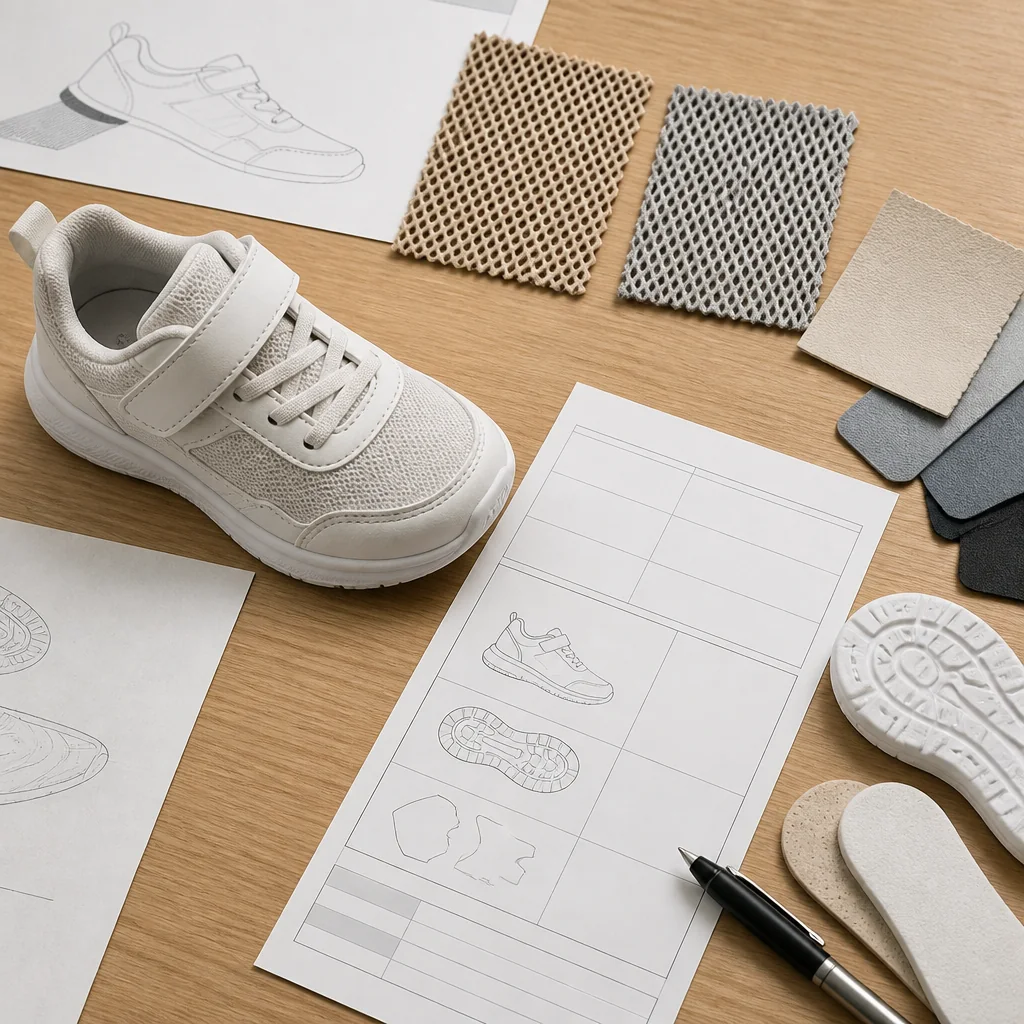
KidsShoeWorks uses breathable mesh on its kids' sneaker product entry and engineered mesh on its materials page. The supplied pages do not confirm that the terms identify the same upper. Resolving that point is the central task in a UK wholesale kids' sneaker mesh upper brief. The product entry provides broad build wording, while the materials page describes a named material category. A buyer therefore needs confirmation of which description applies to the upper proposed for development.
The evidence boundary is straightforward. Published material descriptions can be carried into the inquiry at their stated scope, but they do not supply buyer-specific test methods, numerical thresholds or acceptance criteria. The status fields and workflow recommendations below are editorial controls for the buyer; they are not presented as KidsShoeWorks' internal terminology or as guaranteed services.
Put the two mesh terms side by side
The first step is to record what each page actually says. This makes the missing relationship visible without creating a combined material name.
| Published wording | Source context | Question for the inquiry |
|---|---|---|
| Breathable mesh or PU upper | The product entry gives this as the build wording for kids' sneakers. | Is the proposed upper the breathable mesh referenced in this entry, and how should that mesh be identified in the sample brief? |
| Engineered mesh | The materials entry describes light, breathable knit-style uppers for warm-weather and active styles. It applies the descriptors breathable, lightweight and quick-dry. | Does the proposed upper correspond to this engineered-mesh entry? |
| Listed uses for engineered mesh | The materials entry lists kids' sneakers, sports runners and sandals. | Is engineered mesh being proposed for this particular kids' sneaker definition? |
If the buyer requests an engineered mesh kids' sneaker upper, the inquiry can quote that materials-page term directly. If the starting point is the product entry, it can retain breathable mesh until the relationship is confirmed. Combining the terms into a new phrase such as engineered breathable mesh would add a connection that the supplied pages do not document.
As an editorial recommendation, give the upper field one of four working statuses: requested, confirmed, alternative proposed or open. These labels help the buyer distinguish an initial preference from an agreed material reference. They do not imply that KidsShoeWorks uses the same status system.
Build the component record
The quality page states that upper, lining, outsole and adhesive choices are confirmed before the sample stage. Its incoming-material checkpoint separately names upper, lining, outsole, label and adhesive samples as items aligned to the brief. The two lists show why a mesh preference cannot stand in for the complete component record.
| Component | Where the quality page names it | Recommended buyer entry |
|---|---|---|
| Upper | Before the sample stage and at incoming-material alignment | Record the requested material wording, available reference and current status. |
| Lining | Before the sample stage and at incoming-material alignment | Enter a separate requirement or leave a clearly marked question. |
| Outsole | Before the sample stage and at incoming-material alignment | State the applicable material or construction request independently of the upper. |
| Adhesive | Before the sample stage and at incoming-material alignment | Keep any requirement or document request in its own field. |
| Label sample | At incoming-material alignment | Track the label reference separately from the upper definition. |
The product entry also names colorway, logo, closure and outsole texture as custom fields for kids' sneakers. These belong in a separate design block in the inquiry. The published list does not describe them as engineered-mesh options.
Decide what the descriptors need to mean
The engineered-mesh entry supplies qualitative descriptions: breathable, lightweight and quick-dry. It does not provide a numerical breathability value, a weight limit, a drying method or a durability threshold. Those words can identify buyer priorities, but the supplied evidence does not turn them into project acceptance criteria.
For a children's sneaker material specification, the editorial recommendation is to separate three layers:
- Published description
Record the applicable wording from the materials page, including the engineered-mesh material name and any relevant published descriptors.
- Buyer requirement
State which attribute matters to the project and provide any requirement already established by the buyer, importer or retailer. Leave the field open when no requirement has been supplied.
- Acceptance criterion
Identify the governing method, sample condition, threshold and review point when the project has defined them. Do not derive these details from the qualitative material description.
This structure also makes the material question easier to answer. The buyer can ask whether the proposed upper matches the named material reference, then address any measurable requirement through the documentation or testing scope that applies to the project.
Use each checkpoint for its stated purpose
The quality page assigns different subjects to different checkpoints. Mapping the open questions to those stated subjects prevents a fit or construction review from closing an unresolved material field.
| Checkpoint | Published scope | Recommended use in the inquiry |
|---|---|---|
| Before the sample stage | Upper, lining, outsole and adhesive choices are confirmed. | Ask for the applicable upper name or reference and record any component choice that remains open. |
| Incoming materials | Upper, lining, outsole, label and adhesive samples are aligned to the brief. | Provide distinct references for the upper and the other named items. |
| Sample review | Fit, comfort, logo placement, finish and closure are reviewed together. | Use these as the stated sample-review subjects while tracking material identity separately. |
| In-line checks | Assembly, stitching, bonding, flex and stability are checked during production. | Keep these construction checks separate from any project-specific mesh test or threshold. |
The quality page's fit review also names toddler, little kid and big kid sizing. The buyer can identify the applicable bracket in the inquiry or ask what fit information is needed for the proposed program. As an editorial control, the fit status and upper-material status should remain separate because the published checkpoints address different subjects.
Ask what proof applies to the project
Under documentation, the quality page says KidsShoeWorks can align around buyer-specific packing labels, market-specific material notes, inspection-photo requests, third-party test coordination and document requests from an importer or retailer. Its proof statement says the company would rather send inspection photos, measured samples and the test reports a project actually requires than show certifications unrelated to the order.
That wording supports a project-specific discussion. It does not identify every item as an automatically included deliverable. The buyer can make the request precise by asking:
- which material name or reference can identify the proposed mesh upper;
- whether a photo, measured sample, material note or other available record can address the open question;
- how an importer or retailer document request should be supplied;
- whether third-party test coordination may apply to the project;
- which party will provide any required method and acceptance criterion; and
- which documentation and proof options are available for the proposed program.
The supplied evidence identifies no UK-specific standard, certification result or laboratory method. Any such requirement must come from the applicable project documentation rather than from the published mesh descriptions.
What to include in the inquiry
A useful inquiry shows what is known, what is requested and what still needs confirmation. The following fields keep that distinction visible:
- Product definition
Identify the program as a kids' sneaker and state the intended use that applies to the buyer's project.
- Current upper wording
Enter breathable mesh, requested engineered mesh or another buyer-supplied term. Mark the entry as requested, confirmed, alternative proposed or open.
- Material identity question
Ask whether the proposed upper is the engineered mesh described on the materials page. If it is different, ask what name or reference should appear in the sample brief.
- Attributes and criteria
List the relevant published descriptors separately from buyer-supplied methods, thresholds and evidence requirements.
- Adjacent components
Give lining, outsole and adhesive their own entries. Add the label reference as a separate incoming-material field where applicable.
- Design fields
Record the applicable colorway, logo, closure and outsole-texture requirements.
- Fit scope
Identify the intended toddler, little kid or big kid bracket, or ask which fit information may be required.
- Documentation request
Attach any importer or retailer request and describe the material note, inspection photo, measurement or project-specific test report being discussed.
- Next commercial question
Ask which development, sampling, quotation, documentation and project-specific proof options may apply. Leave price, timing and other commercial terms open for a project-specific response.
Send the current definition through the request-a-quote page. The immediate goal is to obtain an accurate upper reference while keeping lining, outsole, adhesive, fit, design and proof questions in their proper fields.
Sources and verification
- Children's Footwear Products | KidsShoeWorks First-party site source
- Kids' Shoe Materials | Mesh, PU, Canvas, Rubber & EVA | KidsShoeWorks First-party site source
- Quality Control for Children's Shoes | KidsShoeWorks First-party site source
Share the current children's footwear definition and ask which development, sampling or quotation options may apply to the project.
Send your project brief