Product Development
UK Children's Sneaker Upper Material Specification
A procurement guide for separating a children's sneaker upper option from the requirements and evidence questions that still need review.
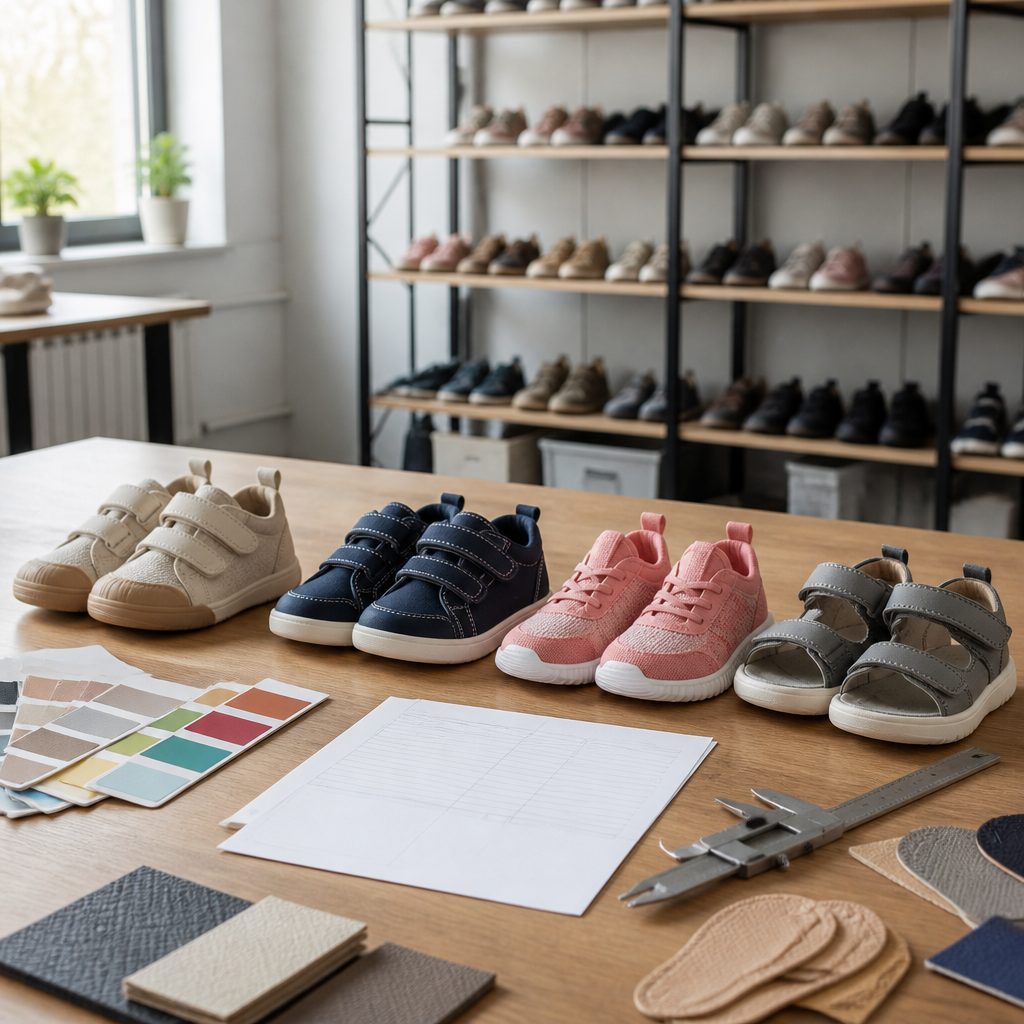
A material label is only the beginning of a quotation request. For a UK children's sneaker upper material specification, the editorial recommendation is to separate the proposed upper from the design choices, intended context, and unanswered evidence questions. That gives suppliers a clearer request to read and gives the buyer a more useful basis for comparing responses.
Calling an upper mesh or PU does not, by itself, define the finished sneaker. It leaves open the colorway, logo, closure, outsole texture, sizing scope, and any documentation or testing questions the buyer needs addressed. The product listing offers a set of starting options; the brief records what the buyer wants considered for the style.
The fields that define the request
The kids' sneakers listing identifies kids' sneakers with a breathable mesh or PU upper. It also identifies custom colorway, logo, closure, and outsole texture. For quotation purposes, treat each item as its own field rather than compressing them into a single material description.
| Brief field | Starting option on the sneaker listing | Editorial recommendation for the buyer |
|---|---|---|
| Product family | Kids' sneakers | Name the product family and state the intended context in the buyer's own terms. |
| Upper | Breathable mesh or PU upper | Record the proposed route and identify any material questions that remain open. |
| Colorway | Custom colorway | Provide a color direction or reference separately from the upper choice. |
| Logo | Custom logo | Supply artwork and note the placement to be reviewed. |
| Closure | Custom closure | Identify the closure direction under consideration. |
| Outsole texture | Custom outsole texture | State the texture request on its own line. |
This format prevents one decision from standing in for another. A colorway request, for example, remains a colorway request. It does not imply anything about the selected upper. Keeping the entries separate also makes omissions easier to spot before an inquiry moves forward.
Mesh and PU: what the record supports
The materials page describes engineered mesh as light, breathable, quick-dry, and knit-style. It names kids' sneakers, sports runners, and sandals among the uses of engineered mesh. Those are useful background points for a children's sneaker mesh upper brief, provided they remain descriptions of engineered mesh rather than requirements met by a proposed style.
PU appears as an upper option on the sneaker listing. The supplied materials excerpt does not add properties for PU. For a kids shoe PU upper quotation, describe the properties, documents, or performance questions the buyer wants reviewed instead of attaching unverified language to the material name.
The available excerpts do not provide a test method or result for either option. They also do not provide a wear-life result, water-resistance result, safety conclusion, certification, retailer decision, or UK-market approval. Do not put any of those statements into the upper specification unless separate, material-specific support is requested and reviewed for the inquiry.
Write an upper brief that can be compared
A private-label children's sneaker specification is easier to review when it distinguishes selections from open questions. The sequence below is editorial guidance for the buyer, not a statement of a fixed factory process or a pre-approved build.
- Set the intended context. Identify the request as a kids' sneaker and describe how the buyer intends to position it. Keep this as a buyer input, not as a claim that the product is suitable for a particular season, channel, school program, or market.
- Name the upper starting point. Record breathable mesh or PU when either is the proposed option. If engineered mesh is being considered, its light, breathable, quick-dry, knit-style description can be retained as source background.
- Separate visual and construction directions. Put colorway, logo, closure, and outsole texture on individual lines. This lets a reviewer see which details are selected and which still require a response.
- State unresolved questions plainly. List the material, documentation, market, or performance points that need review as questions. A question in a brief is not an achieved requirement or an approval.
- Identify the requested review scope. Include the sizing band the buyer wants considered and add packing-label or document requests only when they are relevant to the inquiry.
The result is a request that can be handed between sourcing, design, and merchandising without silently adding assumptions. It also makes later changes traceable: a revision to logo placement does not need to be confused with a revision to the upper route.
Before the sample stage
The quality page says that upper, lining, outsole, and adhesive choices are confirmed before the sample stage. Its incoming-material checkpoint says upper, lining, outsole, label, and adhesive samples are aligned to the brief. These checkpoints make it sensible to resolve the wording of the upper selection and identify open questions before asking which sample-related options may apply.
The same page includes toddler, little kid, and big kid sizing in its fit-review scope. A buyer can name the sizing band to be reviewed rather than assume that one size range or fit consideration applies to every sneaker request.
Evidence requests stay open
The quality page names buyer-specific packing labels, market-specific material notes, inspection photo requests, third-party test coordination, and document requests from an importer or retailer as topics it can align around. It frames proof around inspection photos, measured samples, and test reports a project actually requires, rather than unrelated certifications.
- State whether the buyer is asking about a market-specific material note for a defined question.
- Identify an inspection-photo request and any document request originating with the importer, retailer, or internal team.
- Describe the measured-sample or test-report question that needs to be considered.
- Ask whether third-party test coordination is relevant to the stated request.
Phrase each item as a request for discussion. That preserves the difference between an evidence need and an evidence result, while giving the recipient enough detail to respond to the actual issue.
Quotation request checklist
Before using Request a Quote, condense the material decision into a short record. This checklist combines the sneaker configuration fields with the quality-page topics that may be raised for review.
- Product and intended context
- Name the kids' sneaker family and describe the buyer's intended context without asserting suitability or approval.
- Proposed upper
- State breathable mesh or PU as the starting option. For mesh, note whether the engineered-mesh description is included only as background.
- Design directions
- List colorway, logo, closure, and outsole texture independently.
- Sizing and documents
- Name the sizing band to be reviewed. Add a packing-label request or importer or retailer document request when applicable.
- Questions requiring a response
- List material notes, inspection photos, measured samples, test-report questions, or third-party coordination topics that remain open.
Submit that record with the inquiry and ask which development, sampling, or quotation options may apply. Keep any response about material, documentation, or testing tied to the defined sneaker request so it can be assessed against the buyer's stated need.
Sources and scope
The products page supports the sneaker family, upper options, and configurable design fields used here. The materials page supports the engineered-mesh description and named uses. The quality page supports the pre-sample material checkpoint, sizing categories, and documentation or proof topics.
These sources support a disciplined inquiry brief. They do not turn an upper option into a documented result for a particular product, market, retailer, or requirement.
Sources and verification
- Children's Footwear Products | KidsShoeWorks First-party site source
- Kids' Shoe Materials | Mesh, PU, Canvas, Rubber & EVA | KidsShoeWorks First-party site source
- Quality Control for Children's Shoes | KidsShoeWorks First-party site source
Share the current children's footwear definition and ask which development, sampling or quotation options may apply to the project.
Send your project brief