Product Development
Three Statuses: Private Label Kids Sneaker Sample Approval Checklist
Record accepted, revise-and-resample and unanswered decisions by field, while keeping material, production, packing and proof questions at their proper checkpoints.
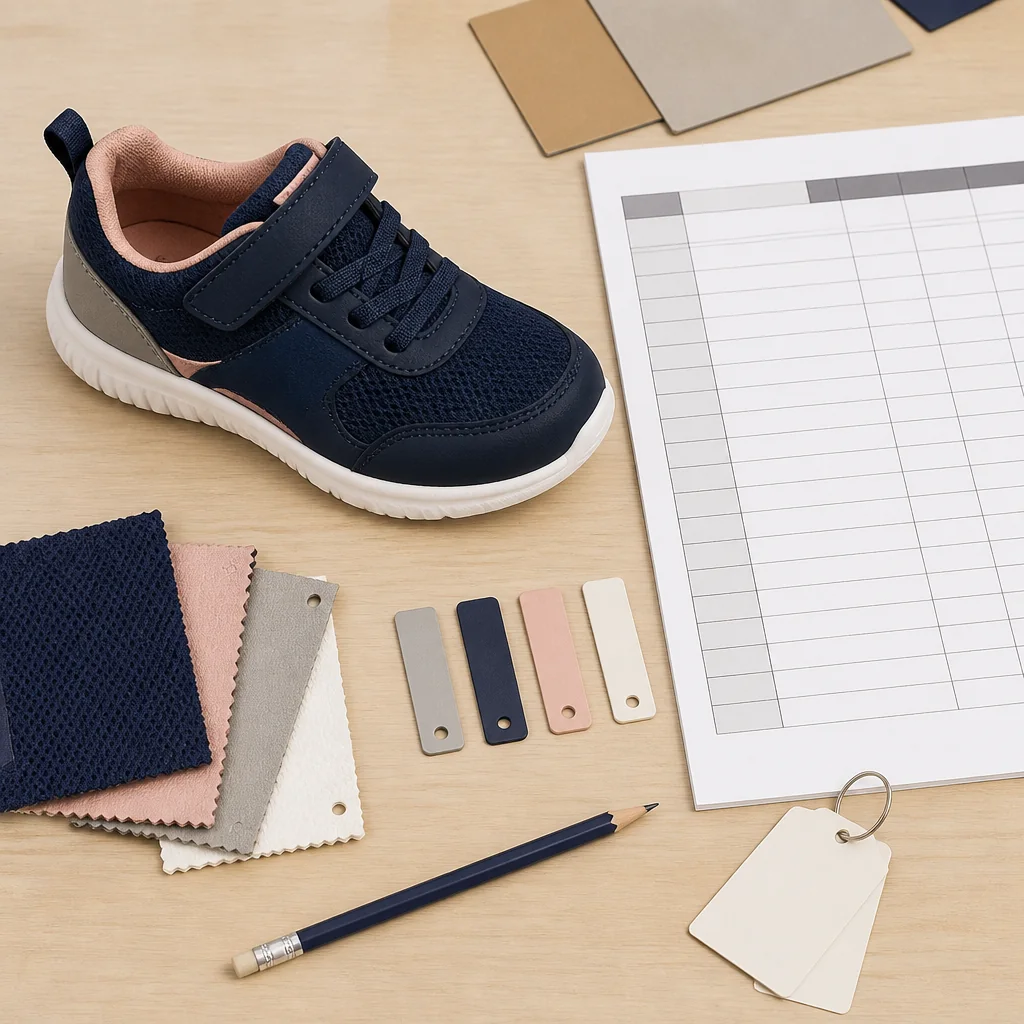
At sample review, record a separate decision for each field KidsShoeWorks identifies: fit, comfort, logo placement, finish and closure. A private label kids sneaker sample approval checklist works best as a decision record, not a release for every part of the project. Keep earlier material confirmations and later production or packing checks outside those five decisions.
The matrix and status labels below are editorial recommendations for the buyer. They are not presented as a KidsShoeWorks form or required workflow. KidsShoeWorks states that its quality checkpoints are aligned to the product brief and written inspection plan, so those project documents should provide the buyer's acceptance criteria. The published benefit of sample review is a better chance that bulk matches the approved sample, not a guarantee of exact conformity.
Start with three field statuses
A field-level status makes the scope of each decision visible. Apply one of these buyer-defined labels to every sample-review field:
- Accepted
- The buyer considers this field consistent with the written requirement for the identified sample revision. Acceptance applies only to that field and version.
- Revise and resample
- The observed sample differs from the buyer's requirement, or the buyer wants to review the proposed correction on another sample before accepting it.
- Unanswered
- The available sample, requirement or review basis does not resolve the field. Record what information or further review is needed.
This structure keeps an open question from being absorbed into a general signature. It also allows one field to move forward while another remains under review.
Which version is being reviewed?
Before assigning statuses, identify the product and sample revision. The KidsShoeWorks product page lists breathable mesh or PU as upper build options for kids' sneakers. It separately identifies colorway, logo, closure and outsole texture as customization categories. These published categories can organize the record, but they do not confirm every requested variation, treatment or combination.
As an editorial control for the buyer, place the following information above the matrix:
- Product reference
- Use the buyer's style name, model reference or other project identifier.
- Sample identity
- Enter the sample identifier, revision and review date so the decisions point to one version.
- Intended use
- State the project's intended use. KidsShoeWorks describes the listed sneaker category as best for daily wear and school retail, but that general description is not proof of suitability for a particular buyer or market.
- Upper selection
- Reference the requested upper specification and its current confirmation status rather than relying only on the words mesh or PU.
- Colorway
- Identify the color reference represented by the sample.
- Logo
- Reference the artwork revision and placement instruction.
- Closure
- Name the requested closure and the configuration shown on the sample.
- Outsole texture
- Point to the texture reference under review without extending the decision to an unreviewed variation.
When any part of this definition changes, the buyer should create a new revision rather than relying on later teams to interpret an earlier approval.
The approval matrix
This buyer-owned kids sneaker sample review checklist uses the fields in the published sample-review checkpoint. It intentionally supplies no numerical tolerances, fit standards or performance limits. Enter criteria only from the current buyer brief and written inspection plan.
Field-by-field sample decision record
| Review field | Brief requirement | Observed sample state | Status | Requested revision | Unanswered question |
|---|---|---|---|---|---|
| Fit | Reference the applicable buyer requirement. | Record the review result and its scope. | Accepted, revise and resample, or unanswered. | Describe the requested change without adding an unsupported tolerance. | Identify any missing size, fit or review basis. |
| Comfort | State the criterion defined for this project. | Describe what the review established and what it did not. | Accepted, revise and resample, or unanswered. | Name the feature that needs another review. | Keep unresolved suitability questions visible. |
| Logo placement | Cite the artwork revision and placement instruction. | Record the artwork version and position observed. | Accepted, revise and resample, or unanswered. | Reference the corrected artwork or instruction. | List missing artwork or placement information. |
| Finish | Reference the required appearance or finish definition. | Describe only the identified sample. | Accepted, revise and resample, or unanswered. | State the visible correction requested. | Separate appearance questions from later performance checks. |
| Closure | Reference the selected closure definition. | Record the configuration and review result. | Accepted, revise and resample, or unanswered. | State what should change in the next version. | Retain any unresolved operation or construction question. |
Hypothetical example: one record could mark logo placement as accepted, closure as revise and resample, and comfort as unanswered when the buyer's review basis is still missing. The three entries describe different decisions; none should be converted into approval of the entire shoe.
Reference photographs, artwork and specifications by revision. This buyer-side practice preserves what each status meant if an attachment is later replaced.
Material choices are an earlier record
The published quality sequence separates material confirmation from sample findings. KidsShoeWorks states that upper, lining, outsole and adhesive choices are confirmed before the sample stage. Its sample-review checkpoint covers fit, comfort, logo placement, finish and closure.
Timing and buyer record
| Checkpoint | Published fields | Editorial buyer action |
|---|---|---|
| Before the sample stage | Upper, lining, outsole and adhesive choices. | Reference each current specification or written confirmation in the sample record. |
| Sample review | Fit, comfort, logo placement, finish and closure. | Compare each field with the current requirement and assign its own status. |
Keep the two records linked but distinct. If the sample appears inconsistent with a written material choice, the buyer should record the discrepancy as an open matter rather than allowing visual acceptance to replace the earlier confirmation.
Approved in review, open in production
Sample approval does not close the later production checkpoint. KidsShoeWorks identifies assembly, stitching, bonding, flex and stability as in-line checks performed during production. Those production fields should not be marked accepted merely because the sample-review fields have been resolved.
For the buyer's production handoff, retain the current brief and written inspection-plan revisions, the identified sample record, every field-level decision and any correction closed after another review. Carry forward unanswered items that remain relevant to production. The buyer can also ask how the sample revision and project documents may be identified during production and inspection.
The stated benefit of sample review remains limited: it provides a better chance that the bulk run matches the approved sample. The approval record should preserve that boundary rather than state or imply exact bulk conformity.
Packing and proof stay outside sign-off
Final packing has a separate published checkpoint. KidsShoeWorks states that carton counts, inner packing, labels and outer cartons are checked before shipment. A sample decision should therefore leave packing status open for that later checkpoint.
The quality page also names several documentation topics that KidsShoeWorks can align around. Each is a project question, not evidence that a test, report, photograph, certification or document is automatically included or complete.
Questions carried beyond sample approval
| Topic | Published scope | Question for the project inquiry |
|---|---|---|
| Final packing | Carton counts, inner packing, labels and outer cartons are checked before shipment. | Which packing instructions apply, and when will their status be reviewed? |
| Buyer-specific packing labels | Listed as a topic KidsShoeWorks can align around. | Which label instructions apply to this project? |
| Market-specific material notes | Listed as an alignment topic. | Are such notes relevant, and which buyer reference should govern them? |
| Inspection photo requests | Listed as an alignment topic. | Which images are requested, and when may that request apply? |
| Third-party test coordination | Listed as an alignment topic. | Is coordination applicable, and what separate testing requirements remain open? |
| Importer or retailer documents | Document requests from an importer or retailer are listed as an alignment topic. | Which individual documents are requested, and what is their current status? |
Keep each request open until its relevance and status are confirmed for the project. Coordination should not be recorded as a completed test, passed result or automatic deliverable.
Project inquiry handoff
Send a compact record that lets the recipient see both the current definition and the remaining decisions. Include:
- the product reference, intended use and sample revision;
- the current upper, lining, outsole and adhesive confirmations;
- separate statuses for fit, comfort, logo placement, finish and closure;
- requested revisions and fields requiring another sample review;
- production and final-packing questions assigned to their later checkpoints;
- testing, photo, label and document questions whose applicability remains open.
The private-label sneaker program page is presented as an example of how KidsShoeWorks may scope, sample and run a program. It is not a customer result or a promised workflow. Share the current definition and decision record through the project inquiry, then ask which development, sampling or quotation options may apply to the project.
Sources and verification
- Children's Footwear Products | KidsShoeWorks First-party site source
- Quality Control for Children's Shoes | KidsShoeWorks First-party site source
- Kids' Shoe Programs: Case Study Format | KidsShoeWorks First-party site source
Share the current children's footwear definition and ask which development, sampling or quotation options may apply to the project.
Send your project brief