Children's Footwear Development
Private Label Kids Sneaker Outsole Texture Requirements: RFQ
A buyer-authored RFQ record for a listed outsole-texture field that keeps open development, review, evidence, and quotation points visible.
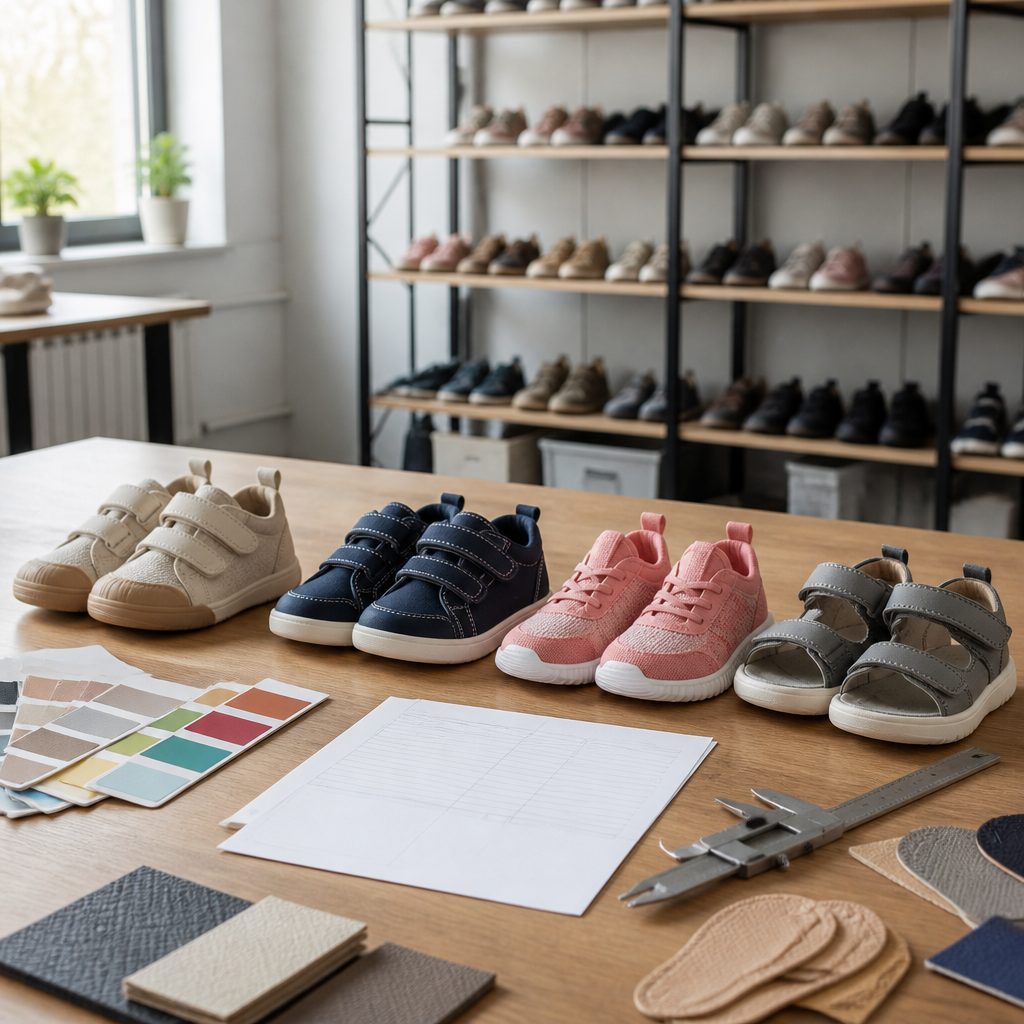
As an editorial recommendation, begin an outsole-texture request with the buyer's reference and a written note explaining what that reference is intended to communicate. For private label kids sneaker outsole texture requirements, this prevents a short product-page label from taking on an unstated meaning during an RFQ discussion.
The KidsShoeWorks products page names outsole texture as a sneaker customization field. Its quality page names material, sample-review, production, and packing checkpoints for other stated subjects. The useful procurement task is to record the requested surface direction clearly, then ask which project-specific development, sampling, review, proof, and quotation options may apply.
Start with the buyer's own record
The record below is editorial guidance for the buyer. It is not a description of a KidsShoeWorks workflow or a promise that a given request can be developed, sampled, quoted, reviewed, or evidenced.
| Record item | Editorial entry for the buyer |
|---|---|
| Current sneaker definition | State the current children's sneaker direction in a few clear terms so the surface request is tied to the intended product. |
| Reference identifier | Name the image, drawing, physical reference, or written note being shared. Record its current revision or date where that helps prevent mix-ups. |
| Requested surface direction | Describe what the outsole reference is meant to show. Keep visual direction separate from any additional criterion the buyer wishes to raise. |
| Colorway entry | Record the current colorway direction in its own entry when relevant. |
| Logo entry | Record the current logo direction in its own entry when relevant. |
| Closure entry | Record the current closure direction in its own entry when relevant. |
| Open project points | Ask what further definition, development information, sampling information, quotation inputs, or evidence discussion may be relevant to the request. |
This structure gives a custom kids sneaker outsole texture request a stable reference point. It also lets a product team compare a response against the same buyer-authored brief instead of treating a general customization label as a completed requirement.
Read the customization list one field at a time
After preparing the record, compare it with the sneaker listing. The page presents kids' sneakers as a starting point for private-label and retail orders. Its customization entries can be recorded without combining their meanings.
| Product-page field | Documented statement | Buyer use in an inquiry |
|---|---|---|
| Colorway | Colorway is named as a custom field. | Keep the color direction in its own buyer-authored entry. |
| Logo | Logo is named as a custom field. | Keep the logo reference in its own buyer-authored entry. |
| Closure | Closure is named as a custom field. | Keep the requested closure in its own buyer-authored entry. |
| Outsole texture | Outsole texture is named as a custom field. | Identify the reference and state what the buyer wants the reference to communicate. |
In the supplied product excerpt, the custom-field line ends with those field names. It gives no definition of a particular outsole texture. A children's sneaker outsole specification inquiry should therefore carry its own written description rather than infer detail from the word "texture."
Put documented checkpoints on their actual timeline
The quality page provides useful timing for nearby footwear decisions. The following table keeps each timing statement in the lane named by that page.
| Time lane | Documented checkpoint | Editorial use for the inquiry |
|---|---|---|
| Before the sample stage | Material control says upper, lining, outsole, and adhesive choices are confirmed before the sample stage. | Ask how the defined outsole-texture request relates to the current outsole choice. |
| Sample review | Sample review names fit, comfort, logo placement, finish, and closure. | Keep those named topics separate from the texture request unless a project response addresses a connection. |
| During production | In-line checks name assembly, stitching, bonding, flex, and stability. | Ask whether any project-specific checkpoint can be aligned to the buyer's stated surface question. |
| Before shipment | Final packing names carton counts, inner packing, labels, and outer cartons. | Keep packing information in the packing portion of the brief. |
The provided checkpoint descriptions do not list outsole texture as a reviewed field. That is the boundary to retain: the timeline organizes related information, but it does not supply a texture criterion. Any desired review point remains an item for the inquiry.
Keep nearby checkpoint terms in their lanes
Fit, comfort, logo placement, finish, and closure are the terms named for sample review. A buyer should not present a surface reference as evidence of one of those sample-review topics unless the project discussion expressly connects them.
Assembly, stitching, bonding, flex, and stability are the terms named for in-line checks. Carton counts, inner packing, labels, and outer cartons belong to final packing. As an editorial recommendation, keep a proposed texture review in a distinct line of the brief rather than attaching it to one of these nearby lists.
That distinction matters when several sneaker decisions are moving at once. A colorway note can remain a colorway note. A logo reference can remain a logo reference. A closure request can remain a closure request. The outsole-texture reference can then be assessed against its own written purpose.
Ask about proof in project terms
The quality page says KidsShoeWorks would rather send inspection photos, measured samples, and test reports that a project actually requires than certifications unrelated to the order. This describes an evidence-over-badges position. It does not make any one item a default deliverable for every sneaker inquiry.
For the buyer, the next step is to name the question that any proof would need to address. Then ask which evidence, if any, is relevant to that defined project. This preserves room to discuss inspection photos, measured samples, or test reports without presuming a named test, a certificate, or a particular result.
Use a concise RFQ question set
A short RFQ can make the open points easier to assess against the current brief. The questions below are editorial prompts for a private label kids sneaker customization inquiry, not assertions about an available service or outcome.
- Can the outsole-texture reference be considered with the current children's sneaker definition?
- What further written detail or reference is needed to assess the request?
- Is the supplied reference understood as visual direction only, or is a separate criterion being requested?
- Which development information, if any, may apply to the defined request?
- Which sampling information, if any, may apply to the defined request?
- Can any project-specific quality checkpoint be aligned to the stated surface question?
- What inputs may be relevant before quotation is discussed?
- What project-specific evidence, if any, may be relevant to the question raised?
Send the current definition with the inquiry
Use the quote inquiry to share the current sneaker definition, the identified outsole-texture reference, and the distinction between visual direction and any separately stated criterion. Add colorway, logo, and closure as separate entries when they are part of the project.
The sneaker page supports raising outsole texture as a customization field. The quality page supplies adjacent checkpoints with their own named subjects. Keeping those two facts separate gives the buyer a clearer basis for asking which development, sampling, quotation, or project-specific evidence options may apply.
Sources and verification
- Children's Footwear Products | KidsShoeWorks First-party site source
- Quality Control for Children's Shoes | KidsShoeWorks First-party site source
Share the current children's footwear definition and ask which development, sampling or quotation options may apply to the project.
Send your project brief