Materials & Sourcing
Mesh vs PU upper for private label kids sneakers
Mesh has published descriptors; PU is listed only as an upper option. Keep that asymmetry visible through material definition, sampling, quotation and production review.
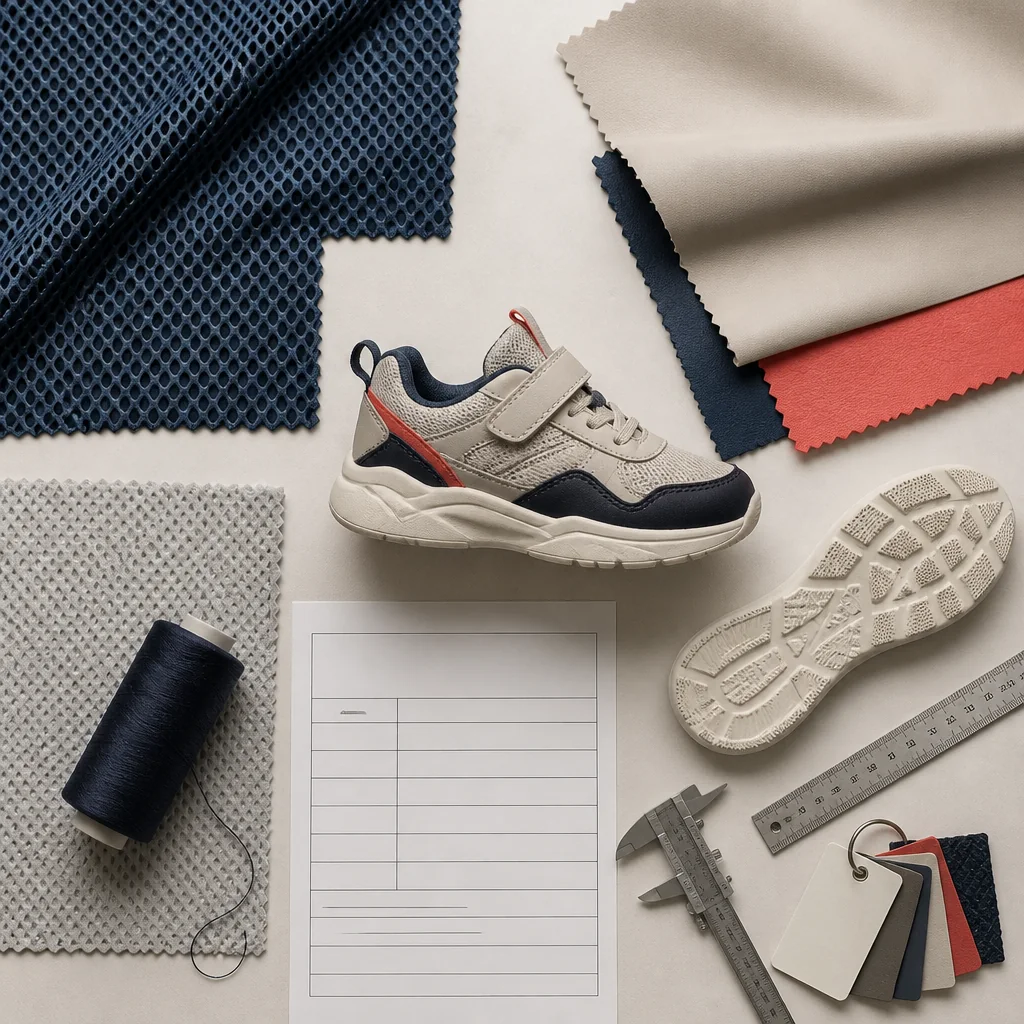
When a brand, retailer or product team must choose a mesh vs PU upper for private label kids sneakers, the first task is to separate published material facts from fields that still need project confirmation. KidsShoeWorks' kids' sneaker product information names a breathable mesh upper or a PU upper as build options for a style positioned for private-label and retail orders, including daily wear and school retail. Separately, the materials information describes engineered mesh as light, breathable and quick-dry, with uses that include kids' sneakers, sports runners and sandals. Those pages supply no matching PU attribute list.
Mesh is therefore the better-documented route in the supplied evidence, not a proven superior material. Select it when the published descriptors fit the brief and the proposed mesh construction can be confirmed. Keep PU in play when design direction points there, but require a project-specific definition before treating a PU quotation as comparable to mesh.
Why the upper decision comes before supplier shortlisting
Kids sneaker upper materials should be evaluated in three distinct layers so availability is not mistaken for performance evidence.
- Buyer requirement: Record the shoe role, intended channel, target size group and the characteristics the brand wants to evaluate.
- Published description: Keep the wording and scope of the available mesh information intact, without extending it to every mesh construction.
- Project confirmation: Ask for the exact upper reference, paired materials, finish and applicable customization fields for the proposed sneaker.
A listed PU option means PU can be considered for the product route described on the page. It does not establish PU breathability, weight, drying behavior, durability, comfort or cost. In the same way, the engineered-mesh description should not be applied automatically to any material labeled only as mesh.
What the published material descriptions establish
Keep the kids' sneaker product scope separate from the engineered-mesh material description. The supplied pages do not state that every breathable mesh upper uses the specific engineered mesh described on the materials page.
| Published information | Procurement meaning |
|---|---|
| Mesh route. The kids' sneaker product information lists a breathable mesh upper. In a separate material description, engineered mesh is characterized as light, breathable and quick-dry and is associated with kids' sneakers, sports runners and sandals. | Mesh has documented descriptors, but the buyer should ask whether the proposed sneaker uses that engineered-mesh construction. Do not transfer those attributes to another mesh reference without confirmation. |
| PU route. The kids' sneaker product information establishes PU as an upper option. The supplied evidence does not provide corresponding PU attributes. | Treat the missing detail as an evidence gap. Request the exact construction, finish and project-relevant characteristics before comparing PU with mesh. |
The practical choice is between a route with some published material descriptors and a route that still needs a fuller definition. Neither route is documented as universally safer, more comfortable, more durable or more suitable for children.
Questions the open material fields should force
Convert the asymmetry into fields every proposed construction must answer. That approach produces more useful quotations than asking whether mesh or PU is simply better.
Technical definition
- For the mesh route, is the proposed upper the engineered mesh described in the material information, or a different mesh reference?
- For the PU route, what exact upper construction and finish are proposed, and which requested characteristics can be documented for that project?
- Which lining, outsole and adhesive choices are paired with each upper route?
- Which colorway, logo, closure and outsole-texture options apply to the selected sneaker style? The product page lists those customization fields; confirm applicability for the project.
- Which toddler, little kid or big kid size group is being developed, and where should size-specific fit observations be recorded?
Commercial and market questions
- What sampling information, minimum order requirements, price basis and lead-time information apply to the current definition?
- What testing scope or market-specific documentation does the buyer require, who is responsible for each item and when should it be reviewed?
- Which packing labels, inspection photo requests, checklist alignment items or document requests from an importer or retailer need discussion for the order?
Keep commercial and documentation questions in separate fields from material attributes. A favorable material description should not hide an unconfirmed MOQ, schedule or testing responsibility.
When two upper quotes describe different shoes
An upper-only decision leaves the rest of the stack open, so a mesh quote and a PU quote can look comparable on paper while describing two different shoes. The KidsShoeWorks quality framework identifies upper, lining, outsole and adhesive choices as material-control points confirmed before the sample stage. Buyers can use that checkpoint as a specification freeze. It does not mean a particular combination has already been approved.
- Upper
- Record mesh or PU, the exact proposed reference and any construction or finish description supplied for the project.
- Lining
- Name the lining paired with each upper route rather than leaving it unspecified.
- Outsole
- Record the proposed outsole choice and identify whether the requested outsole texture applies to the style.
- Adhesive
- Include the adhesive choice in the written material definition so it can be aligned with later construction checks.
If both upper routes are being quoted, repeat the full stack for each one. Comparing a complete mesh stack with an incompletely defined PU stack can produce two prices for materially different shoes, even when the product name and artwork match.
What the sample is allowed to prove
The documented sample-review checkpoint covers fit, comfort, logo placement, finish and closure. Use those points to compare the submitted shoe with the approved brief. A sample is not, by itself, proof that an upper will meet an unstated performance result.
- Material identity: Check that the submitted upper corresponds to the reference written into the sample request.
- Fit and comfort: Record observations against the intended size group rather than extending one sample observation across all children's sizes.
- Appearance and finish: Review the agreed colorway and logo from the product customization fields together with logo placement, finish and closure from the sample-review checkpoint.
- Open claims: If breathability, quick drying or another characteristic matters to acceptance, define what evidence or evaluation the buyer requires. Website descriptors are not completed project results.
Revisions should update both the sample notes and the written material stack. Otherwise the physical sample may change while the quotation or inspection plan still refers to an earlier definition.
Where the approved upper shows up after sampling
The same upper reference should remain visible after sampling. The quality framework identifies checkpoints from incoming materials through in-line review and final packing, giving buyers places to request alignment with the brief.
- Incoming-material alignment: Compare upper, lining, outsole, label and adhesive samples with the written definition. Record substitutions or unresolved differences before relying on the approved sample as the reference.
- In-line checks: Carry the selected construction into review of assembly, stitching, bonding, flex and stability. State which observations or records are requested rather than assuming a generic inspection label covers the buyer's concerns.
- Before packing: Connect construction review, including stitching, bonding, flex point and outsole stability, with final packing fields for carton counts, inner packing, labels and outer cartons.
These checkpoints create traceability between the brief, sample and written inspection plan. They are not a guarantee that a material will achieve a result that was never defined or evaluated.
Supplier comparison request that keeps routes separate
Send the same compact definition to each supplier under consideration. Allow an explicit response such as not confirmed rather than inviting broad marketing terms to fill gaps.
- Shoe role: Daily wear, school retail or the buyer's other defined use and channel.
- Upper route: Engineered mesh for confirmation, PU for confirmation, or both as separately specified quotation routes.
- Full material stack: Upper, lining, outsole and adhesive for each route.
- Product customization fields: Colorway, logo, closure and outsole texture, with applicability confirmed for the selected sneaker style.
- Sample-review points: Fit, comfort, logo placement, finish and closure, reviewed against the written buyer brief.
- Size group: The intended toddler, little kid or big kid range and the fit-review points the buyer wants recorded.
- Buyer document alignment: Any requested packing labels, market-specific material notes, inspection photo requests, checklist alignment, third-party test coordination or document requests from an importer or retailer. The quality page identifies these as possible alignment topics; the applicable scope still needs confirmation for the order.
- Commercial response: Ask which development, sampling, MOQ and quotation information applies to the submitted definition, together with any project lead-time information.
Do not request only a mesh price and a PU price. Compare two identified constructions that use the same response fields, not two upper labels attached to undefined material stacks.
Which commercial unknowns still need confirmation?
Use a gap register until each field has a project-specific answer. Blank or open is more accurate than an unsupported assumption.
| Field | Current evidence position | Buyer action |
|---|---|---|
| Mesh identity | The product page lists breathable mesh; a separate page describes engineered mesh. | Ask whether the proposed upper is the described engineered mesh. |
| PU characteristics | No detailed PU attributes appear in the supplied evidence. | Request the project construction, finish and relevant supporting information. |
| Comparative cost | No mesh-versus-PU price comparison is documented. | Compare quotations only after both material stacks are defined. |
| MOQ, sampling and lead time | No project terms are established by the supplied material descriptions. | Ask which information applies to the current shoe definition. |
| Testing and market requirements | Possible alignment topics are identified; no project scope or result is established. | Specify the target market, requested documents, responsibilities and timing. |
| Size-specific fit | Fit review by children's size group is a documented checkpoint, not a project result. | Define the size group and record observations during sample review. |
Keep this register with the quotation and sample comments so different constructions are not compared under the same short material label.
Review the current children's footwear options, material descriptions and quality checkpoints. Then share the current children's footwear definition and ask which development, sampling or quotation options may apply to the project.
Sources and verification
- Children's Footwear Products | KidsShoeWorks First-party site source
- Kids' Shoe Materials | Mesh, PU, Canvas, Rubber & EVA | KidsShoeWorks First-party site source
- Quality Control for Children's Shoes | KidsShoeWorks First-party site source
Share the current children's footwear definition and ask which development, sampling or quotation options may apply to the project.
Send your project brief