Sourcing Guides
Mesh vs PU Kids Sneakers Wholesale Before Sample Stage
For wholesale kids sneaker programs, mesh versus PU is a pre-sample product-definition gate. Write the upper first, then treat colorway, logo, closure, and outsole texture as separate custom fields.
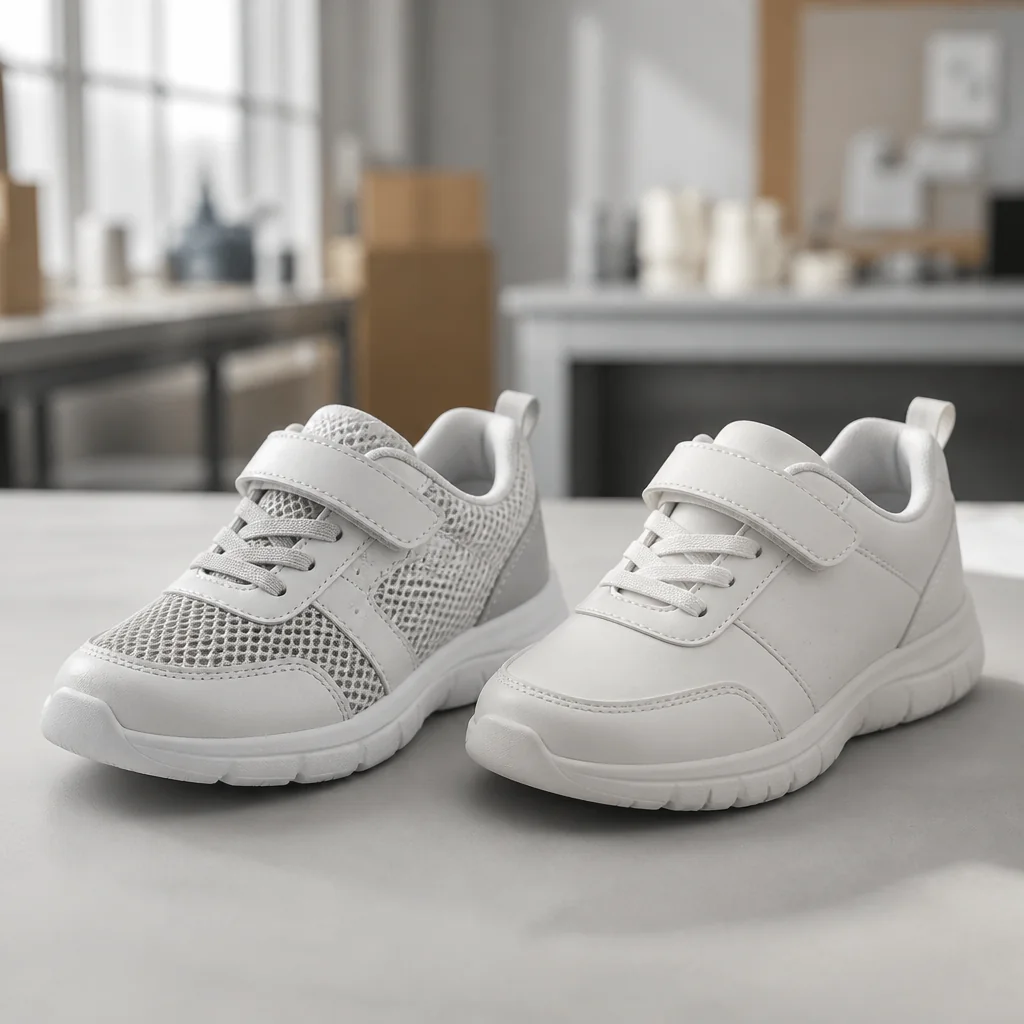
Wholesale briefs that leave the upper blank still send kids sneaker programs into sampling without a fixed material baseline. Treat mesh vs PU kids sneakers wholesale as a pre-sample product-definition gate, not a late style note. Inside the published kids sneaker family for daily wear and school retail, the build is limited to breathable mesh or PU. Colorway, logo, closure, and outsole texture remain separate custom fields once that binary upper choice is written.
Why an open upper still fails a kids sneaker RFQ
Procurement teams often name age band, color story, and branding while the upper stays blank. On the published kids sneaker product family, the build is defined as breathable mesh or PU. Without one of those options written, material control for the upper has no target on the brief, and sample approval has no fixed material baseline to match.
That gap is a buyer-side definition problem. Write mesh or PU before you ask which development, sampling, or quotation paths may apply. Until the choice is written, the brief stays open on the part of the shoe that most strongly shapes appearance, hand feel, and how lining and adhesive choices will be judged later.
What the published kids sneaker build allows
The products overview positions kids sneakers as a starting point for private-label and retail orders. The page notes popularity with brands that want casual wear, school use, and a wide color story. Best-for roles are daily wear and school retail. The published build is breathable mesh or PU upper. Custom fields listed for that family are colorway, logo, closure, and outsole texture.
A private label kids sneakers upper decision therefore sits inside those two materials. This article does not expand the sneaker family into sandals, rain boots, canvas shoes, or other footwear lines. Programs that need a different footwear type belong under a different product brief rather than a free-form override of the sneaker build.
Engineered mesh attributes you can actually cite
For breathable mesh kids sneakers wholesale work, use only the engineered mesh attributes on the materials page. Do not import outdoor, safety, or weather claims the page does not state.
- Light, breathable knit-style upper construction
- Positioned for warm-weather and active styles
- Quick-dry among the listed traits
- Listed use includes kids sneakers, sports runners, and sandals on the materials page
PU appears on the products page only as the alternate upper option for kids sneakers. No durability rating, weather rating, or wear-test claim for PU is present in the supplied excerpts. Buyers who need PU for a brand look, school retail finish, or private-label story should treat that as a design and merchandising choice, then ask which sampling or quotation options may apply. Do not assume performance attributes that have not been published for PU on these pages.
Where wholesale children's sneakers material control sits
Quality control for children's shoes is described as matching a buyer brief, with fit, bonding, flex, wear, and packing checked before an order leaves the factory. Wholesale children's sneakers material control is the first checkpoint in the ladder that matters for the upper decision.
| Checkpoint | What gets checked | Buyer relevance for the upper lock |
|---|---|---|
| Material control | Upper, lining, outsole, and adhesive choices confirmed before the sample stage | Mesh or PU must already be written so upper confirmation has a target |
| Sample review | Fit, comfort, logo placement, finish, and closure reviewed together | Assumes the upper material is already fixed, not still open |
| In-line checks | Assembly, stitching, bonding, flex, and stability during production | Protects bulk alignment after sample approval |
| Final packing | Carton counts, inner packing, labels, and outer cartons before shipment | Export handoff, not a path to invent the upper later |
Incoming materials inspection also aligns upper, lining, outsole, label, and adhesive samples to the brief. Write mesh or PU first, then expect material control to confirm those choices before the sample stage. Sample review is the next gate, not the moment to invent the upper. Full checkpoint language sits on the quality control page.
Colorway, logo, closure, and texture after the upper lock
Custom work on kids sneakers is documented as colorway, logo, closure, and outsole texture. Those fields support private-label and retail differentiation. They refine branding and hardware on top of a fixed build; they do not rewrite the published upper options.
- Colorway. Supports a wide color story for casual and school retail positioning, and still needs a mesh or PU base.
- Logo. Branding and placement topics for sample review; logo work does not define upper material.
- Closure. A custom field reviewed with fit, comfort, finish, and logo at sample review; it is not a mesh or PU substitute.
- Outsole texture. A custom field separate from upper material. Outsole is also part of material control, but texture customization is not an upper decision.
Even a brief that already names colorways, a logo file, a closure type, and a tread note is still incomplete if mesh or PU is missing. Write the upper first, then list the four custom fields as the controllable brand layer on top of that lock.
Do fit bands or proof requests fill a missing upper?
Fit review is described across toddler, little kid, and big kid sizing for day-to-day wearability. That work is important and runs beside the upper decision. It does not tell a factory whether the upper is mesh or PU. Documentation topics a buyer may raise include buyer-specific packing labels, market-specific material notes, inspection photo requests, third-party test coordination, and document requests from an importer or retailer.
Those topics are framed as items the quality process can align around, with a preference for inspection photos, measured samples, and the test reports a project actually requires rather than badges unrelated to the order. They remain order-specific questions. Naming them in an inquiry does not settle the mesh-or-PU choice, and this article does not convert them into pre-approved service packages. Ask which documentation topics apply after the upper is named.
Using the program format when materials are still open
The public case-study page includes an example private-label sneaker program described as an example of how scoping, sampling, and running a program can be organized. Use that page as a format reference for how a program conversation may be structured. Do not read it as a completed customer case with volumes, outcomes, or commercial terms. Open material questions still break that format: without mesh or PU on the brief, scoping and sampling lack the upper baseline the products page already treats as the sneaker build.
A material-locked definition block for your inquiry
Before development, sampling, or quotation discussion, send a short definition block that keeps the program inside published scope:
- Product family: kids sneakers for daily wear and/or school retail
- Upper lock: breathable mesh or PU (choose one)
- If mesh: note the materials attributes you care about (light, breathable knit-style, warm-weather/active, quick-dry) without adding unsupported claims
- If PU: state it as the alternate upper choice without inventing performance attributes
- Known custom fields: colorway, logo, closure, outsole texture (list only what is decided)
- Parallel questions: fit band focus (toddler, little kid, big kid) and any packing-label, material-note, inspection-photo, or third-party test topics the project may need
- Ask which development, sampling, or quotation options may apply to the project
That last line is an invitation, not a documented service menu. Keep QC language as checkpoint timing, not as a promise of specific commercial deliverables beyond what the quality page describes.
How to verify upper scope on the first-party pages
This article draws only on first-party KidsShoeWorks pages for products, materials, quality, and the case-study format example. Verified boundaries include kids sneakers limited to breathable mesh or PU upper; engineered mesh attributes as listed on the materials page; material control of upper, lining, outsole, and adhesive before the sample stage; custom fields limited to colorway, logo, closure, and outsole texture; and fit bands plus documentation topics as parallel review items.
Evidence gaps remain intentional. No MOQ, price, lead time, or order volume is published in the excerpts used here. PU has no expanded performance sheet in those excerpts. Certifications are not presented as order proof. The case-study page is a scoping and sampling format example, not a results case. Buyers who need commercial quantities or test protocols should ask project-specifically rather than infer them from product marketing copy.
After the upper is locked: pages and quote path
- Confirm the program is a kids sneaker for daily wear or school retail, not another footwear family.
- Write mesh or PU as a locked upper choice, using only published mesh attributes if mesh is selected.
- List decided custom fields: colorway, logo, closure, outsole texture.
- Note fit band focus and any documentation topics you may want aligned later.
- Review products, materials, quality, and the program format example, then use request a quote to share the current children's footwear definition and ask which development, sampling, or quotation options may apply.
Sources and verification
- Children's Footwear Products | KidsShoeWorks First-party site source
- Kids' Shoe Materials | Mesh, PU, Canvas, Rubber & EVA | KidsShoeWorks First-party site source
- Quality Control for Children's Shoes | KidsShoeWorks First-party site source
- Kids' Shoe Programs: Case Study Format | KidsShoeWorks First-party site source
Share the current children's footwear definition and ask which development, sampling or quotation options may apply to the project.
Send your project brief