Children's Footwear Product Development
Children's Shoes Wholesale Logo Placement Review
A buyer-led way to review logo placement on a children's shoe sample while keeping sneaker scope, packing checks, and documentation requests distinct.
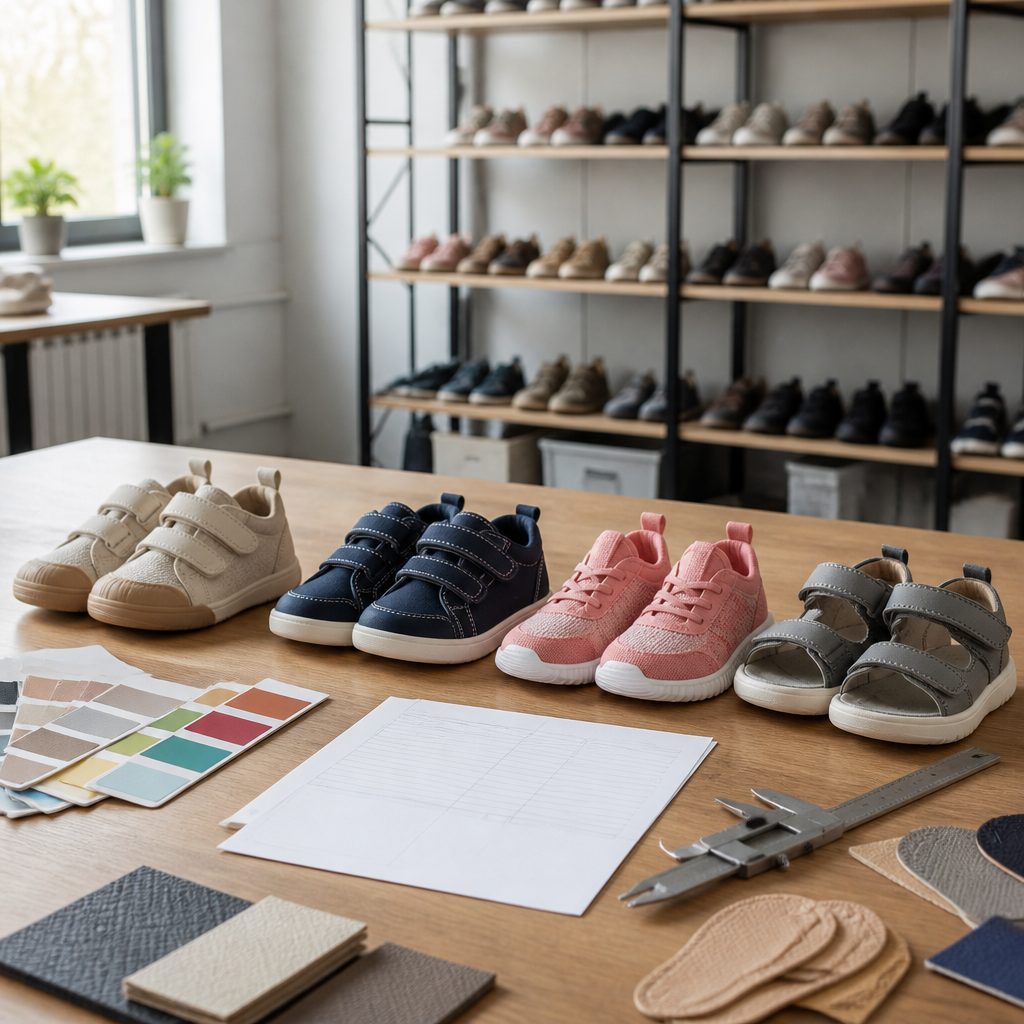
A logo placement question becomes useful when it can be answered against a physical sample and a current design reference. For a children's shoes wholesale logo placement review, the immediate question is narrow: does the sample visibly show the mark where the buyer intends it to appear?
KidsShoeWorks publishes two relevant references with different scopes. The products page lists colorway, logo, closure, and outsole texture as custom options for its kids' sneaker entry. The quality page says that fit, comfort, logo placement, finish, and closure are reviewed together at sample review. Those points create a sound basis for a project-specific discussion, but they are not a described artwork-proof, revision, or sign-off route.
Start with the sample question
Artwork alone may show intent, yet it cannot answer every question a buyer has about how a visible mark reads on the shoe. The buyer's review question should therefore identify the design reference, the location to inspect, and the observation needed from the sample. That keeps the request focused on what can be seen rather than implying a production outcome from a single review item.
Editorial recommendation: treat logo placement as one recorded observation within the sample review. The review note below is a buyer-created children's footwear sample review checklist, not a published KidsShoeWorks form.
- Current reference
- Name the current design image, artwork version, or style reference used to compare the sample. Include the footwear category when it affects which product is being discussed.
- Placement question
- State the location the team wants to inspect and attach the relevant visual reference. Keep the question about the visible result; do not presume a method, measurement tolerance, or construction detail.
- Sample observation
- Record what is visible on the sample and whether it answers the stated placement question. An unresolved location can remain an open point without becoming a judgment on the entire shoe.
- Buyer decision
- Separate the team's internal decision from questions it still needs to raise. This preserves a clear record without describing an internal note as supplier approval.
A short note is usually easier to circulate than a broad instruction such as "check the logo." It gives product, sourcing, and brand reviewers one reference point and keeps later comments tied to the same shoe definition.
What the two references cover
The products page is category-specific. Its custom-logo reference belongs to the kids' sneaker entry, alongside colorway, closure, and outsole texture. That makes the entry relevant to a private label kids sneaker logo customization discussion. It does not establish that the same option applies to every children's footwear category.
The quality page covers a review checkpoint instead. It puts logo placement in the same sample review as fit, comfort, finish, and closure. A buyer can use that published grouping to keep the visible mark in the sample conversation while assessing the other named items separately.
Five observations in the same review
Reviewing several items at one checkpoint does not merge their conclusions. A sample can answer a placement question while leaving fit open, or it can raise a closure question without changing what was observed about the mark. The table turns the source-named items into separate editorial prompts for the buyer's team.
| Sample-review item | Editorial prompt for the buyer |
|---|---|
| Logo placement | Does the sample show the mark at the intended location in the current reference? |
| Fit | What fit question does this sample allow the team to assess? |
| Comfort | What comfort observation should be recorded independently of the visual review? |
| Finish | Which visible finish details need an observation on this sample? |
| Closure | What closure question should remain visible in the review note? |
This division avoids a common review problem: using a favorable observation in one field as an unspoken answer in another. Each item can be noted on the same sample while retaining its own question and result.
When the project is not a sneaker
The sneaker listing is a useful starting point only for the product entry it describes. A buyer developing kids' sneakers can ask about the listed logo option with the other relevant sneaker choices in view. A buyer working on another shoe type should define the actual project before assuming that the sneaker reference carries across.
- Identify the footwear category and attach the current style reference.
- Describe the logo-placement question the sample needs to answer.
- Ask whether the relevant logo, closure, material, or outsole questions may apply to that defined project.
This is more precise than importing a sneaker option into a different product family. The brand intent may be similar, but the inquiry should stay attached to the shoe under discussion.
Packing belongs later
The quality page presents sample review and final packing as separate checkpoints. At sample review, it names fit, comfort, logo placement, finish, and closure. At final packing, it names carton counts, inner packing, labels, and outer cartons before shipment. The two stages can matter to one project without serving as evidence for the same detail.
- Sample-review question
- Does the sample make the intended logo location observable against the current reference?
- Final-packing question
- What carton-count, inner-packing, label, or outer-carton information is relevant to this project's export presentation?
A packing label can be important to the final handover, but it should not be treated as confirmation of an earlier visual-placement observation. Keeping the questions apart also makes it easier to send each topic to the right reviewer.
Documentation requests need a name
The quality page says it can align around buyer-specific packing labels, market-specific material notes, inspection photo requests, third-party test coordination, and document requests from an importer or retailer. These are topics a buyer can raise for the project. The excerpt does not define a fixed photo set, timing, test requirement, or universal document package.
- For inspection photos, name the specific sample or inspection question the images should address.
- For packing labels, distinguish the export-packing request from the shoe-logo placement question.
- For material notes, identify the market question that makes the request relevant.
- For importer or retailer documents, identify the requested document and its project context.
Specific requests are more useful than asking for every possible quality record. They give the project definition enough detail to determine which documentation questions are relevant.
The message to send
Send the current children's footwear definition, the design reference, and the logo-placement question that the sample should make observable. Add any distinct sample-review questions for fit, comfort, finish, or closure. Include a packing or documentation question only where it has a defined purpose for the project.
For a kids' sneaker, the published custom-options line provides the narrow basis for discussing its listed logo option. For another category, ask whether the relevant options may apply rather than assuming the sneaker entry covers it. Use the quote inquiry page to share the current definition and ask which development, sampling, or quotation options may apply.
Sources and verification
- Quality Control for Children's Shoes | KidsShoeWorks First-party site source
- Children's Footwear Products | KidsShoeWorks First-party site source
Share the current children's footwear definition and ask which development, sampling or quotation options may apply to the project.
Send your project brief