Quality Control
Kids Sneaker Bulk Production Inspection Checklist
An approved kids’ sneaker sample is not yet a bulk control record. Use this buyer-owned checklist to map each reference to its checkpoint, keep material and fit out of the wrong lane, and leave unsupported tolerances as open project questions.
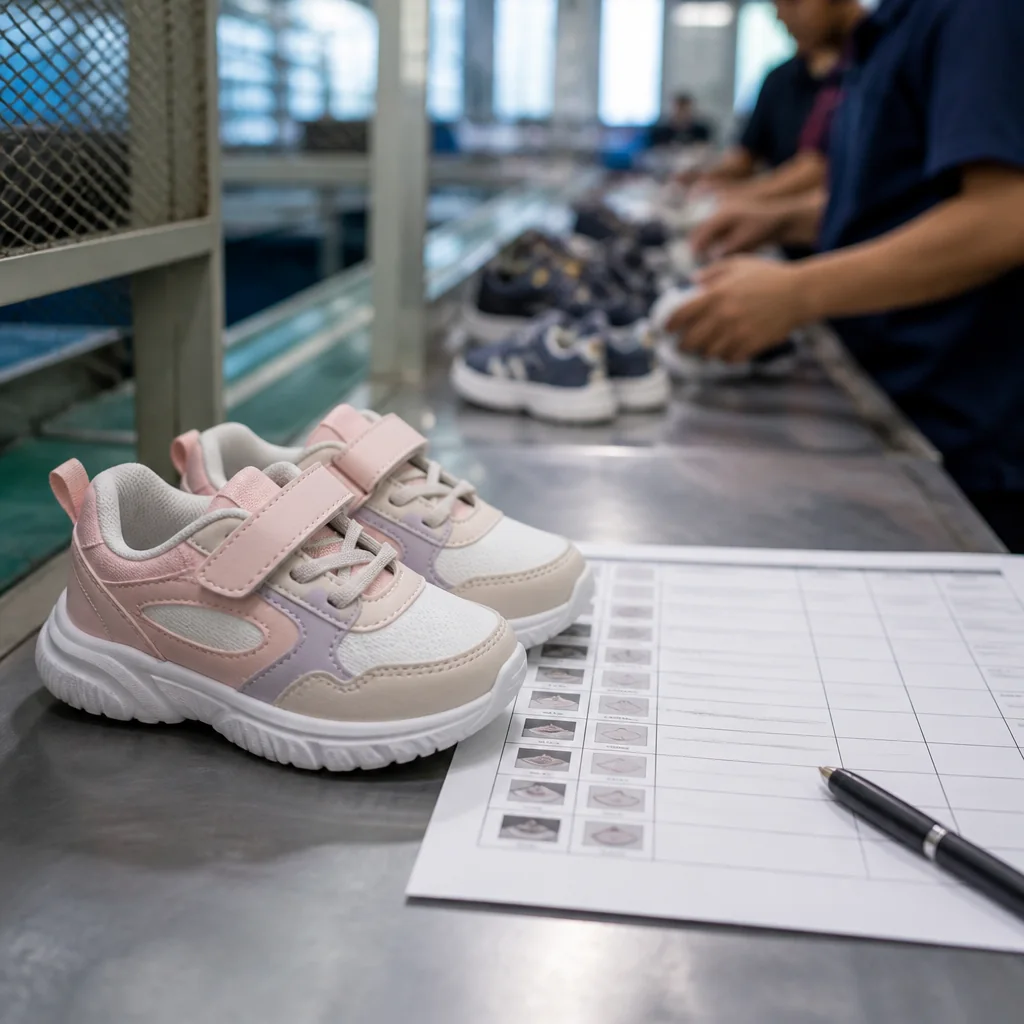
An approved kids’ sneaker sample can still leave bulk production without a stage-specific control record. A practical kids sneaker bulk production inspection checklist starts at that handoff: lock the sample as the production reference, then assign each verification item to the checkpoint where it belongs. Without that map, teams often push material confirmation or fit review onto the line, invent acceptance limits that were never agreed, or treat packing as the only formal gate. Build a buyer-owned control sheet from the published sneaker definition and the documented quality ladder, and leave unsupported frequencies, tolerances, and evidence packages as open questions.
When the approved sample becomes the production reference
Sample sign-off answers whether the shoe looks and feels right for the brief. It does not by itself document what will be checked while pairs are assembled, stitched, bonded, flexed, and stabilized on the line. Treating the approved sample as a silent guarantee of bulk match often reveals the gap only after cartons are nearly full.
Record which physical or photo references are locked, which checkpoint owns each check, what evidence you want to see, and which acceptance criteria remain unresolved. KidsShoeWorks frames quality checkpoints as items aligned to the product brief and a written inspection plan, with inspection starting before bulk production. That framing supports a control sheet; it does not supply a universal pass-fail matrix for every order.
Freeze only the sneaker details actually defined
Before writing inspection rows, freeze only what the product category actually defines. On the children’s footwear products page, kids’ sneakers are positioned as a starting point for private-label and retail orders, popular with brands that want casual wear, school use, and a wide color story. They are described as best for daily wear and school retail, with a build option of breathable mesh or PU upper, and custom fields covering colorway, logo, closure, and outsole texture.
- Category role: daily wear and school retail—not a performance claim beyond that positioning.
- Upper path listed: breathable mesh or PU upper.
- Custom fields listed: colorway, logo, closure, and outsole texture.
- Project status still open: which of those fields your program selected, and whether those selections are already sample-approved.
Engineered mesh is described separately on the materials page as light, breathable, knit-style uppers for warm-weather and active styles, used in kids’ sneakers among other categories. That is a material-family note, not a finished-shoe property list for every PU or hybrid build. Keep mesh attributes on the mesh row. Do not extend them to a PU upper or to bulk footwear without project confirmation. Treat the colorway, logo, closure, and outsole texture list as available custom fields, not as proof that every combination is already approved for your run.
For product families, see the children’s footwear products overview. Material language for mesh and related uppers sits on the kids’ shoe materials page.
Map each control to its documented time gate
The quality page organizes inspection as a ladder from materials through final carton. Use that ladder as the spine of the control sheet. Do not collapse the four gates into one generic quality claim.
| Documented checkpoint | What is checked at that gate | Stated buyer-facing benefit | Control-sheet use |
|---|---|---|---|
| Incoming materials | Upper, lining, outsole, label, and adhesive samples aligned to the brief | Fewer surprises after sample approval | Reference material swatches and supplier notes; do not park these solely in in-line rows |
| Sample review | Fit, comfort, logo placement, finish, and closure reviewed together | Better chance that the bulk run matches the approved sample | Lock the approved sample set and fit-band notes before bulk starts |
| In-line checks | Assembly, stitching, bonding, flex, and stability checked during production | Problems are caught before the order is fully packed | Primary bulk-production rows on this checklist |
| Final packing | Carton counts, inner packing, labels, and outer cartons checked before shipment | Cleaner export handover | Endpoint of this sheet, not a substitute for in-line rows |
A related construction-review line on the same page lists stitching, bonding, flex point, and outsole stability as checks before packing, with the benefit that problems are caught before the bulk run is finished. Keep “outsole stability” as a construction or in-line stability topic. Do not treat it as interchangeable with the custom “outsole texture” field on the product card.
Keep material and fit decisions out of the wrong lane
Two early gates carry most of the specification risk. Incoming materials align upper, lining, outsole, label, and adhesive samples to the brief. Material control language also states that upper, lining, outsole, and adhesive choices are confirmed before the sample stage. Sample review then brings fit, comfort, logo placement, finish, and closure together, with fit and comfort covering toddler, little kid, and big kid sizing for day-to-day wearability.
That separation matters for a kids shoe inspection plan. If a buyer re-opens upper hand-feel, lining choice, adhesive grade, or size-band fit only after assembly has started, the control sheet has already lost its sequence. Those topics can still be discussed as project-specific re-checks, but the published ladder places them earlier. In-line work is not documented as the default home for material confirmation or fit sign-off.
| Decision type | Documented home | Risk if deferred into bulk only |
|---|---|---|
| Upper, lining, outsole, label, and adhesive sample alignment | Incoming materials | Bulk pairs built against unaligned material samples |
| Upper, lining, outsole, and adhesive choice confirmation | Material control: confirmed before the sample stage | Bulk pairs built against an unconfirmed material set |
| Fit, comfort, logo placement, finish, closure | Sample review across toddler, little kid, and big kid sizing | Line checks used to compensate for an unlocked sample reference |
| Assembly, stitching, bonding, flex, stability | In-line checks during production | Issues found only after packing has already started |
Editorial recommendation for buyers: keep a short “do not reassign” note on the control sheet so production teams know which rows still require a sample or material reference rather than a mid-run visual call.
Define the in-line rows without inventing acceptance limits
Children’s sneaker in-line quality checks, as documented, cover assembly, stitching, bonding, flex, and stability during production. Those five subjects are enough to populate the bulk-production core of the sheet. The published evidence does not establish numerical tolerance, inspection frequency, sampling method, laboratory test method, issue-escalation path, or a standard photo package for every order. Leave those cells blank until the project writes them.
| In-line subject | Approved reference to cite | Item to verify during production | Evidence you may request | Unresolved acceptance criterion |
|---|---|---|---|---|
| Assembly | Approved sample pair or photo set | Component placement and build sequence match the reference | In-process photos or measured sample, if the project asks | Open: any size, alignment, or completeness limit still unwritten |
| Stitching | Approved sample stitch path and density notes | Stitch continuity and path consistency on production pairs | Close-up photos of problem zones, if requested | Open: stitch-count, skip, or repair rule not supplied in source evidence |
| Bonding | Approved bonded edges and adhesive-related sample notes | Bond lines and attachment integrity during production | Photos or measured samples the project actually requires | Open: peel, coverage, or cure criterion not defined here |
| Flex | Approved flex-point behavior on the sample | Flex location and behavior against the reference | Project-defined observation method only | Open: cycle count, angle, or pass rule not published |
| Stability | Approved outsole stability / construction reference | Stability behavior checked during production, separate from texture cosmetics | Photos or notes the project specifies | Open: measurement method and limit not published |
Private label sneaker production QC often fails here by filling empty cells with generic footwear conventions. Prefer an explicit “TBD with factory and buyer” mark over a borrowed AQL number or an assumed frequency. The quality page’s benefit language is limited to catching problems before the order is fully packed or before the bulk run is finished. It does not claim defect elimination or an automatic bulk match to the sample.
For the broader quality ladder and documentation topics, use the quality control page as the source boundary for these gates.
Treat packing as the endpoint of this control sheet
Final packing is documented as a separate checkpoint: carton counts, inner packing, labels, and outer cartons checked before shipment, aimed at a cleaner export handover. Packing discipline is also described more generally as carton counts, labels, stickers, and presentation for the export run. That is the end of the bulk-production control sheet, not a second full article on carton engineering.
Use the packing row only to show where in-line work stops and logistics presentation begins. If carton art, assortments, or receiving rules need their own brief, point that work to a dedicated packing note rather than expanding every in-line row. A related resource covers wholesale children’s sneaker packing requirements when that boundary needs more depth.
Separate evidence requests from promised deliverables
Documentation topics the company can align around include buyer-specific packing labels, market-specific material notes, inspection photo requests, third-party test coordination, and document requests from an importer or retailer. The proof preference stated on the quality page is to send inspection photos, measured samples, and the test reports a project actually requires, rather than certifications unrelated to the order.
- Inspection photo requests: discussable alignment topic, not an automatic package for every PO.
- Measured samples and required test reports: preferred form of proof when the project needs them; not a fixed deliverable list.
- Third-party test coordination: a topic for alignment, not a statement that testing is performed or included by default.
- Buyer checklist alignment: listed among buyer documents; still requires project-level definition of the checklist itself.
- Importer or retailer document requests: can be raised; not pre-approved content for every market.
When you draft the control sheet, put evidence requests in their own column. Mark each as “requested for this project” or “not required,” so nobody confuses a discussable topic with a guaranteed standard service.
Submit the current definition with open control questions
Close with a short inquiry package rather than a generic summary. Share the current children’s footwear definition for the sneaker program, attach the approved references, and ask which development, sampling, or quotation options may apply, together with the inspection-plan questions still open.
- State the sneaker definition in play: daily wear / school retail role, mesh or PU upper path, and the colorway, logo, closure, and outsole texture fields that matter to this run.
- List locked references: approved sample IDs or photos, material swatches, and any fit-band notes already reviewed.
- Attach the control-sheet spine: incoming materials, sample review, in-line (assembly, stitching, bonding, flex, stability), and final packing as the endpoint.
- Flag wrong-lane risks: any material or fit item someone wants to push only into production, and whether that is a deliberate project re-check.
- Leave open cells visible: acceptance limits, frequency, sampling method, and evidence deliverables still unmarked.
- Ask alignment questions: which inspection photos, measured samples, test reports, packing labels, material notes, or importer/retailer documents this project needs, and which development, sampling, or quotation options may apply.
That package keeps the buyer in control of the kids sneaker bulk production inspection checklist without pretending the factory page already filled every cell. When you are ready to share the current definition and those open control questions, use the request a quote form so the team can respond against the brief you actually freeze.
Sources and verification
- Children's Footwear Products | KidsShoeWorks First-party site source
- Quality Control for Children's Shoes | KidsShoeWorks First-party site source
- Kids' Shoe Materials | Mesh, PU, Canvas, Rubber & EVA | KidsShoeWorks First-party site source
Share the current children's footwear definition and ask which development, sampling or quotation options may apply to the project.
Send your project brief