Footwear Sourcing
Infant Shoes Wholesale Specification Change Log for RFQ Teams
A buyer-owned change log for infant footwear RFQ work: authority labels, pre-sample baseline rows, revision fields and quality-page handoffs without expanding published sneaker or mesh scope.
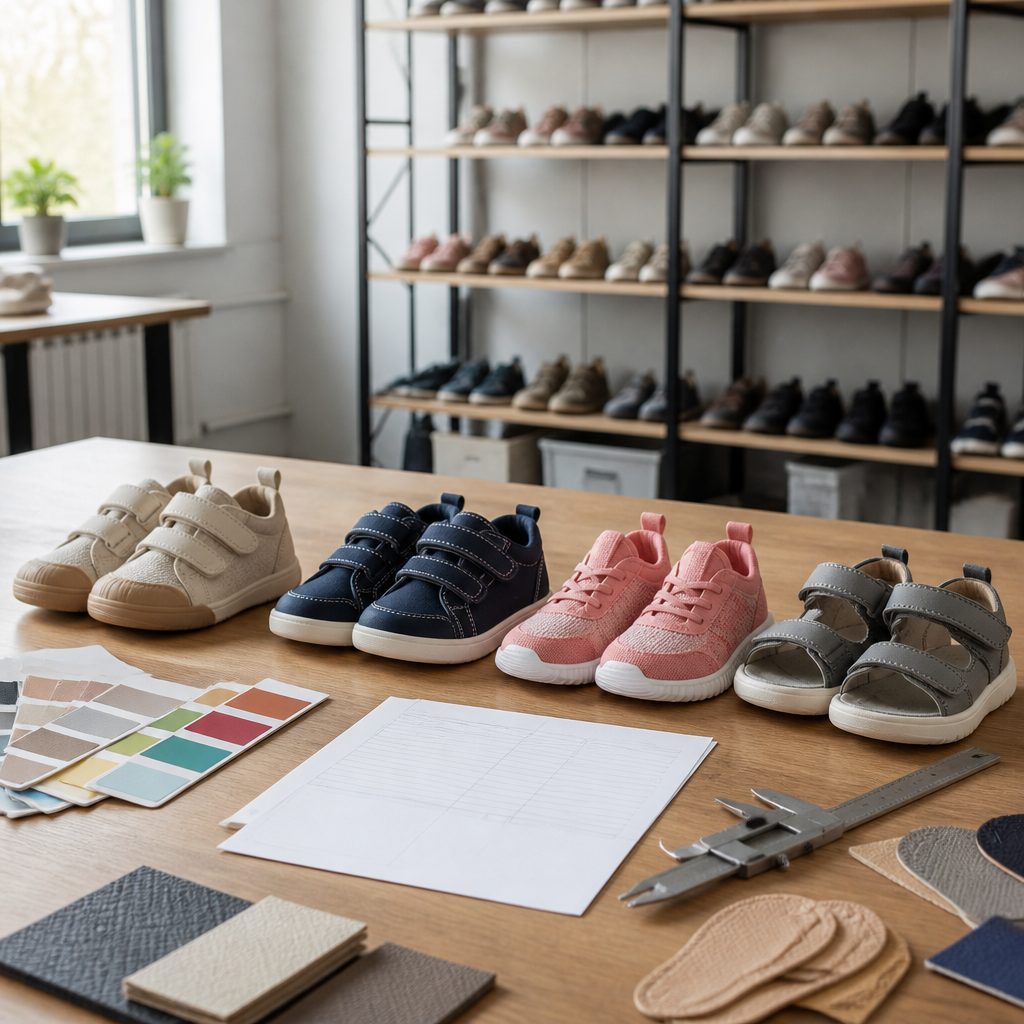
When an infant footwear RFQ note, a product-page extract and a sample comment each list a different value for the same field, the buying team no longer has a single active baseline. An infant shoes wholesale specification change log is the working record that shows which entry governs, who can change it and which points remain open. Treat the log as an editorial procurement method owned by the buyer, not as a documented KidsShoeWorks change-control service.
The supplied KidsShoeWorks excerpts do not establish an infant product category, infant size range or infant-specific construction. Hold those points open until the project record itself supports a different status. Keep the log beside the infant footwear RFQ specification and update it as sample comments and later quality handoffs arrive.
When two briefs both look current
Specification drift begins when parallel files all read as complete. Design may still work from the first brief while sourcing works from later material notes. Neither file shows whether a change was accepted, rejected or deferred, so the next handoff inherits ambiguity.
KidsShoeWorks describes its quality checkpoints as aligned with the product brief and a written inspection plan. That makes the identity of the active brief consequential whenever a checkpoint is discussed. Start with one baseline rather than reconciling documents from memory. When two entries conflict, keep both in the history, mark only one as current when its status supports that treatment, and name the next decision needed for the other. Deleting the older value erases useful context about what changed and why.
Authority labels for each requirement
Give every row an authority label that states what the entry represents without adding more certainty than the source supports. A published children's shoe option stays reference material until its relevance to the current infant project is confirmed in the project record.
| Authority label | Use in the log | Procurement treatment |
|---|---|---|
| Buyer request | A feature, target or document topic requested by the buying organization. | Record it as requested, not confirmed. Identify who can approve a response or alternative. |
| Published reference | Information taken from a public product, material or quality page. | Preserve the stated product scope. Ask whether the information applies to the proposed infant project. |
| Project-specific confirmation | A requirement confirmed for the current development record by a named party with authority for that field. | Capture the source, authority role, date and affected specification field. Do not extend the confirmation to unrelated fields. |
| Open question | A point for which suitability, availability, evidence or responsibility remains unresolved. | Keep it visible and assign a next decision point. Do not fill the gap with a website reference or assumption. |
A public page that describes a children's shoe category can help form a question for an infant footwear inquiry. On its own, it does not create an infant category, size range, construction or project commitment.
Pre-sample baseline rows the buyer can own
Before sample comments enter the discussion, create rows for the current product definition. The baseline does not need every field settled; it needs to show what is known, who supplied it and what remains open. The following rows are an editorial recommendation for a children's footwear buyer brief.
- Footwear definition: intended product type, use context and any reference style, with infant-specific suitability left open where it has not been confirmed.
- Intended market: destination and buyer-supplied market requirements, without treating a market name as evidence of compliance.
- Requested size scope: the buyer's proposed range, measurement basis and unresolved fit questions.
- Materials: separate rows for upper, lining, outsole and adhesive topics rather than one broad material approval.
- Construction: requested assembly, stitching, bonding and sole details, each with its own status.
- Appearance: color, finish and placement references linked to the correct drawing or file version.
- Closure: requested closure type and any usability or fit questions that require project review.
- Packing and documentation: requested label, inner packing, carton and evidence topics, clearly distinguished from confirmed deliverables.
The KidsShoeWorks quality page places confirmation of upper, lining, outsole and adhesive choices before the sample stage. A buyer can treat those four topics as separate pre-sample handoff fields and leave them as requests or open questions until project-specific information changes their status. The same quality excerpt names toddler, little kid and big kid sizing in its fit-review description; it does not name an infant size scope. Keep the buyer's proposed infant range as an open project question rather than reading the published size-band wording as confirmation.
What to capture when a field changes
Replacing an old value with a new one is not enough. The buyer needs to know where the revision came from, which value now governs and who may change the baseline. The fields below form an editorial infant shoe sample revision checklist. They are a recommended buyer method, not a supplier-operated system.
| Field | What to enter |
|---|---|
| Revision ID | A buyer-controlled identifier for the row so related emails and drawings can point to one entry. |
| Entry or revision date | When the request or status change was logged. |
| Field affected | The precise specification element, such as upper material, closure, logo placement or inner packing. |
| Previous entry | The superseded value and its source reference. Retain it for traceability. |
| Requested revision | The proposed new value in language that can be checked against a drawing, sample or document. |
| Effective baseline value | The value that currently governs after any confirmation. Leave blank or mark "none confirmed" while the row is only proposed. |
| Request source | The person, team, file or published page that introduced the revision. |
| Decision owner | The role or person authorized to change the baseline for this field. An identified participant is not automatically an approver. |
| Current status | A controlled term such as proposed, under review, confirmed, superseded or open. |
| Evidence reference | The applicable email, marked image, drawing, page link, sample note or project confirmation. |
| Next decision or handoff point | The review at which the entry should be confirmed, rejected, revised or kept open. |
Status should describe the requirement, not the confidence of the person entering it. A clearly written buyer request remains a request until the project record supports a different status. A sample may display a revised feature while commercial, size-scope or documentation implications stay open.
Hypothetical buyer-side entry: a request to move a logo from drawing revision A to a sample-marked placement would open a new row with status proposed, decision owner set to the brand product lead, and next decision point set to sample review. The effective baseline value would stay at the drawing placement until that owner confirms the logo field alone.
Product references versus project confirmations
Two KidsShoeWorks pages show why source scope belongs in the log. They cover different subjects and should stay separate rather than being combined into an inferred infant-footwear capability.
| Published source | Stated scope | Appropriate log treatment |
|---|---|---|
| Children's footwear products | The kids' sneaker excerpt associates customization with colorway, logo, closure and outsole texture. It also describes breathable mesh or PU as upper build references for that sneaker category. | Cite the page as a kids' sneaker reference. Ask separately whether any named option is relevant to the current infant definition. |
| Kids' shoe materials | The engineered-mesh excerpt describes a light, breathable, knit-style upper and names kids' sneakers, sports runners and sandals as uses. | Record engineered mesh as a published material reference only. Do not mark it suitable, available or approved for an infant project without project-specific support. |
Keeping the rows separate prevents a subtle scope expansion. The sneaker customization list does not establish engineered-mesh characteristics, and the mesh description does not establish the sneaker customization options. Neither excerpt defines an infant footwear program.
Sample review as a reconciliation point
KidsShoeWorks identifies fit, comfort, logo placement, finish and closure as topics considered together during sample review. These topics can become reconciliation fields in the buyer's log if the record continues to distinguish observation from approval.
- Compare the reviewed sample with the active baseline and the referenced drawing or comment file.
- Record each observed attribute under its own field. Avoid a blanket status that suggests the entire specification was confirmed.
- For every mismatch, enter the previous value, requested revision, source, decision owner and next decision point.
- Update the effective baseline value and current status only for the field actually addressed by the review, and only after the authorized owner confirms it.
- Carry unresolved size scope, infant suitability, evidence and packing questions forward instead of closing them through silence.
A reviewed logo position says nothing, by itself, about a closure or an infant size range. Field-level status keeps a visible sample characteristic from becoming a conclusion about the whole program.
Later checkpoints without losing the baseline
The quality page describes in-line checks covering assembly, stitching, bonding, flex and stability during production. It then identifies carton counts, inner packing, labels and outer cartons as final-packing topics checked before shipment. These are documented quality-page checkpoints. Their applicability and exact requirements for an unreviewed infant project still need project-specific discussion.
Prepare for those discussions by carrying forward only the active baseline. Link each construction field to the relevant current specification entry, and keep packing fields tied to the current artwork, label or packing instruction. When a late revision is proposed, reopen the affected row, record the proposed change and establish which later checkpoint should use it. Partial confirmation also needs field-level control: a stitching discussion should not close an open outsole-stability question, and a label review should not imply that inner packing or carton requirements have also been settled.
What a bounded revision summary should include
The inquiry package should make the current definition easy to distinguish from its history. Include the active footwear description, requested size scope, current material and construction entries, closure and appearance requirements, and the revision status of each unresolved item. Attach or reference only the drawings, images and instructions that the log identifies as current.
- Current footwear definition and authority labels for each open field
- Requested size scope and any unresolved fit questions
- Material, construction, appearance and closure entries with effective baseline values where confirmed
- Infant-specific questions on product type, size scope, construction or material availability for project review
- Requested evidence or document topics, listed separately from confirmed deliverables
- A request to identify which development, sampling or quotation options may apply to the project
A buyer may also ask which packing, MOQ or quotation information applies. Asking the question does not turn any option, quantity or timing into a documented commitment.
For documentation, the KidsShoeWorks quality page says the company can align around buyer-specific packing labels, market-specific material notes, inspection photo requests, third-party test coordination and document requests from an importer or retailer. Keep each requested topic separate in the log. Coordination is not the same as performing, passing or certifying a test, and a request is not proof that a particular photo, sample, report or document will be provided.
Send the current revision summary through the project inquiry page and ask which development, sampling or quotation options may apply. Enter the response against the exact open row that prompted it, and leave the rest of the specification unchanged until its own evidence or decision arrives.
Sources and verification
- Quality Control for Children's Shoes | KidsShoeWorks First-party site source
- Children's Footwear Products | KidsShoeWorks First-party site source
- Kids' Shoe Materials | Mesh, PU, Canvas, Rubber & EVA | KidsShoeWorks First-party site source
Share the current children's footwear definition and ask which development, sampling or quotation options may apply to the project.
Send your project brief