Footwear Sourcing
Receiving brief for infant shoes wholesale packing requirements
A working receiving record keeps published children's-shoe packing checks separate from buyer instructions, requested outputs, and open project questions.
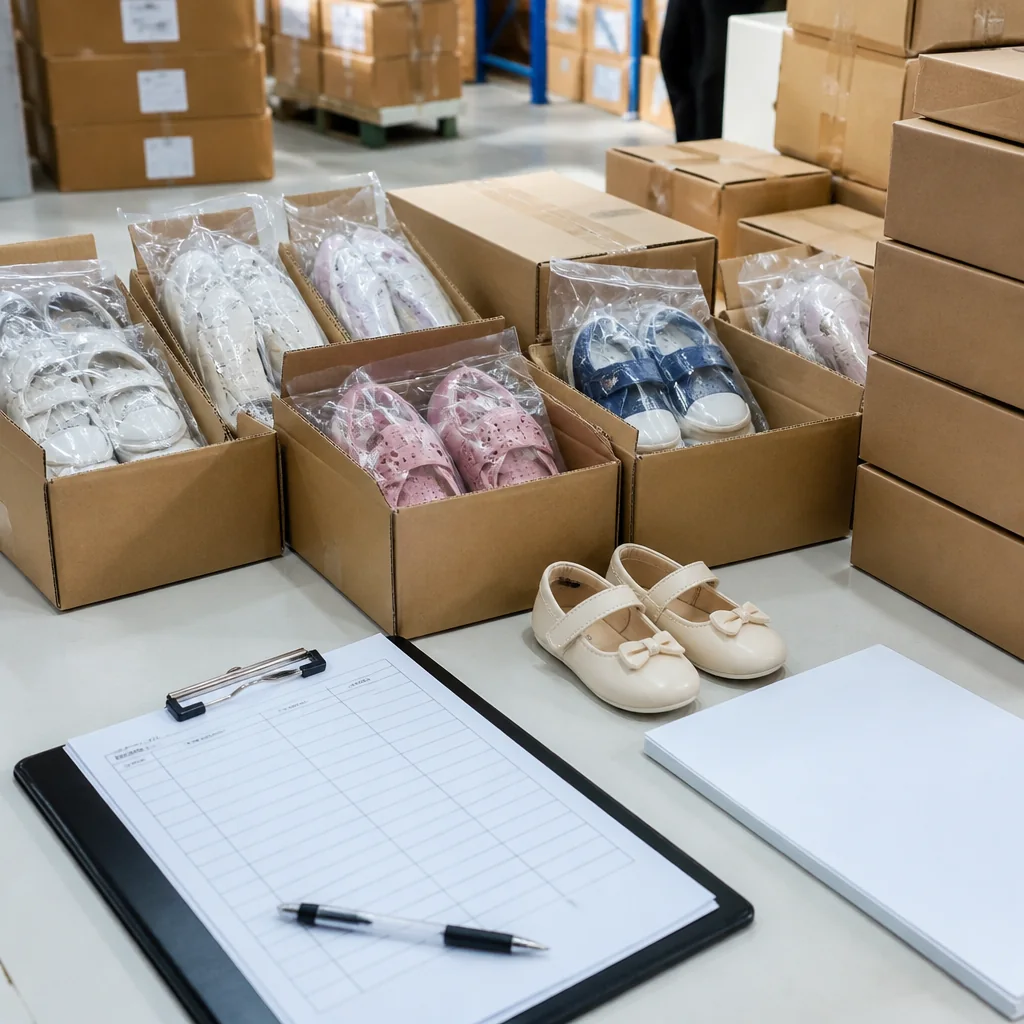
A buyer can complete a footwear definition while leaving the receiving handoff unresolved. For teams researching infant shoes wholesale packing requirements, our editorial recommendation is to prepare a separate receiving brief before requesting a quotation discussion. The brief can record the company's published packing-review points, the buyer's instructions, the outputs the buyer wants to request, and the questions that still need a project-specific answer.
The supplied evidence sets a clear boundary. The KidsShoeWorks quality page discusses packing checks for children's shoes generally; the excerpt contains no infant-specific packing rule. The supplied products page excerpt concerns customization points for kids' sneakers. All blank fields, acceptance questions, and workflow suggestions below are editorial recommendations for the buyer.
Where the product definition ends
In the proposed buyer record, the product definition identifies the footwear under discussion. A separate packing section captures how the buyer wants packed goods identified and presented, what the buyer wants to review, and which decisions remain open. This separation keeps a published company statement from being mistaken for a project instruction.
| Record field | What belongs here | Entry prompt |
|---|---|---|
| Published statement | One statement from a first-party page, preserved at its original scope. | [Enter the source location and one relevant statement without joining it to another source row.] |
| Buyer instruction | A packing or receiving condition supplied by the buyer. | [Enter the instruction, its authoritative file or data source, and its current status.] |
| Requested output | The specific proof, document, note, or coordination question the buyer wants to raise. | [Name the requested item and the decision it is intended to support.] |
| Open question | A point awaiting buyer input or a project-specific response. | [Write the unresolved question and identify the buyer's decision owner.] |
Use a separate row for each subject. If an instruction has not been decided, mark it as open instead of filling the field with an assumed value. The buyer can also apply its own status vocabulary, provided that drafts, requests, and approved instructions remain distinguishable.
Three published packing statements
The quality-page excerpt uses packing language in three contexts. Preserve those contexts when transferring the statements into the receiving record.
| Quality-page context | Published scope | Recommended record treatment |
|---|---|---|
| Quality overview | Carton counts, labels and export presentation. | Store this as the overview statement only. |
| Detailed packing discipline | Carton counts, labels, stickers and presentation are reviewed for the export run. | Store this as the export-run review statement. |
| Final packing | Carton counts, inner packing, labels and outer cartons are checked before shipment. | Store this as the before-shipment checkpoint. |
Keep export presentation attached to the overview row. The reference to stickers belongs to the detailed packing-discipline row. Inner packing and outer cartons belong to the final-packing row. Combining these terms into a single attributed specification would give one statement a broader scope than its published wording.
The excerpt supplies no project value for carton counts. It provides no required label content or inner-packing configuration. Those details need buyer instructions or project-specific answers before they can be entered as requirements.
What must the buyer decide?
For this working record, the editorial recommendation is to turn children's footwear packing requirements into acceptance questions. The questions should expose missing information without introducing a retailer rule, market standard, carton ratio, label format, or presumed infant requirement.
- Product scope: Which footwear family, style reference, and intended size grouping does the packing record cover? If infant applicability needs confirmation, what exact question should be raised?
- Carton counts: Has the buyer defined an instruction? If so, which buyer-supplied record contains the applicable value?
- Labels: What content does the buyer want discussed, and which file, artwork source, or data owner is authoritative?
- Stickers: Is there a buyer instruction for this project, or should the subject remain an open question?
- Inner packing: What presentation or packing instruction, if any, has the buyer approved? Which parts are still drafts?
- Outer cartons: Does the buyer want to define carton identifiers, markings, or grouping information? Where will those instructions be recorded?
- Export presentation: What does the buyer want its receiving or logistics team to review, and how will the buyer record its decision?
- Decision control: Who owns each buyer instruction, what is its status, and which project response is still needed?
An unanswered field can remain open. This is more precise than treating a familiar packing convention as though it had been supplied by the buyer or published by the company.
Proof requests without presumed deliverables
The documentation section of the quality page is headed What we can align around. It names buyer-specific packing labels. It separately names market-specific material notes and inspection photo requests. Third-party test coordination appears as another topic. The section also includes document requests from an importer or retailer.
That wording supports asking about those topics during a project discussion. It stops short of promising a particular label implementation, photo set, note, test, report, or document for every project. The buyer's record should therefore describe each item as a request until a project-specific response establishes otherwise.
- Inspection photo request: State what the buyer wants shown, the stage the requested image should represent, and who will review it.
- Buyer-specific packing label: Identify the authoritative content or artwork, then ask what proof or review option may apply.
- Market-specific material note: Name the requested note and the buyer question it is intended to address.
- Third-party test coordination: Ask whether coordination may apply and which project inputs would be needed. Leave the test and result unsettled unless separately established.
- Importer or retailer document request: Name the requested document, the requesting party, and the decision for which it is needed.
After receiving a response, the buyer can update the status of each line. A request should not be relabeled as confirmed merely because its general topic appears on the quality page.
The kids' sneaker boundary
The products-page excerpt lists colorway, logo, closure and outsole texture as customization points for kids' sneakers. That is a product-family statement about kids' sneakers. Its scope does not establish the same options for infant footwear, and it provides no packing specification.
For an infant-footwear inquiry, the editorial recommendation is to describe the current product directly and leave unverified development options as questions. The receiving brief can use the buyer's product identifiers without importing customization language from the sneaker excerpt.
A scoped inquiry before quotation
Once the record contains the available buyer instructions, requested outputs, and open questions, use a short cover note to frame the next conversation. The following wording is an editorial template rather than a documented company process:
We are preparing [current children's footwear definition]. Our receiving brief contains [buyer-supplied packing instructions] and identifies [open questions]. We would like to ask which requested outputs or coordination topics may apply to this project. After reviewing the available information, please indicate which development, sampling, or quotation options may apply.
Share the completed information through the quote request. Keep undecided packing points visible so the response can address the actual project scope rather than an assumed configuration.
Sources and scope
- Quality Control for Children's Shoes: source for the three packing statements and the documentation-alignment topics used above.
- Children's Footwear Products: source only for the listed customization points for kids' sneakers.
The supplied excerpts document no infant-specific packing standard, fixed export configuration, required label format, commercial quantity, or completed project outcome.
Sources and verification
- Quality Control for Children's Shoes | KidsShoeWorks First-party site source
- Children's Footwear Products | KidsShoeWorks First-party site source
Share the current children's footwear definition and ask which development, sampling or quotation options may apply to the project.
Send your project brief