Sourcing Guides
Freeze fields for childrens shoes wholesale Canada material control
Canada wholesale kids footwear inquiries often skip a written material freeze. Confirm upper, lining, outsole and adhesive before sampling so sample approval does not leave material surprises later.
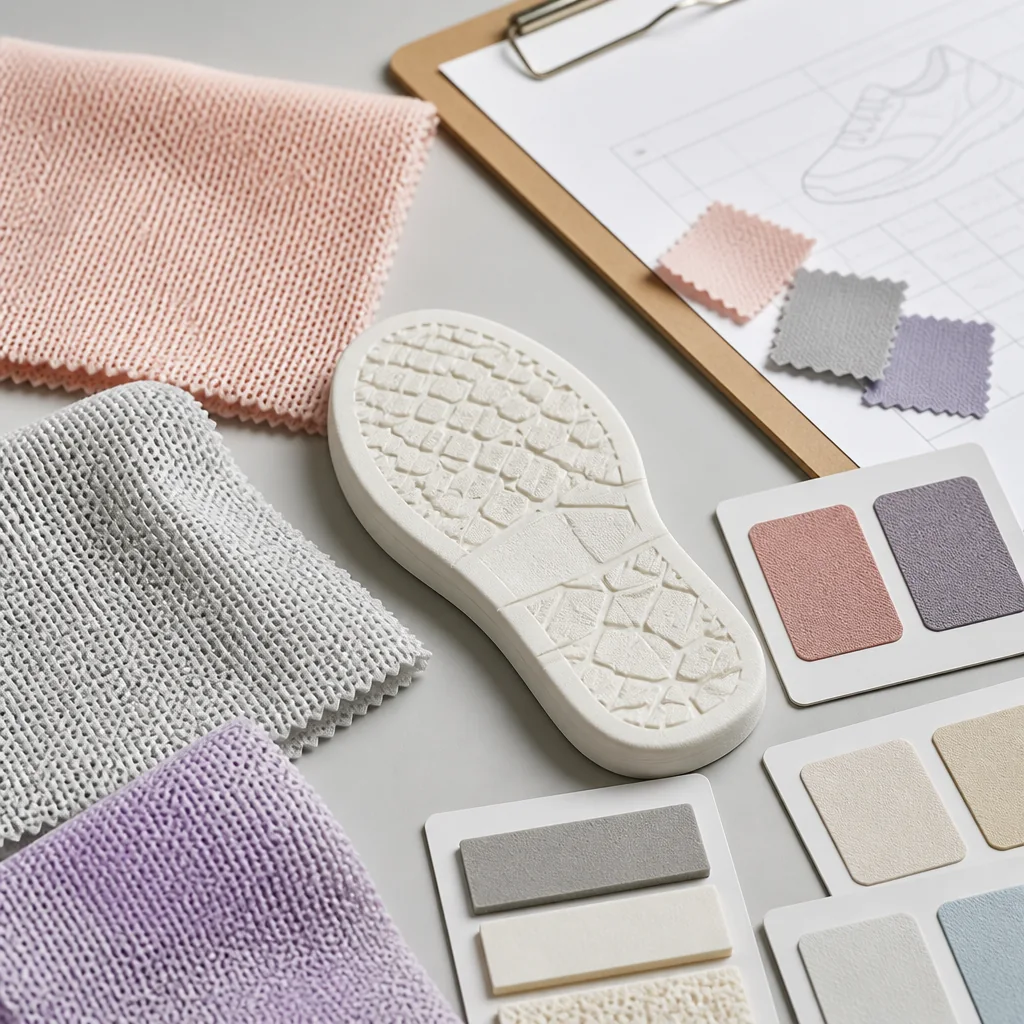
Canada wholesale buyers often send photos and a sample request while materials stay implied. An attractive sample can still arrive, yet sign-off only freezes what was built. For childrens shoes wholesale Canada material control, the practical fix is to write upper, lining, outsole and adhesive into the brief before sampling so bulk work does not surface choices the photos never settled.
On the quality ladder, material control sits as a pre-sample gate, not cleanup after approval. Fit brackets, construction checks, packing rules and sample-review cosmetics belong later, so a Canada wholesale inquiry does not collapse every checkpoint into one vague request.
Why sample-first wholesale requests leave materials open
A common Canada wholesale pattern is to start with photos and a sample ask. That sequence does not prove upper, lining, outsole and adhesive were aligned to a brief before sampling began.
Material control confirms those four choices before the sample stage. The stated buyer benefit is fewer surprises after sample approval. If the fields stay open, sample sign-off freezes only what was built, not what the program intended. Close the material freeze before any sample request rather than adding material notes after the first sample lands.
Four material fields the brief must name
Scope for this gate is narrow. Material-control language names four fields only. Do not expand the freeze into a full materials catalog or invent categories this checkpoint does not list. Buyers who need a children's footwear upper lining outsole check should still freeze adhesive in the same pre-sample block; none of these four fields wait until after sample sign-off.
| Field | What material control confirms |
|---|---|
| Upper | Upper material choice before the sample stage |
| Lining | Lining material choice before the sample stage |
| Outsole | Outsole material choice before the sample stage |
| Adhesive | Adhesive choice before the sample stage |
When you draft a wholesale kids shoes Canada material brief, write each of the four choices in plain terms the factory can match. Freezing only color, logo or size still leaves this gate open. Label samples sit under the incoming-materials checkpoint, not as a fifth material-control field; keep label language there unless project documentation needs a market-specific material note as an alignment request.
Mapping the freeze to the incoming-materials checkpoint
Material control and the incoming-materials checkpoint sit on the same quality ladder. Incoming materials checks that upper, lining, outsole, label and adhesive samples are aligned to the brief, with the same buyer benefit: fewer surprises after sample approval. Sequence the Canada inquiry the same way.
- Write upper, lining, outsole and adhesive into the product definition before any sample request.
- State that incoming materials should align upper, lining, outsole, label and adhesive samples to that brief.
- Treat sample approval as a later gate that reviews fit, comfort, logo placement, finish and closure together, not as a substitute for the material freeze.
- Keep upper, lining and outsole confirmation language attached to the material block so construction or packing notes do not dilute it.
The sequence uses published checkpoints so a Canada wholesale program does not approve a sample while materials remain ambiguous.
Which topics stay outside the material gate
Material control fails when every quality topic lands in one pre-sample email. The quality ladder separates those lanes by time and purpose. Keep each checkpoint's list exact.
| Lane | What gets checked | When it belongs |
|---|---|---|
| Material control | Upper, lining, outsole and adhesive choices | Before the sample stage |
| Incoming materials | Upper, lining, outsole, label and adhesive samples aligned to the brief | Materials intake |
| Fit and comfort | Toddler, little kid and big kid sizing for day-to-day wearability | Alongside or after sample review, not inside the material freeze |
| Construction review | Stitching, bonding, flex point and outsole stability | Before packing |
| In-line checks | Assembly, stitching, bonding, flex and stability | During production |
| Sample review | Fit, comfort, logo placement, finish and closure reviewed together | Sample stage, after materials are aligned |
| Packing discipline | Carton counts, labels, stickers and presentation | For the export run |
| Final packing | Carton counts, inner packing, labels and outer cartons | Before shipment |
For Canada wholesale work, keep fit brackets, construction notes and packing rules out of the material-control block. They matter as later decisions. Collapsing them into one checklist blurs responsibility and makes sample approval harder to interpret.
Where sneaker and mesh language may enter
Some Canada programs center kids sneakers. Product language for that family lists a breathable mesh or PU upper as the build starting point. Colorway, logo, closure and outsole texture are custom options on that product family. Materials-page language for engineered mesh describes light, breathable knit-style uppers used in kids' sneakers, sports runners and sandals.
Those statements are optional material notes only. They do not expand factory capability claims, freeze colorways or closures, or replace the four-field set. If the program is a sneaker or mesh-led style, record upper family as mesh or PU inside the upper field, and keep mesh use notes limited to the published style contexts. Mesh attributes do not replace lining, outsole or adhesive confirmation.
Proof modality limited to material control
Quality-page proof language prefers evidence over badges: inspection photos, measured samples and the test reports a project actually requires, rather than certifications unrelated to the order. Documentation topics that can be aligned around include market-specific material notes, inspection photo requests, third-party test coordination and document requests from an importer or retailer.
For Canada wholesale kids shoe adhesive confirmation and the rest of the material set, keep proof requests inside that modality:
- Ask for inspection photos that show the materials named in the brief.
- Ask for measured samples when dimensions or thickness matter to the freeze.
- Name only the test reports the project requires; do not request a badge wall.
- If market-specific material notes or third-party test coordination matter, frame them as alignment requests for the project, not as pre-owned services or guaranteed certificates.
That keeps the Canada inquiry honest about what is being requested and what the published quality language supports.
Material-control block for a Canada wholesale inquiry
Editorial recommendation for the buyer: attach a short material block when you share a children's footwear definition and ask which development, sampling or quotation options may apply.
- Program market: Canada wholesale / retail channel context (channel only; no regulatory claim).
- Style family: sneaker, school shoe, sandal or other family you are developing.
- Upper: material family (for sneakers, mesh or PU if that matches the program).
- Lining: material choice.
- Outsole: material choice.
- Adhesive: adhesive choice expected.
- Incoming materials alignment: upper, lining, outsole, label and adhesive samples to the brief.
- Proof requests limited to this gate: inspection photos, measured samples, project-required test reports; optional market-specific material notes or third-party test coordination as alignment asks.
- Out of scope for this block: toddler / little-kid / big-kid fit review, construction review, in-line checks, packing discipline, final packing, logo placement and closure cosmetics.
Hypothetical buyer planning note, not a customer case and not an order: one inquiry might freeze a mesh upper, textile lining, rubber outsole and the intended adhesive, then ask which sampling path may apply. No quantity is implied.
First-party pages that set the boundary
Scope for this article rests on three first-party pages. The quality control page supplies material control, the incoming-materials checkpoint, later lanes for fit, construction, packing discipline and final packing, documentation alignment topics and proof modality. The materials page bounds engineered mesh uses to kids' sneakers, sports runners and sandals. The products page bounds kids sneaker upper language to breathable mesh or PU. Read those pages as ceilings for the brief.
What to send with the quote request
- Write the current children's footwear definition with upper, lining, outsole and adhesive frozen before any sample request.
- Separate fit, construction review, in-line checks, packing discipline and final packing into later brief sections so sample review stays interpretable.
- Add only optional sneaker or mesh upper notes that match published language, if the style needs them.
- Share that definition and ask which development, sampling or quotation options may apply to the project via the request a quote path.
Closing the material gate first will not replace bulk inspection. It does give Canada wholesale programs a cleaner baseline so sample approval is not forced to carry unwritten material decisions.
Sources and verification
- Quality Control for Children's Shoes | KidsShoeWorks First-party site source
- Children's Footwear Products | KidsShoeWorks First-party site source
- Kids' Shoe Materials | Mesh, PU, Canvas, Rubber & EVA | KidsShoeWorks First-party site source
Share the current children's footwear definition and ask which development, sampling or quotation options may apply to the project.
Send your project brief