Children's Sneaker Sourcing
Wholesale Children's Sneakers: Documenting an Upper Choice
A focused decision record separates published upper options from project-specific questions, customization dependencies and evidence requests.
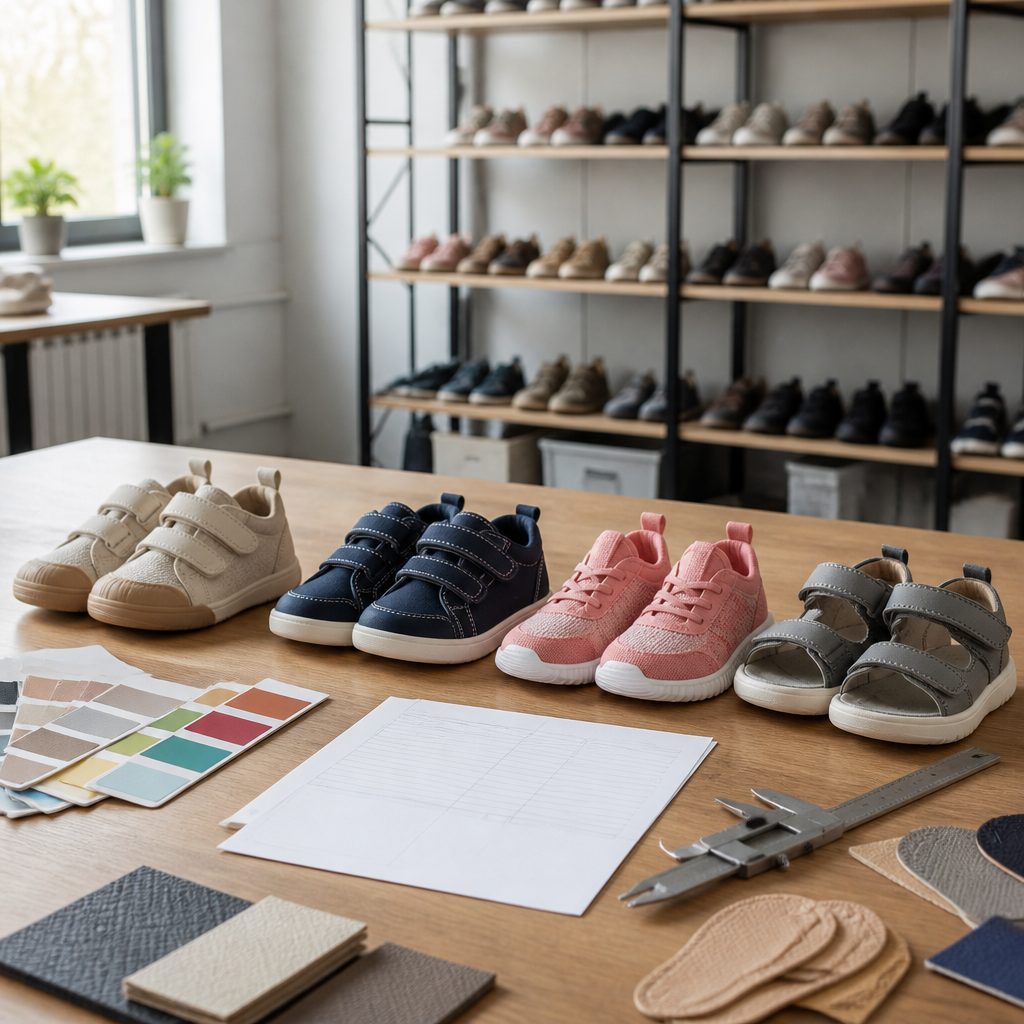
A quotation request for wholesale children's sneakers may identify either breathable mesh or PU as the proposed upper. Both appear in the KidsShoeWorks sneaker range, but those category names do not provide the same amount of information. The published engineered-mesh description includes specific attributes, while the supplied PU evidence contains no equivalent attribute set.
That difference creates a documentation problem rather than a basis for declaring one material better. The buyer needs to show what has been selected, which details remain open and what project evidence will be needed for review. Published material descriptions should be kept separate from desired outcomes: neither an upper category nor a quality checkpoint establishes how a particular finished shoe will fit, feel or perform.
The available material evidence is uneven
The children's footwear range lists breathable mesh and PU as upper options for kids' sneakers. It also lists colorway, logo, closure and outsole texture as customizable fields. These entries establish available product directions, not a completed specification or confirmation that every requested combination can be produced.
KidsShoeWorks describes engineered mesh as a lightweight, breathable, quick-dry, knit-style upper. The material page identifies engineered mesh for kids' sneakers, sports runners and sandals. Those attributes belong to the published engineered-mesh category; a material proposed for an actual project still needs a precise reference.
| Upper entry | Published information | Question for the project record |
|---|---|---|
| Breathable mesh | Listed as a kids' sneaker upper option | Is the proposal based on the published engineered-mesh category or a different mesh specification? |
| Engineered mesh | Described as lightweight, breathable, quick-dry and knit-style | What exact material reference is proposed for the shoe? |
| PU | Listed as a kids' sneaker upper option | What project-specific PU specification and supporting information are available? |
| Upper undecided | No current material selection | What information is needed before the buyer selects a direction? |
The supplied sources do not support a PU comparison based on durability, care, price, safety or suitability for a wearing context. They also do not show that every mesh used in a sneaker program shares the engineered-mesh attributes. Those points should remain open instead of being completed with general material assumptions.
A six-field record for the upper decision
As an editorial recommendation for the buyer, place the current material decision in one compact record. This format makes missing information visible without turning an inquiry into a claim about factory practice.
| Decision field | What the buyer records |
|---|---|
| Intended use | The product category and intended wearing context, stated in the buyer's own terms. |
| Proposed upper | Breathable mesh, a precise engineered-mesh reference, PU or undecided. |
| Construction context | Proposed lining, outsole and adhesive references, with unconfirmed details clearly marked as inquiry fields. |
| Customization dependencies | Colorway, logo, closure and outsole texture requirements that may need to be reviewed with the upper. |
| Unresolved questions | Material, fit, finish, closure or construction points that require project-specific review. |
| Requested evidence | The photos, measurements, reports or buyer documents requested for a defined decision. |
The intended use field is context for discussion, not proof that either material will produce a desired result. A buyer requirement can be written as a question or proposed acceptance criterion until relevant project evidence is available.
The same distinction matters for private label children's sneakers. Branding and appearance requirements may depend on the proposed upper, but the product page does not document every logo method, color execution or material combination. The record can associate those requests with the upper while leaving feasibility for project review.
Where customization meets construction
- Colorway
The editorial recommendation is to identify target colors, placement and the reference intended for review. The published evidence confirms colorway as a customizable field but does not confirm a particular execution.
- Logo
Record the artwork status, intended location and proposed execution. Logo customization is listed for the sneaker range, and logo placement appears within the documented sample-review scope.
- Closure
Name the proposed closure and any sample questions attached to it. Closure is listed as customizable and is reviewed during the sample checkpoint.
- Outsole texture
Include the buyer's visual or technical reference. The customizable texture field does not define the outsole material or its construction.
- Lining, outsole and adhesive
Keep these as separate inquiry fields when the project definition is incomplete. KidsShoeWorks documents their alignment or review within its material controls, but the supplied product evidence does not prescribe combinations for a mesh or PU upper.
Which checkpoint addresses each open item?
The quality-control page documents incoming-material, sample, in-line and final-packing checkpoints. As an editorial method, the buyer can assign each open question to the checkpoint where it is relevant. This produces a clearer inquiry while preserving KidsShoeWorks' published role as checking or aligning items against the brief.
| Checkpoint | Documented scope | Recommended entry in the buyer's record |
|---|---|---|
| Incoming materials | Upper, lining, outsole, label and adhesive samples are aligned to the brief. | List the references that should correspond to the written product definition. |
| Sample review | Fit, comfort, logo placement, finish and closure are reviewed together. | Identify the questions and proposed acceptance criteria that require examination on a sample. |
| In-line checks | Assembly, stitching, bonding, flex and stability are checked during production. | Connect relevant checks to the approved construction and written inspection plan. |
| Final packing | Carton counts, inner packing, labels and outer cartons are checked before shipment. | State the packing and identification details supplied for the project brief. |
For example, the upper reference belongs with incoming-material alignment, while logo placement and closure belong in sample review. Bonding and stitching appear in the documented in-line scope. These mappings identify when an item is checked; they are not advance findings about the finished product.
Evidence tied to a decision
KidsShoeWorks groups buyer-specific packing labels, market-specific material notes and inspection photo requests under documentation topics it can align around. The same section identifies third-party test coordination and document requests from an importer or retailer as alignment topics.
The quality page also states a preference for project-relevant inspection photos, measured samples and test reports over certifications unrelated to the order. It does not say that a particular photo set, sample measurement, report or third-party activity is automatically included in every project.
The editorial recommendation is to connect each request to a specific question. A photo request can identify the views the buyer wants reviewed. A measured-sample request can name the dimensions of interest. A report request can identify the material or construction issue it is intended to address. Any document requirement from an importer, retailer or target market should be supplied as a project input, with applicability, responsibility and timing confirmed for that project.
Comparing responses on the same basis
A broad mesh entry and a broad PU entry should not be scored as though they contain equivalent evidence. The published engineered-mesh category has documented attributes; a proposed project material still needs its own precise reference. The PU option likewise needs project-specific information before a buyer can assess it against the same brief.
For response review, the editorial recommendation is to use the completed decision records rather than the material category names alone:
- Check whether each proposed upper has a precise reference.
- Keep engineered-mesh attributes limited to the category documented on the material page.
- Request a project-specific description when PU is proposed.
- Review colorway, logo, closure and outsole texture beside the selected upper.
- Keep lining, outsole and adhesive entries marked as proposed until confirmed.
- Match each unresolved question to a documented checkpoint.
- Tie each evidence request to a material, sample, production or packing decision.
- Separate published information, buyer requirements and open questions.
This approach reveals whether two responses address the same product definition. It also prevents a more detailed category description from being mistaken for proof about a particular project material.
The record to send for review
The upper can remain provisional when the inquiry is submitted. Record breathable mesh, a precise engineered-mesh reference, PU or undecided as the current direction, then include the intended use, construction context, customization dependencies, open questions and requested evidence.
Share the current definition through the project inquiry and ask which development, sampling or quotation options may apply. The resulting discussion can address the actual kids sneaker upper materials under consideration without assuming that either category guarantees a particular outcome.
Sources and verification
- Children's Footwear Products | KidsShoeWorks First-party site source
- Kids' Shoe Materials | Mesh, PU, Canvas, Rubber & EVA | KidsShoeWorks First-party site source
- Quality Control for Children's Shoes | KidsShoeWorks First-party site source
Share the current children's footwear definition and ask which development, sampling or quotation options may apply to the project.
Send your project brief