Sourcing Guides
Write Size Range First in a Custom Infant Shoes Size Range Brief
A custom infant shoes size range brief makes toddler and little-kid coverage checkable before samples. Keep size range beside style and market, fence sneaker attributes, and leave infant-only questions visible.
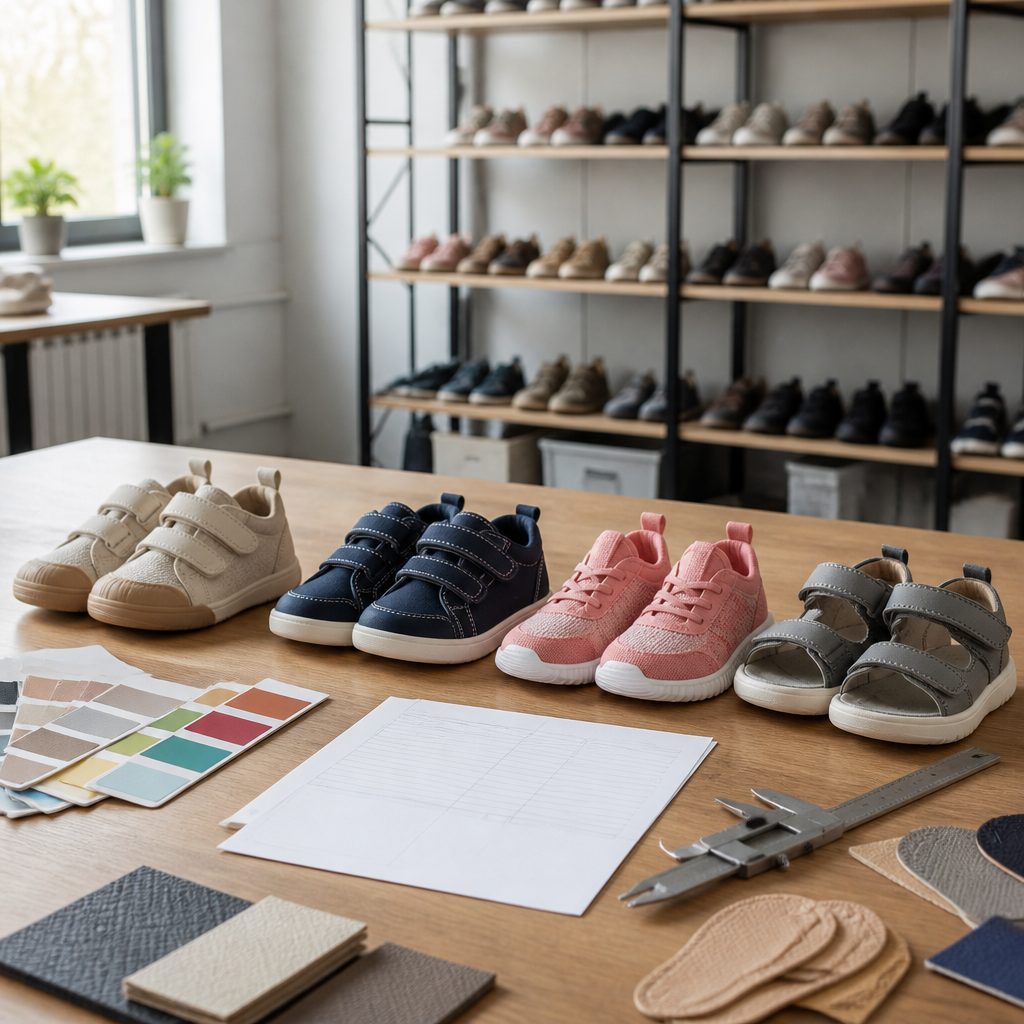
Colorways and logos often freeze while the size story never gets written. Later bulk fit checks then have no agreed band to enforce. A custom infant shoes size range brief names toddler versus little-kid coverage as an opening field so a custom infant shoes fit review can score against that band, not against vague comfort talk.
KidsShoeWorks publishes fit language for toddler, little kid, and big kid sizing, and places size range inside the buyer brief path. Stay inside that published scope. Do not invent an infant-only catalog family, last shapes, or grade rules. The practical job is to lock size range before sample review begins.
When size range is missing, fit review has nothing to enforce
If the brief only says “infant” or “kids,” construction can look clean and materials can match a swatch while the shoe still misses daily use. The size story was never recorded. For a toddler sizing kids footwear brief, the failure is procedural: reviewers argue about comfort with no shared size-range claim on the page.
Published quality guidance frames fit review as toddler, little kid, and big kid sizing checked for day-to-day wearability. That language helps only when the brief already states which of those bands, or which mix, the program covers.
Material control, construction review, and packing discipline are separate ladders. None of them replace an explicit size-range line. Give size range the same priority as style and target market. A blank field at sample stage leaves bulk fit checks without an agreed standard, no matter how carefully other attributes were frozen.
Put size range in the brief beside style and target market
The About path lists the first step as the buyer sending a brief that includes style, size range, target market, quantity, logo, and packing notes. Size range is already an opening input, not a later correction. For infant-oriented programs, that placement is the control point that matters most.
- Style: silhouette and use case the brand intends to sell.
- Size range: the toddler, little-kid, and/or big-kid bands under review, written as a closed statement the sample can be checked against.
- Target market: channel and wear context that make those bands meaningful.
- Quantity, logo, and packing notes: commercial and handoff fields kept beside size range, not used instead of it.
Market language explains where the shoe sells. Size range defines which feet the sample must serve. Keep them side by side so a retail story or school-use note is not treated as if it defined foot size. Copy that field order and hold sampling until the size line is explicit.
What the published fit review actually covers
Quality pages separate fit review from material control. The table restates only those published scopes so buyers do not merge them into one vague quality promise.
| Checkpoint | What the published language covers | What it does not replace |
|---|---|---|
| Fit review | Toddler, little kid, and big kid sizing reviewed for day-to-day wearability | A blank size-range field, last geometry, or unstated grade rules |
| Material control | Upper, lining, outsole, and adhesive choices confirmed before the sample stage | Size-band decisions or wearability claims by age |
| Construction review | Stitching, bonding, flex point, and outsole stability before packing | Agreement on which sizes the program includes |
| Packing discipline | Carton counts, labels, stickers, and export presentation | Fit or size-range definition |
Buyer benefit language on that page is modest: fit and comfort review aims at a better chance of matching the target market. Treat that as a checkpoint label, then write your own size bands in plain terms the sample team can compare. It is alignment language, not a wear-test result and not a guarantee of infant-specific lasts.
Sample review is a comparison point for fit and comfort
Inspection language places sample review after incoming materials and before in-line production checks. At sample review, fit, comfort, logo placement, finish, and closure are reviewed together so the bulk run has a better chance of matching the approved sample. That sequence is where size-range discipline becomes checkable.
- Confirm incoming materials against the brief (upper, lining, outsole, label, and adhesive samples as listed).
- Bring the written size range into sample review so fit and comfort are judged against that band, not against a photo alone.
- Record logo placement, finish, and closure in the same review so attribute disputes do not reopen size questions later.
- Treat the approved sample as the comparison point for bulk, not as proof that every future size will fit without further definition.
An infant shoe sample fit checkpoint, in practical buyer terms, means the sample is checked against the size-range line already written in the brief. The published checkpoint list does not expand sample review into bulk guarantees, measured infant lasts, or automatic multi-size coverage. If more sizes are needed after the first sample, add those bands as brief updates before further sampling.
Sneaker attribute scope is not a size-range answer
The products page presents kids' sneakers as a starting point for private-label and retail orders. Framing covers casual wear, school use, and a wide color story. Build language names a breathable mesh or PU upper. Custom fields listed there are colorway, logo, closure, and outsole texture. Those are real program levers. They are not a size-range answer.
| Field type | Published sneaker scope | Buyer risk if misused |
|---|---|---|
| Build | Breathable mesh or PU upper | Treating upper choice as proof of infant fit coverage |
| Custom options | Colorway, logo, closure, outsole texture | Freezing brand look while size bands stay open |
| Use framing | Daily wear and school retail popularity | Confusing channel story with toddler or little-kid size definition |
Keep attribute scope and size range on separate brief lines. A strong colorway and a preferred closure still leave toddler versus little-kid coverage undefined. Nothing in the sneaker excerpt claims a dedicated infant product family. Write infant-only coverage as an open question rather than inferring it from kids' sneaker popularity.
Private-label repeat supply still needs explicit size bands
Industry language for retail and private-label brands points to branded ranges with controlled look, packaging, and repeat supply.
Controlled look and repeat supply stay coherent only when size bands are stable across reorders. A vague first brief reopens fit debate under new seasonal packaging on every reorder. That channel note does not publish volumes, infant as a named family, or automatic multi-season size expansion.
Write the size bands once. Keep them beside logo and packing notes. Reuse the same wording when requesting a repeat run. Controlled packaging cannot repair an undefined size story.
Keep infant-category unknowns on separate open lines
Published product reference used here is kids' sneakers, not an infant-specific family. Fit language covers toddler, little kid, and big kid sizing for day-to-day wearability. It does not publish infant-only lasts, soft-sole rules, or a separate infant size chart. Leave those gaps visible instead of filling them with inference.
- Whether the intended infant or early-toddler band is fully covered by the toddler language on the quality page, or needs extra definition from the brand.
- Whether soft sole, pre-walker, or first-walker requirements apply (none of those terms appear in the excerpts used here).
- How many sizes must be sampled before a multi-size program is considered aligned (the excerpts do not set that count).
- Whether school-use or daily-wear sneaker framing fits the infant SKU plan, or whether a different silhouette brief is required.
Leaving these lines open is a procurement discipline choice. It protects the custom infant shoes size range brief from false completeness. It also keeps material rows, packing notes, and sneaker custom fields from being stretched into sizing answers they do not provide. For first-party ceilings, see the quality and products pages. The about brief path shows where size range already sits. Channel framing is on industries.
Send a size-range-first definition for the next project step
Share a children's footwear definition that makes size range impossible to skip. Write style, size range, target market, quantity, logo, and packing notes in one place. Add fit questions only as questions: which toddler or little-kid bands must the sample prove, and which infant-only items remain unknown. Do not treat development, sampling, or quotation topics as already-scoped infant services unless a later reply confirms them for that project.
- State the size range in buyer language (for example, the toddler band only, or toddler plus little kid), separate from colorway and closure.
- Name the target market and wear context so fit review for day-to-day wearability has a market to match.
- List open infant-category questions on their own lines rather than burying them under sneaker attribute notes.
- Ask which development, sampling, or quotation options may apply to that written definition, without assuming MOQ, lead time, or service scope not present in published materials.
That sequence keeps the custom infant shoes size range brief as the control document. Sample review then has something concrete to enforce, and bulk discussion can refer back to the same size line. When the definition is ready, teams can use the request path to share it and ask which next-step options fit the project.
Sources and verification
- About KidsShoeWorks | Kids' Shoe Manufacturing Partner First-party site source
- Quality Control for Children's Shoes | KidsShoeWorks First-party site source
- Children's Footwear Products | KidsShoeWorks First-party site source
- Kids' Footwear by Industry & Channel | KidsShoeWorks First-party site source
Share the current children's footwear definition and ask which development, sampling or quotation options may apply to the project.
Send your project brief