Buyer Guidance
Custom Infant Shoe Logo and Closure Options: Scope Check
Logo and closure terms from a kids' sneaker card can organize a brief, but they stay sneaker-scoped until infant applicability is answered. Build a ledger, then send a narrow design request.
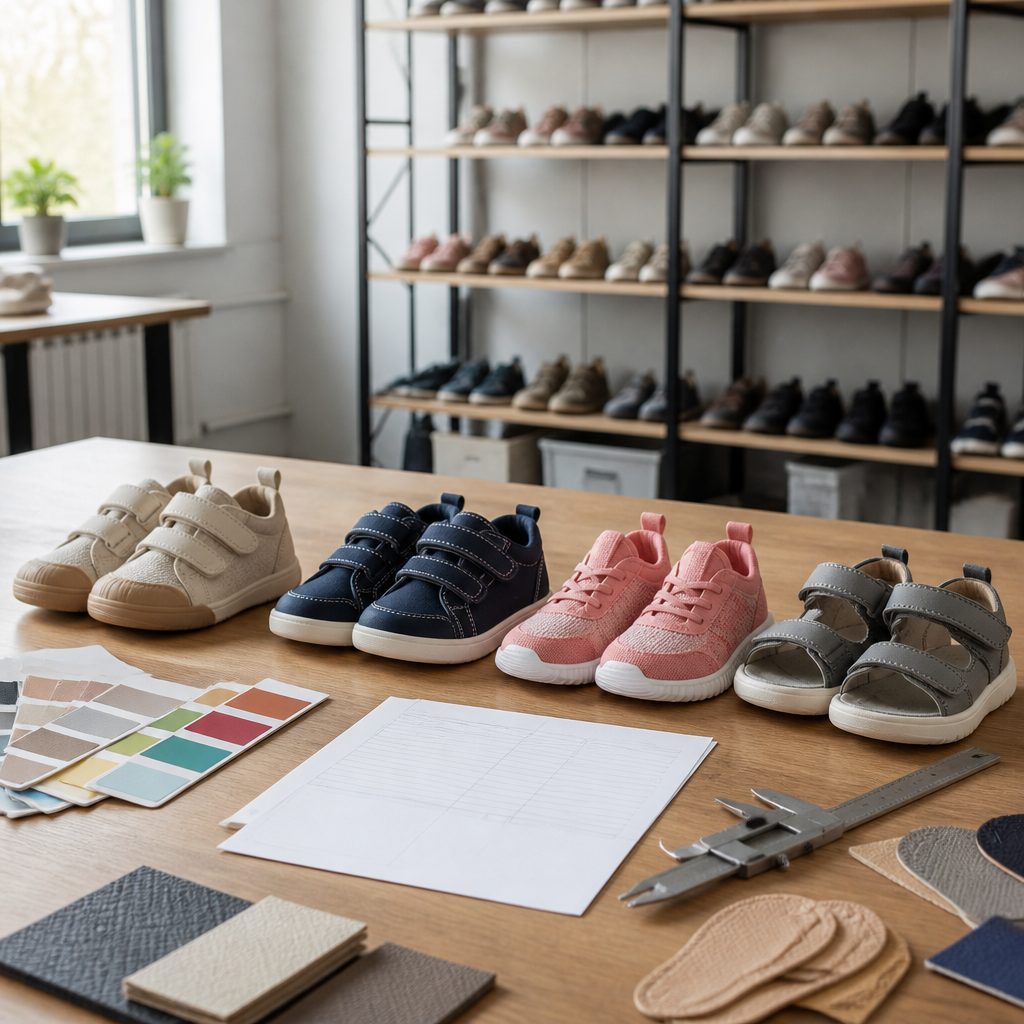
Buyers drafting custom infant shoe logo and closure options often pull familiar labels from the products page: under Custom for kids' sneakers, the card lists colorway, logo, closure, and outsole texture. The same card presents kids' sneakers as a strong starting point for private-label and retail orders. Those lines describe the listed sneaker family. The supplied excerpts do not attach them to infant footwear.
The procurement risk is attribute transfer—writing a specification as if a product-family Custom list already covers the infant brief. Editorial recommendation for the buyer: treat the sneaker wording as a labeled reference, keep every infant-facing preference marked open, and only then assemble the inquiry fields.
What Breaks When Attributes Cross Product Families
A logo note or closure preference can look complete on paper while the published basis still points at kids' sneakers. When those fields enter an infant line without a scope mark, the brief reads as if the option set is already confirmed. Downstream, sample talk and packing notes get mixed into the same “approved” stack even though each source is doing a different job.
This article uses a scope ledger so each field keeps its published basis. Where the excerpts stop, the row stays unresolved. That is a writing discipline for the buyer, not a documented factory workflow.
Three Source Types, Three Jobs
Use the site pages as separate instruments:
- Product-family reference — kids' sneakers Custom list and the private-label / retail starting-point wording on products.
- Quality checkpoint reference — sample review subjects and related control language on the quality page.
- Buyer brief inputs — style, size range, target market, quantity, logo, and packing notes as listed on the about page.
Relevant to one inquiry, yes. Equivalent claims, no. None of those excerpts states that the sneaker Custom attributes apply to infant footwear.
Scope Ledger for Logo, Closure, and Adjacent Fields
The table is an editorial worksheet. It records published wording at stated scope and marks infant status. It is not an infant catalog and does not invent availability.
| Request field or reference | Published basis | Stated scope | Status for an infant request |
|---|---|---|---|
| Colorway | Listed under Custom on the products page | Kids' sneakers | Unresolved for infant |
| Logo | Listed under Custom on the products page | Kids' sneakers | Unresolved for infant |
| Logo placement | Named among sample-review subjects on the quality page | Sample review | Unresolved for infant |
| Closure | Listed under Custom on the products page | Kids' sneakers | Unresolved for infant |
| Closure at sample review | Named among sample-review subjects on the quality page | Sample review | Unresolved for infant |
| Outsole texture | Listed under Custom on the products page | Kids' sneakers | Unresolved for infant |
| Fit language on quality | Toddler, little kid, and big kid sizing in fit-review wording | Quality page fit review | Does not define an infant range |
| Size range | Named as a field when a buyer sends a brief | Buyer brief input | Include as a brief input; infant applicability remains open |
| Materials | Upper, lining, outsole, and adhesive under material control | Quality checkpoint | Does not define infant construction |
| Packing notes | Named as a field when a buyer sends a brief | Buyer brief input | Include as a brief input |
| Packing discipline | Carton counts, labels, and export presentation | Quality checkpoint | Does not define project packing |
After the ledger is filled, blank source language is not permission to copy sneaker Custom fields into an infant specification. Keep unresolved rows as questions in the brief.
Kids' Sneaker Customization at Source Scope
Supported product-page facts, used only at that scope:
- Custom on kids' sneakers: colorway, logo, closure, and outsole texture.
- Kids' sneakers described as a strong starting point for private-label and retail orders.
When the proposed product is that sneaker family, those lines are direct. For an infant program, the editorial recommendation is to cite them as comparison references—for example, “products page, kids' sneakers Custom: logo and closure”—and pair each citation with an open question about the submitted footwear definition. Apply the same split to colorway and outsole texture so they do not ride in on the logo and closure request.
Sample Review Versus Confirmed Options
The quality page states that at sample review, fit, comfort, logo placement, finish, and closure are reviewed together. The stated buyer benefit is a better chance that the bulk run matches the approved sample. That language describes checkpoint content and a bulk-match benefit relative to an approved sample. It does not list infant SKUs, approve a proposed infant sample in advance, or extend sneaker Custom attributes to infant footwear.
Fit review on the same page uses toddler, little kid, and big kid sizing. Those terms should stay where the page puts them. For size, the about page only establishes that size range is one of the fields a buyer sends in a brief; it does not define infant sizing or a separate review service for ranges.
If the brief needs an infant shoe logo placement review topic, name logo placement as a requested review subject tied to sample-review language, and leave whether it applies to the infant definition open. That is buyer framing, not a confirmed infant program.
How to Frame a Custom Infant Shoe Design Request
A custom infant shoe design request is strongest when brief fields stay inputs and product Custom lists stay labeled references. The about page lists style, size range, target market, quantity, logo, and packing notes as what a buyer sends. Editorial recommendation for structuring that submission:
- State the current children's footwear definition and style intent without assigning an unsupported age, fit standard, or construction to the word infant.
- Include size range and target market as brief inputs, and note if you are distinguishing the project from toddler, little kid, and big kid wording on the quality page.
- Put logo under the brief’s logo field; if placement matters, call out infant shoe logo placement review as a question, not a settled option.
- For an infant footwear closure inquiry, describe the preferred closure as a question against the proposed style, not as an offered infant closure type.
- Keep colorway and outsole texture on separate lines when they only come from the kids' sneaker Custom list.
- Add quantity and packing notes as inputs, then ask which development, sampling, or quotation options may apply to the submitted definition.
That order keeps packing notes, logo text, and a sneaker reference from looking like one approved product sheet.
Which Infant-Specific Points Stay Visible?
The items below are inquiry topics only. They are not documented services, capabilities, or commitments.
- For the submitted footwear definition, which development, sampling, or quotation options may apply?
- May the proposed product family be discussed as an infant footwear project, or does the definition need more detail first?
- If logo is in the brief, can logo placement be considered as a review topic for that definition?
- Can the requested closure be discussed against the proposed style, and which details should stay open pending a written reply?
- What size-range information should sit in the brief so the request is not read as the quality page’s toddler / little kid / big kid framing?
- If colorway or outsole texture is only a kids' sneaker reference, which attributes, if any, may be discussed for the submitted definition?
- Which logo and packing notes should accompany style, size range, target market, and quantity?
Send the Brief With Open Rows Intact
A narrow, checkable request states the current children's footwear definition, tags any kids' sneaker Custom wording as a product-page reference, and leaves infant-specific logo and closure points visible as questions. That is more useful than treating either preference as settled when the supplied pages do not assign them to infant shoes.
Share the definition and brief through request a quote, and ask which development, sampling, or quotation options may apply. Attach the scope ledger or a short list of unresolved rows so open fields stay part of the request rather than disappearing into assumed options.
Sources and verification
- Children's Footwear Products | KidsShoeWorks First-party site source
- Quality Control for Children's Shoes | KidsShoeWorks First-party site source
- About KidsShoeWorks | Kids' Shoe Manufacturing Partner First-party site source
Share the current children's footwear definition and ask which development, sampling or quotation options may apply to the project.
Send your project brief