Packaging and Quality
Notes to Cartons: A Custom Children's Shoes Packing Checklist
Work backward from the published final-packing checkpoint to separate buyer instructions, reviewed packing fields and requests that still need project agreement.
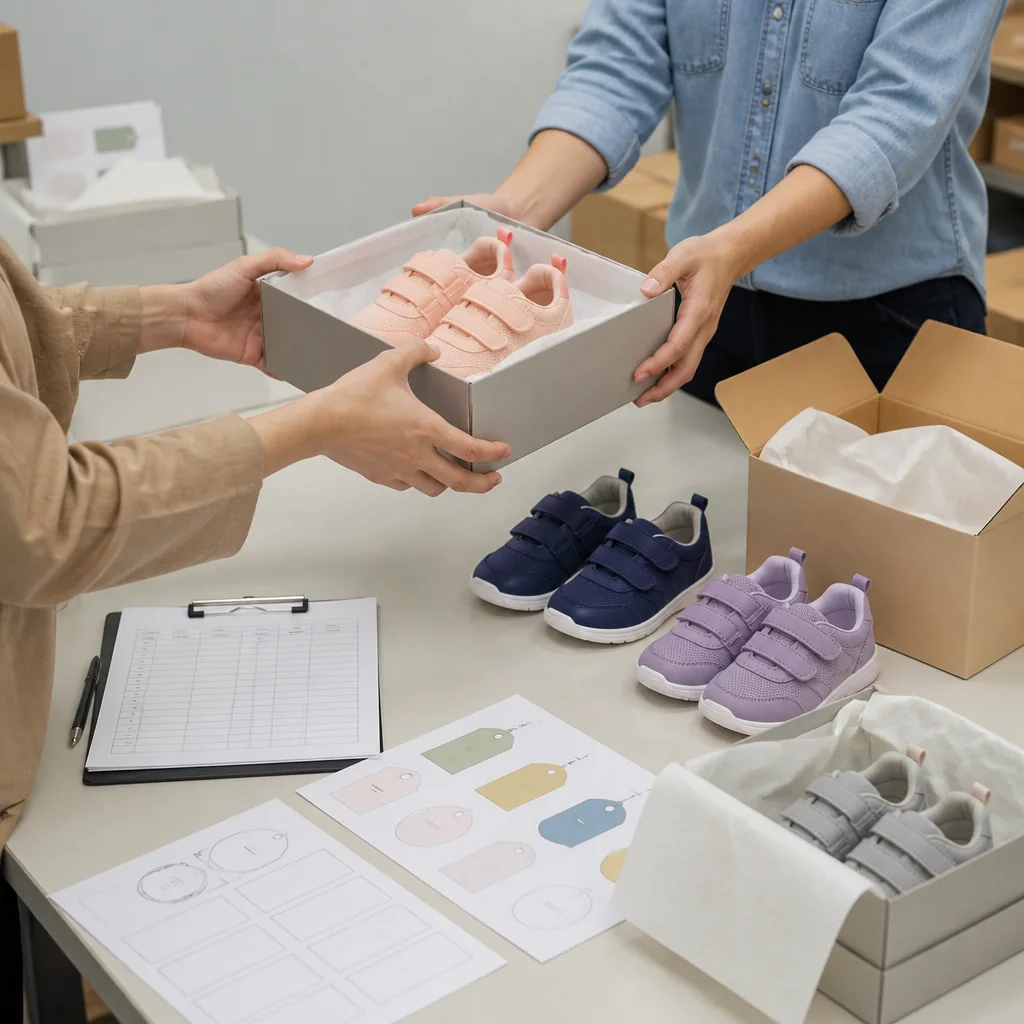
The published final-packing checkpoint names carton counts, inner packing, labels and outer cartons before shipment. The published brief workflow separately puts packing notes in the buyer's submission. This custom children's shoes packing checklist works between those two records: it turns the buyer's notes into visible rows while keeping photo and document requests open for project-specific discussion.
The matrix below is an editorial tool for buyers, not a published KidsShoeWorks form or inspection procedure. Its scope is the packing handoff. The supplied sources do not set carton quantities, inner-pack ratios, dimensions, weights, packaging materials, label formats or tolerances, so the framework leaves those values blank until the buyer has a project-specific instruction.
Four fields at the endpoint
The KidsShoeWorks quality page contains two distinct packing descriptions. Under final packing, it says carton counts, inner packing, labels and outer cartons are checked before shipment. Elsewhere, its packing-discipline description says carton counts, labels, stickers and presentation are reviewed for the export run.
For a buyer-owned handoff, this article recommends preserving both source contexts. Use the four final-packing fields as the endpoint. Give stickers and presentation separately labeled rows when they apply to the project, rather than silently adding them to the narrower final-packing list.
Each applicable row needs either an instruction, a reference or a visible open status. That is an editorial method for organizing children's shoe packing requirements; it is not a claim that KidsShoeWorks uses these columns or status terms.
Which record owns each decision?
Instructions, published review fields and unresolved requests serve different purposes. The following matrix keeps those purposes separate and preserves the source category for checklist alignment.
| Record | Published scope | Editorial use for the buyer |
|---|---|---|
| Buyer instruction | Packing notes are included in the brief described on the About KidsShoeWorks page. | State the requested packing result and identify the reference that defines it. |
| Review: final packing | Carton counts, inner packing, labels and outer cartons are checked before shipment. | Give every published field its own status instead of relying on a general packing approval. |
| Review: packing discipline | Carton counts, labels, stickers and presentation are reviewed for the export run. | Retain this label for stickers and presentation so their source context remains clear. |
| Request: alignment topics | The documentation list includes buyer-specific packing labels. It separately includes inspection photo requests. It also includes document requests from an importer or retailer. | Ask about each relevant item individually and record what still needs project agreement. |
| Request: buyer-documents wording | A separate part of the page presents buyer documents as inspection photos and checklist alignment. | Keep checklist alignment in this source category rather than adding it to the documentation alignment list. |
In this framework, an instruction records what the buyer wants, while a review row identifies a published checkpoint field. A request records a topic that still needs discussion. None of those records confirms the status of the other two.
Packing notes before carton review
The published workflow says the buyer sends a brief containing the style, size range, target market, quantity, logo and packing notes. Those fields identify the product definition attached to the notes, but the source does not prescribe a packing-note format.
For the buyer's internal handoff, this article recommends the following sequence:
- Anchor the notes to the product definition. Carry the current style, size range, target market, quantity and logo reference into the packing file.
- Expand the packing notes into rows. Create separate entries for carton counts, inner packing, labels and outer cartons. Add stickers or presentation only where they apply, with the packing-discipline context identified.
- Separate instructions from references. Put the written requirement in one field and any artwork, diagram or other buyer-approved reference in another.
- Choose visible status terms. A buyer might use defined, open, sent for discussion or not applicable. These are editorial suggestions, not KidsShoeWorks terminology.
- Keep omissions visible. Leave an undefined value open instead of supplying a quantity, dimension, material, format or tolerance from assumption.
A field matrix with blanks intact
The buyer prompts below add no default values. They show the decisions a product or procurement team can record beside each published packing field.
| Field | Source context | Buyer prompt |
|---|---|---|
| Carton counts | Final packing names carton counts. Packing discipline names carton counts separately. | Enter the applicable count instruction or its reconciliation reference. Mark the row open if neither has been established. |
| Inner packing | Final packing names inner packing. | Describe the requested arrangement or point to a buyer-approved visual reference. Leave ratios and materials undefined until specified. |
| Labels | Final packing names labels. Packing discipline names labels separately. | Identify the artwork or data source, revision, intended placement and the buyer's internal approval owner. |
| Outer cartons | Final packing names outer cartons. | Point to the applicable buyer instruction and artwork. Keep dimensions, weights, materials and tolerances open when they have not been defined. |
| Stickers | Packing discipline names stickers for the export run. | Record whether stickers apply, then identify the buyer-supplied content or reference. Do not treat the field as automatically required. |
| Presentation | Packing discipline names presentation for the export run. | Convert the buyer's expected presentation into written acceptance points or an identifiable visual reference. |
For each row, the editorial recommendation is to record the field name, buyer instruction, reference identifier, revision, internal decision owner, status and comment. That structure gives the buyer traceable rows without presenting them as company-standard fields.
Where packing scope ends
The quality page places incoming materials, sample review, in-line checks and final packing at separate inspection checkpoints. A buyer's records can follow that same separation.
| Checkpoint | Published review scope | Editorial boundary |
|---|---|---|
| Incoming materials | Upper, lining, outsole, label and adhesive samples are aligned to the brief. | Track material alignment outside the packing status. |
| Sample review | Fit, comfort, logo placement, finish and closure are reviewed together. | Keep the sample decision in its own record. |
| In-line checks | Assembly, stitching, bonding, flex and stability are checked during production. | Keep construction observations outside the packing row. |
| Final packing | Carton counts, inner packing, labels and outer cartons are checked before shipment. | Limit the packing status to these stated fields. |
For buyer recordkeeping, treat a children's footwear final packing check as evidence only of its stated packing scope. Fit, material alignment, sample review and construction checks retain their own statuses. Related records may be linked, but a packing status should not replace them.
Proof requests: two source categories
The documentation section uses the heading “What we can align around.” Three packing-related entries from that list are relevant to this handoff, and each remains a request rather than an automatically included output.
Packing-related entries from the published alignment list
| Entry | Exact source scope | Editorial question for the buyer |
|---|---|---|
| Buyer-specific packing labels | Listed as a topic KidsShoeWorks says it can align around. | Ask which artwork or data reference applies and which review steps need agreement. |
| Inspection photo requests | Listed as a topic KidsShoeWorks says it can align around. | Identify the packing field, requested view and reference the photo is intended to show. |
| Importer or retailer document requests | Document requests from an importer or retailer are listed as an alignment topic. | Provide the exact request and ask about project applicability, responsibility, format and timing. |
Checklist alignment stays separate
The page separately presents “Inspection photos and checklist alignment” under buyer documents. It does not place checklist alignment in the “What we can align around” list.
As an editorial recommendation, a buyer who wants checklist alignment can identify the checklist, revision and relevant rows, then ask whether and how that request may apply to the project. The supplied source does not define a standard checklist, delivery format, timing, approval responsibility or automatic availability.
What is ready to send?
Before submitting the handoff, the buyer can use this editorial review:
- The packing notes identify the applicable style and current product definition.
- Carton counts, inner packing, labels and outer cartons each have a separate status.
- Stickers and presentation retain their packing-discipline context when included.
- Instructions and proof requests occupy different fields.
- Artwork, diagrams and written references show an identifiable revision.
- Undefined values remain marked open rather than replaced by assumed defaults.
- Photo, checklist and document requests state what still needs project agreement.
- Material, sample and in-line construction records remain outside the packing status.
Send the current footwear definition and packing notes through the project inquiry, with unresolved rows clearly marked. Ask which development, sampling or quotation options may apply to the project. The inquiry itself does not confirm feasibility, pricing, timing, document availability or a completed packing specification.
Sources and verification
- Quality Control for Children's Shoes | KidsShoeWorks First-party site source
- About KidsShoeWorks | Kids' Shoe Manufacturing Partner First-party site source
Share the current children's footwear definition and ask which development, sampling or quotation options may apply to the project.
Send your project brief