Product Development
How to Define a Custom Children's Shoe Size Range
A procurement-focused guide to stating the current size range in a children's footwear brief, separating category labels from numerical endpoints, and carrying unresolved questions into the inquiry.
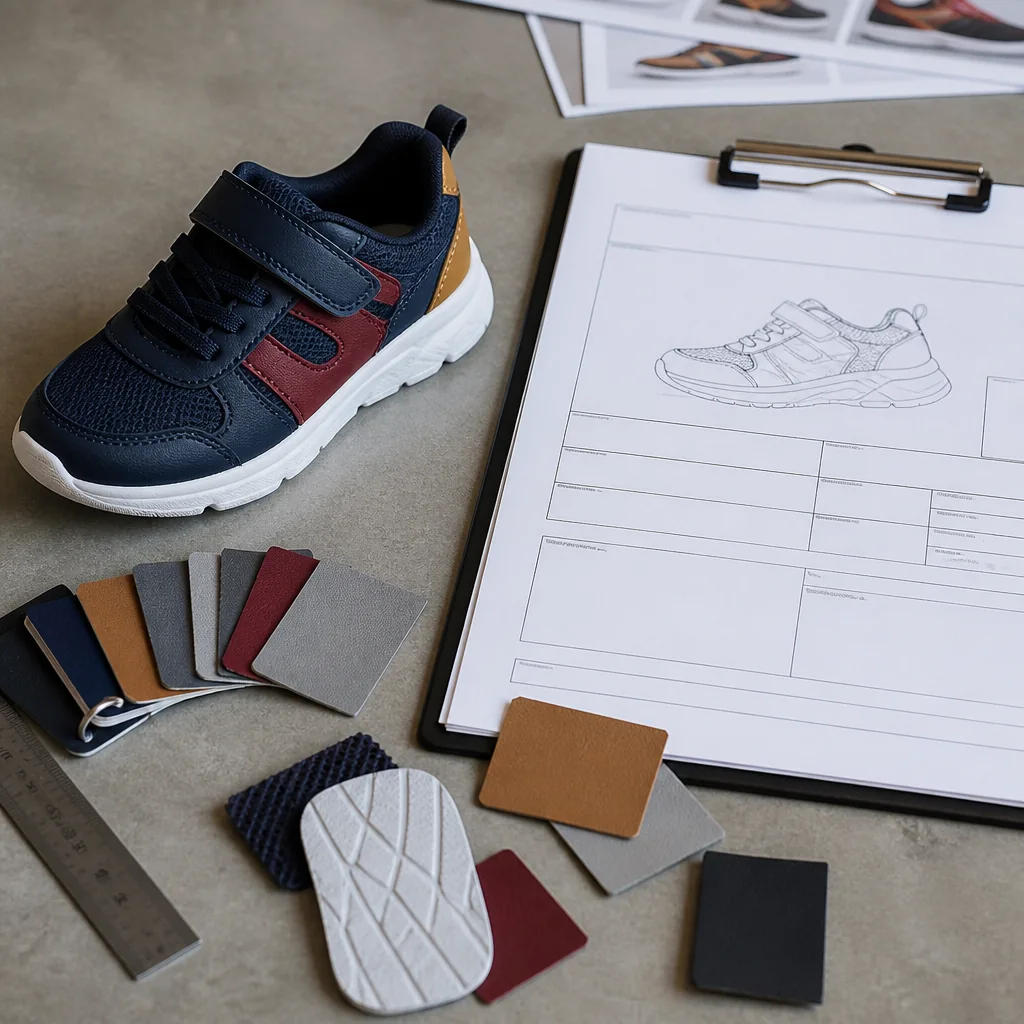
Product teams that need to decide how to define a custom children's shoe size range are settling ownership of one field in the initial brief. The About page brief instruction says the buyer sends style, size range, target market, quantity, logo and packing notes. That language places submission of those items with the buyer. It does not say the manufacturer chooses the range, grades it or holds final technical authority over it.
A line that only says “toddler” or “little kid” still lacks sizing-system or market notation and numerical endpoints. For the buyer, the practical step is to record the range currently requested, name the target market and keep conversion or sampling points on a separate open-question list. The decision record and inquiry template below are buyer-side recordkeeping tools, not a KidsShoeWorks form, size chart or service promise.
Who Submits the Size Range?
A children's footwear size range brief is incomplete until the size field has a usable entry. Buyer input for that field can state the sizing-system or market notation the team already uses, the lower and upper endpoints under discussion and any category wording already in the brief. Where a conversion or grading basis is undecided, leave it as an open project question rather than filling the cell with an assumed value.
The same brief instruction lists quantity, logo and packing notes beside style, size range and target market. Recording each on its own line is a buyer-side habit: later edits stay visible, and product details are less likely to be mistaken for size specifications.
Buyer Input Versus Fit Review
One handoff creates two different responsibilities. The buyer states the current size-range definition. A later quality step may review sizing for day-to-day wearability. Those acts are not the same, and the difference matters when the inquiry is written.
- Buyer input
The About page instruction places size range in the brief the buyer sends. The buyer can record the current requested range without describing it as technically approved.
- Documented checkpoint
The quality page states that toddler, little kid and big kid sizing are reviewed for day-to-day wearability. The same source states that sample review covers fit, comfort, logo placement, finish and closure.
- Open project question
Keep fit-review coverage, category mapping and sampling scope on a separate line from the submitted range. That preserves the difference between the requested input and the review activity.
The quality page describes review of sizing for wearability. It does not convert that language into a fit guarantee, market-acceptance promise or full-range sampling commitment.
Why a Sneaker Spec Leaves the Size Field Empty
Style identity and size-range definition remain separate rows in the buyer record. The product overview describes kids' sneakers as best for daily wear and school retail. The sneaker build reference names breathable mesh or a PU upper. A separate sneaker customization line lists colorway, logo, closure and outsole texture.
Those details help identify the product under discussion. They do not supply a numerical size range. Because the cited build and customization lists appear under kids' sneakers, this article does not transfer them to school shoes, sandals, rain boots, canvas shoes or toddler footwear.
Decision Record for the Size Range
Before the inquiry is sent, build a compact buyer-side record around the published intake fields. Quantity, logo and packing notes stay outside the size-range definition when they are relevant. Use three document labels only: current request, proposed interpretation and open question. These labels describe the buyer's document status; they do not imply factory approval.
| Record field | Recommended entry | Status treatment |
|---|---|---|
| Style | The current style or product family under inquiry. | Current request: record the submitted description. |
| Target market | The market named in the buyer's brief. | Current request: keep the buyer's terminology visible. |
| Current requested range | The sizing-system or market notation already in use, plus lower and upper endpoints. | Current request: identify it as the range being submitted. |
| Category wording | Any toddler, little kid or big kid term used by the buying team. | Proposed interpretation only if mapped; otherwise do not substitute the term for numerical endpoints. |
| Open size questions | Unresolved category mappings, conversions, measurement references, grading questions or sample-coverage questions. | Open question: mark each item explicitly. |
| Other brief fields | Quantity, logo and packing notes, each recorded separately when relevant. | Keep them outside the size-range definition. |
Toddler, Little Kid, Big Kid: What the Excerpt Actually Says
The quality page names three size-segment labels: toddler, little kid and big kid. It says those segments are reviewed for day-to-day wearability. It does not map the terms to ages, numerical sizes, regional systems, foot measurements, tolerances or grading rules. The same excerpt also does not present the three terms as an availability statement for every footwear style.
Until project meaning is confirmed, place the category term beside the current requested range and treat the following as open project questions:
- Which numerical endpoints correspond to the category in the stated target market?
- Which sizing-system or market notation should be used when discussing this project?
- Is a second market conversion relevant, and how should it be recorded?
- Which grading or measurement references, if any, need project-specific agreement?
- Which size or sizes may be relevant to development samples and children's shoe fit review questions?
The quality page does not answer those questions. Mapping remains an inquiry topic, not a documented company service.
Limits of the Fit Checkpoint
Sample review language and unsupported conclusions must stay separate. The buyer decision is to ask what evidence may apply to the project rather than treating fit review as a completed specification.
- Supported checkpoint language
Sizing is reviewed for day-to-day wearability. Sample review covers fit, comfort, logo placement, finish and closure.
- Not established by the quality page
The quality page does not state that every requested size is sampled. It does not say one sampled size validates the complete range. It does not publish a standard size chart or full-range grading rule. It does not guarantee fit, comfort or target-market acceptance.
Where Size Questions Sit in the Quality Sequence
The quality page gives timing boundaries for several review topics. Use those boundaries to decide when to raise each size question while leaving size-by-size coverage open.
Before the sample stage. Upper, lining, outsole and adhesive choices are confirmed before the sample stage. Keep the current range notation and unresolved size questions with the same project brief so the active request remains identifiable.
At sample review. Fit, comfort, logo placement, finish and closure are reviewed together. Ask which size or sizes may be relevant to that review and which project-specific fit information may be available.
During production. Assembly, stitching, bonding, flex and stability are included in the published in-line checks. The quality page does not state that each listed in-line check is performed for every requested size, so any requested size coverage remains a separate inquiry point.
Before shipment. Carton counts, inner packing, labels and outer cartons are checked before shipment. If size identification or assortment details need to appear in packing, ask which information may apply to the project.
What to Send With the Open Questions
The following is an editorial template for a kids shoe manufacturer size range inquiry. It is not a published form, numerical chart or promise of development scope.
- Style
[Current style or product family]
- Target market
[Market named in the brief]
- Current requested size range
[Sizing-system or market notation]: [lower endpoint] through [upper endpoint]
- Category terminology
[Toddler, little kid or big kid, if the buying team uses one of these terms]
- Conversion questions
[State any regional mapping or secondary notation that remains unresolved]
- Grading or measurement questions
[State which basis, if any, needs project-specific confirmation]
- Sampling and fit-review questions
[Ask which development or sampling options may apply and which size or sizes may be relevant to review]
- Other brief fields
[Quantity], [logo notes] and [packing notes], recorded separately when relevant
Send the current style, target market and requested range first, then the clearly labeled open questions. Through the project inquiry page, ask which development, sampling or quotation options may apply to that submission. That order states a current range without presenting conversions, grading or sample coverage as already agreed.
Sources and verification
- About KidsShoeWorks | Kids' Shoe Manufacturing Partner First-party site source
- Quality Control for Children's Shoes | KidsShoeWorks First-party site source
- Children's Footwear Products | KidsShoeWorks First-party site source
Share the current children's footwear definition and ask which development, sampling or quotation options may apply to the project.
Send your project brief