Sourcing Guides
Custom Children's Shoe Packing Requirements to Define
Treat packing as a project definition, not a finishing afterthought. Map inner packing, labels, carton counts, and outer cartons, assign owners, and carry open fields into a scoped inquiry.
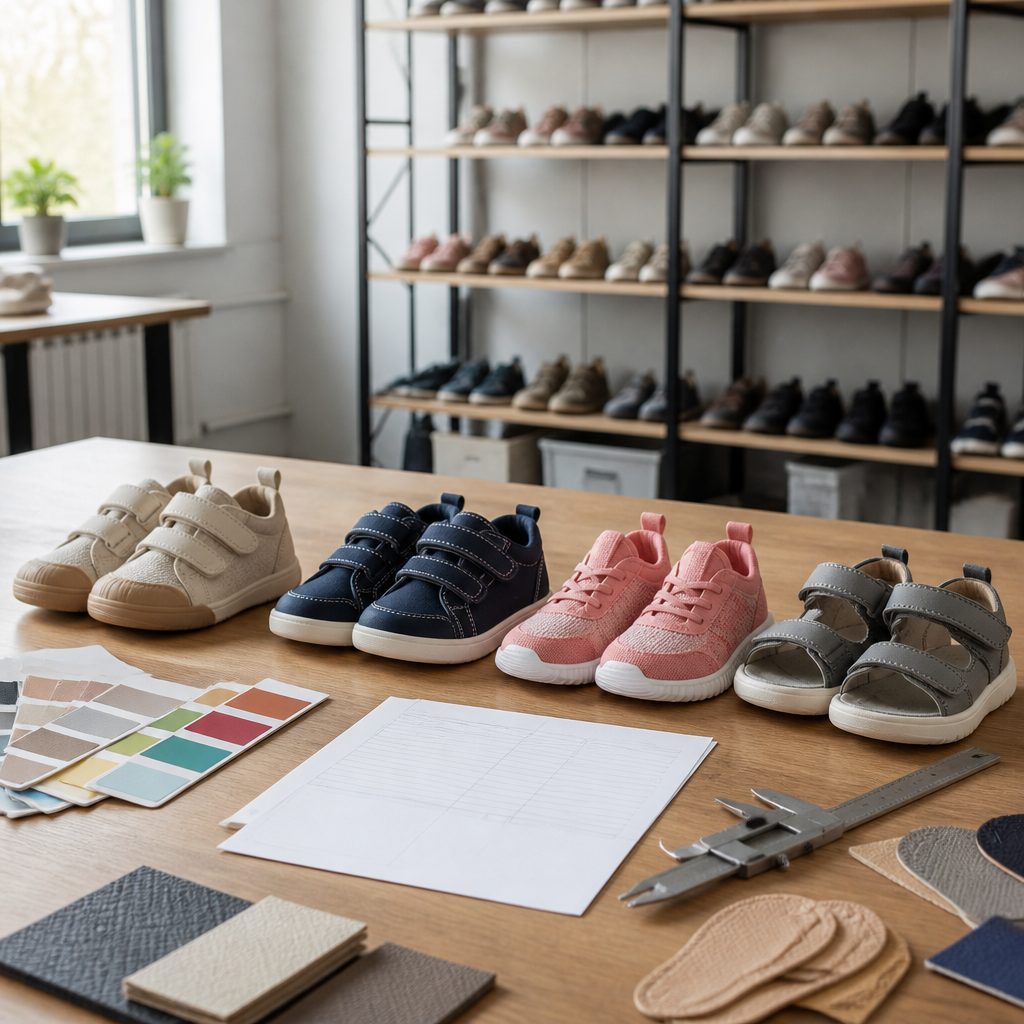
Custom children's shoe packing requirements often lag the shoe itself. Style, size range, market, quantity, and logo may be clear while unit packing, labels, carton counts, and outer-carton presentation stay half-written. Those gaps surface after sample approval, when carton marks and handover evidence become last-minute negotiation. Write packing into the brief as a definition you will later verify, not as a finishing detail assumed to follow an unpublished factory standard.
This guide is a buyer-side framework only. It does not state what any market legally requires. The aim is to make packing fields reviewable, name an owner for each open item, and keep packing separate from upper, fit, and construction decisions.
Where Packing Belongs in the Project Brief
KidsShoeWorks describes the buyer's first step as sending a brief that covers style, size range, target market, quantity, logo, and packing notes. That sequence matters because packing sits with product and commercial fields, not after production has already started.
If packing is missing when the brief is shared, only the stated fields can be reviewed later. Retailer label rules, warehouse unit packing, or importer carton-count conventions will not appear in sample review or final packing checks unless they are part of the written plan. A children's shoe packing label brief is the document that makes those later checks meaningful—not decoration on the RFQ.
Completeness does not mean inventing a market rule. Record what your brand, importer, or retailer actually needs so those items can be aligned and checked. When notes stay incomplete, ownership of artwork, carton presentation, and handover photos remains ambiguous.
Four Packing Fields Buyers Still Need to Define
Published quality content does not give a standard packing configuration. It does describe packing discipline as carton counts, labels, stickers, and presentation reviewed for the export run, and it describes final packing as carton counts, inner packing, labels, and outer cartons checked before shipment. Use those phrases as review topics, not as a ready-made packing recipe. As an editorial recommendation for the buyer, break open questions into four fields you still define or leave explicitly open.
| Decision field | What to specify or leave open | Buyer consideration before bulk |
|---|---|---|
| Inner packing | Unit wrap and pair presentation (for example, poly bag, tissue, or desiccant if your channel requests them—these are buyer prompts, not published factory defaults) | So receiving and retail teams know the unit presentation you expect when the plan includes it |
| Labels and stickers | Content, language, placement, barcode or SKU rules, and who supplies files | Buyer-specific packing labels are a documented alignment topic, not a default set |
| Carton counts | Pairs per inner, inners per outer, and size assortment rules if any | So count rules are written into the plan before bulk rather than settled after cartons are sealed |
| Outer-carton presentation | Marking, handling marks, brand-facing artwork if any, and export presentation notes | Final packing can check outer cartons before shipment when those items are in the plan |
Keep each field explicit. One party may control label content while another controls carton marks. If a field is still unknown, mark it unknown rather than assuming a factory default. That habit stops partial lists from separate conversations from merging into one imaginary packing standard.
Who Owns Each Open Requirement?
Content without ownership still stalls. KidsShoeWorks states it can align around buyer-specific packing labels, market-specific material notes, inspection photo requests, third-party test coordination, and document requests from an importer or retailer. Those are alignment topics—not requirements the manufacturer originates, and not automatic inclusions on every order.
- Buyer or brand owner: unit look, brand labels, SKU logic, photo evidence expected for internal QA, and any retailer-facing packing story.
- Importer or logistics partner: carton marks, count conventions, destination handling notes, and documents needed for receiving or customs workflows on their side.
- Retailer or school program (when present): shelf-ready presentation rules, sticker placement, and assortment packing if the channel dictates it.
- Project documentation: the written inspection plan that records which of the above will be checked, and at which checkpoint.
When you write custom shoe carton labeling questions into the brief, ask who supplies the label file, who approves placement, and whether the importer needs a separate carton mark set. The buyer still decides which packing fields are firm requirements and which remain open questions.
The Tradeoff of Merging Shoe Spec and Packing Notes
Folding packing into the shoe build creates a different problem: sample approval becomes hard to read. KidsShoeWorks separates material control, fit and comfort, construction review, and packing discipline on its quality ladder. Material control covers upper, lining, outsole, and adhesive choices. Fit review covers toddler, little kid, and big kid sizing. Construction review covers stitching, bonding, flex point, and outsole stability before packing. Packing discipline covers carton counts, labels, stickers, and presentation for the export run.
A logo placement or closure choice belongs with sample review of the shoe, not with outer-carton marks. An adhesive or lining change belongs with material control, not with unit wrap. Product family pages, such as kids' sneakers for private-label and retail orders, focus on colorway, logo, closure, and outsole texture. Packing remains a parallel definition. The same brief can hold both sets of fields if they stay labeled.
Checkpoints That Touch Packing
Inspection starts before bulk production and follows checkpoints aligned to the product brief and a written inspection plan. Packing appears in more than one place, each with a limited scope.
- Incoming materials: upper, lining, outsole, label, and adhesive samples are aligned to the brief. Label samples matter here when packing labels are part of the project definition.
- Sample review: fit, comfort, logo placement, finish, and closure are reviewed together. Packing may still be incomplete, so shoe sample approval is not packing approval unless packing was explicitly included.
- In-line checks: assembly, stitching, bonding, flex, and stability are checked during production, before the order is fully packed.
- Final packing: carton counts, inner packing, labels, and outer cartons are checked before shipment so the buyer receives a cleaner export handover when those items were defined.
The published buyer benefit for packing discipline is a cleaner handoff to logistics and receiving teams. That is a process claim about review timing—not a guarantee of compliance, defect-free bulk, or acceptance by any retailer or customs authority. Project-specific requirements still need to be supplied and written into the inspection plan. Preferred proof, as described on the quality page, is inspection photos, measured samples, and the test reports a project actually requires, rather than unrelated certification badges.
How to Convert Unknowns Into Conditional Questions
Open fields should become conditional questions, not silent assumptions. An internal children's footwear export packing checklist can be long; the inquiry to a manufacturer should stay scoped to what may apply to this project.
- Which packing-label options can be aligned if we supply artwork and placement notes?
- Which carton-count and assortment rules should we document before bulk if our warehouse uses fixed pairs-per-carton logic?
- Which inner-packing and outer-carton presentation details need to be written into the inspection plan?
- Which inspection-photo requests, material notes, third-party test coordination, or importer or retailer document requests may apply for this definition?
- Which sampling, quotation, or packing information applies once style, size range, target market, quantity, logo, and current packing notes are shared?
Phrase every item as project-specific. Those documentation topics are listed as items KidsShoeWorks can align around; they are not automatic package contents. Share the current children's footwear definition, including packing notes you already hold, and ask which development, sampling, or quotation options may apply.
If one teammate holds retailer label rules and another holds importer carton rules, consolidate them into a single brief before sample lock. Closing an unresolved field early is cheaper than reopening cartons.
Published Limits on Packing Detail
The first-party pages used here do not publish a universal label format, carton dimensions, packing configuration, regulatory determination, test result, certification, minimum order quantity, lead time, or guaranteed approval outcome. They do not state that KidsShoeWorks determines U.S. or other market labeling, safety, customs, retailer, or import requirements. Sample review and final packing review are not framed as guarantees of compliance, shipment acceptance, durability, or a defect-free bulk run.
Buyer-specific packing labels, market-specific material notes, inspection photos, third-party test coordination, and importer or retailer documents remain alignment topics. Define what you know, mark what you do not know, and request applicable options for the current definition rather than asking the factory to invent market rules.
Packing is a procurement stage with its own owners and checkpoints. Write it into the brief, keep it separate from shoe specification, use published review moments as verification points, and carry remaining unknowns into a scoped inquiry.
Share your current packing notes and product definition to ask which packing-label, carton, sampling, or quotation options may apply. For how packing sits inside the broader quality ladder, see the quality control overview. For how packing notes sit in the initial brief, see how projects start. For product families you may attach packing rules to, review children's footwear products.
Sources and verification
- About KidsShoeWorks | Kids' Shoe Manufacturing Partner First-party site source
- Quality Control for Children's Shoes | KidsShoeWorks First-party site source
- Children's Footwear Products | KidsShoeWorks First-party site source
Share the current children's footwear definition and ask which development, sampling or quotation options may apply to the project.
Send your project brief