Sourcing Guides
Children's Sneakers Mesh vs PU Wholesale
Treat children's sneakers mesh vs PU wholesale as a pre-sample build choice tied to use context and material notes, not a late aesthetic swap after first samples.
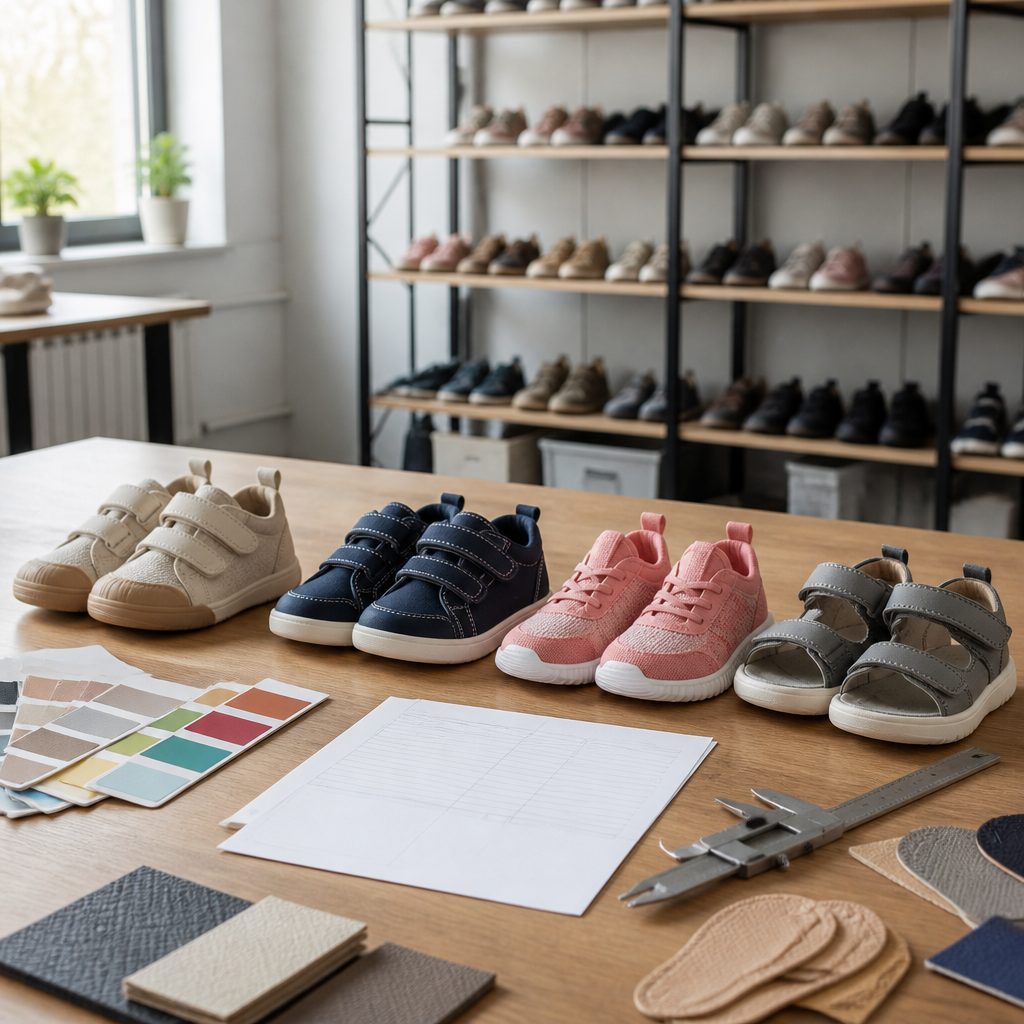
Leaving the upper open until sample comments is a common wholesale kids-sneaker failure mode. Mesh versus PU gets treated as a late aesthetic swap even though the kids' sneaker family already lists both upper options, frames daily wear and school retail use, and treats colorway, logo, closure, and outsole texture as custom fields on a fixed build. Once a sample is cut against an undefined upper, appearance comments often force a rebuild instead of refining one path.
For children's sneakers mesh vs PU wholesale programs, the practical fix is sequence: write the use context, name the upper, then open custom fields and material-control asks. This article walks that order only. It does not invent durability, abrasion, waterproofing, or climate claims the product and materials pages do not state.
Why mesh versus PU cannot wait until sample comments
When the upper stays undefined, teams rewrite the silhouette to match a late material preference rather than judging the sample against a brief they already set. The failure is process, not taste. Upper construction is a build choice for a stated range role—not a comment-round tweak.
A buyer targeting daily wear and school retail should choose between the two listed upper options before requesting colorways or logo placement. After mesh or PU is fixed, appearance feedback stays inside that build. That order is an editorial recommendation for the buyer: lock the upper first, then open custom fields.
Lock the program use context before material language
Kids' sneakers on the product page are best for daily wear and school retail. They are also described as a starting point for private-label and retail orders, and as popular with brands that want casual wear, school use, and a wide color story. Separately, engineered mesh is framed for warm-weather and active styles and is listed among materials used in kids' sneakers, sports runners, and sandals. Those are different starting contexts.
| Framing | What it points to | Buyer implication |
|---|---|---|
| Kids' sneakers: daily wear and school retail | Breathable mesh or PU upper as the listed build options | State school-retail or everyday casual intent before choosing mesh or PU |
| Engineered mesh material note | Light, breathable, quick-dry knit-style uppers for warm-weather and active styles | If the range is warm-weather or active, confirm the materials-page mesh language matches the role |
Do not collapse those framings into one vague kids-sneaker request. A kids sneakers school retail upper discussion and a warm-weather active mesh discussion can both sit inside kids sneakers, but they are not interchangeable briefs. Write the use context first, then name the upper preference that follows from it.
What the published mesh and PU references actually bound
Only a narrow set of descriptors is on the site. Keep the product-family build line separate from the engineered-mesh materials note. Do not merge them into one performance story.
| Reference | Documented language | Not on these pages |
|---|---|---|
| Kids' sneakers product family | Breathable mesh or PU upper; custom colorway, logo, closure, and outsole texture; best for daily wear and school retail | Durability scores, abrasion grades, waterproofing, or school-district compliance |
| Engineered mesh materials note | Light, breathable knit-style uppers for warm-weather and active styles; breathable, lightweight, quick-dry; used in kids' sneakers, sports runners, and sandals | Climate guarantees, wear-test results, or claims that mesh is always better for school retail |
On the product page, PU appears only as the alternate upper option next to breathable mesh. No further PU performance claims are stated there. If a program needs abrasion, waterproofing, or climate language, treat those as open documentation asks relative to the current pages—for example market-specific material notes listed on the quality page—rather than assuming mesh or PU already carries those properties.
When buyers search for breathable mesh children's sneakers, they should still identify which reference they mean: the product-page build option, or the engineered-mesh materials note with its warm-weather and active framing. Those statements are related, not identical.
Sequence custom fields only after the upper type is fixed
Once mesh or PU is fixed, the custom set for the sneaker family is colorway, logo, closure, and outsole texture. Those fields should follow the upper decision, not replace it. Appearance work that arrives before the upper is chosen often forces a rebuild when the material finally lands.
- Confirm daily wear, school retail, warm-weather, or active intent in writing.
- Select breathable mesh or PU as the upper path that matches that intent; if engineered mesh is relevant, cite the materials-page descriptors separately.
- Only then open colorway, logo, closure, and outsole texture on that fixed build.
- Carry the same upper choice into material-control and sample-review asks so comments stay aligned.
This order is buyer-side discipline, not a factory process claim. It keeps private label kids sneakers materials decisions from being overwritten by logo or color debates that belong later.
Material control is a pre-sample checkpoint, not a badge list
Quality content maps material control to upper, lining, outsole, and adhesive choices confirmed before the sample stage, with the stated buyer benefit of fewer surprises after sample approval. Incoming-materials checks align upper, lining, outsole, label, and adhesive samples to the brief. That is where mesh versus PU should be pinned—not after approval.
- State the chosen upper type in the brief before sample stage.
- Ask that upper, lining, outsole, and adhesive choices be confirmed against that brief.
- Limit documentation asks to what is listed as alignable: buyer-specific packing labels, market-specific material notes, inspection photo requests, third-party test coordination, and document requests from an importer or retailer.
- Treat third-party test coordination as a documentation topic a buyer may request, not as a pre-packaged certification promise.
Request alignment to the brief and the written inspection plan rather than inventing lab standards the pages do not claim.
Keep fit review and packing discipline off the material decision
Fit review covers toddler, little-kid, and big-kid sizing for day-to-day wearability. Packing discipline covers carton counts, labels, stickers, and export presentation. Both sit on the same quality ladder as material control, but they answer different questions. Folding fit, packing, and mesh-versus-PU into one vague sample ask blurs responsibility and makes comments harder to action.
Keep the upper decision on material language and use context. Schedule fit review and packing checks as separate lines in the inspection plan so a school-retail upper choice is not delayed by carton-label debates, and so sizing feedback is not used as a proxy for switching mesh to PU after the fact.
Use the private-label sneaker program example only as a process pointer
The case-study page presents an example of how a private-label sneaker program is scoped, sampled, and run. Use that page for how a program can be organized—not as proof of outcomes, quantities, timelines, or customer identities. Nothing in the example authorizes claims about results. If a team needs a model for sequence, read it for scoping and sampling structure, then write the project's own use context and upper choice against the product and materials pages.
Inquiry topics that stay inside the current definition
When the upper path is ready to discuss, keep the inquiry short and field-based rather than expanding into a full RFQ template. Distinct topics inside current scope include:
- Use context: daily wear, school retail, warm-weather, or active framing for the sneaker program.
- Upper preference: breathable mesh or PU on the product-family build line, with any engineered-mesh warm-weather notes called out separately if relevant.
- Custom fields still open: colorway, logo, closure, and outsole texture after the upper is fixed.
- Material-control alignment: confirmation of upper, lining, outsole, and adhesive choices before sample stage.
- Which development, sampling, or quotation options may apply to the project—without treating those topics as guaranteed service packages unless a written response defines them.
Share the current children's footwear definition with those fields filled in. That keeps the conversation on mesh versus PU as a build choice rather than an after-the-fact aesthetic swap. For a structured handoff, use the request a quote path and point the same brief at the products, materials, and quality pages.
Sources and verification
Material, custom-option, and checkpoint claims in this article map only to the kids' sneakers product family, the engineered mesh material note, the quality control checkpoints and documentation list, and the case-study format example. Verify each claim on those pages before treating it as a program requirement. Where durability, climate, or certification language is missing, mark it as an open documentation ask rather than an implied factory claim. Process framing for private-label sneakers should be checked against the case study example of scoping, sampling, and running a program, without reading outcomes into that format.
Sources and verification
- Children's Footwear Products | KidsShoeWorks First-party site source
- Kids' Shoe Materials | Mesh, PU, Canvas, Rubber & EVA | KidsShoeWorks First-party site source
- Quality Control for Children's Shoes | KidsShoeWorks First-party site source
- Kids' Shoe Programs: Case Study Format | KidsShoeWorks First-party site source
Share the current children's footwear definition and ask which development, sampling or quotation options may apply to the project.
Send your project brief