Footwear Sourcing
Definition First: children's sneaker mesh upper wholesale sourcing
Start with the documented sneaker and engineered-mesh references, then define the buyer decisions and open questions that belong in a project inquiry.
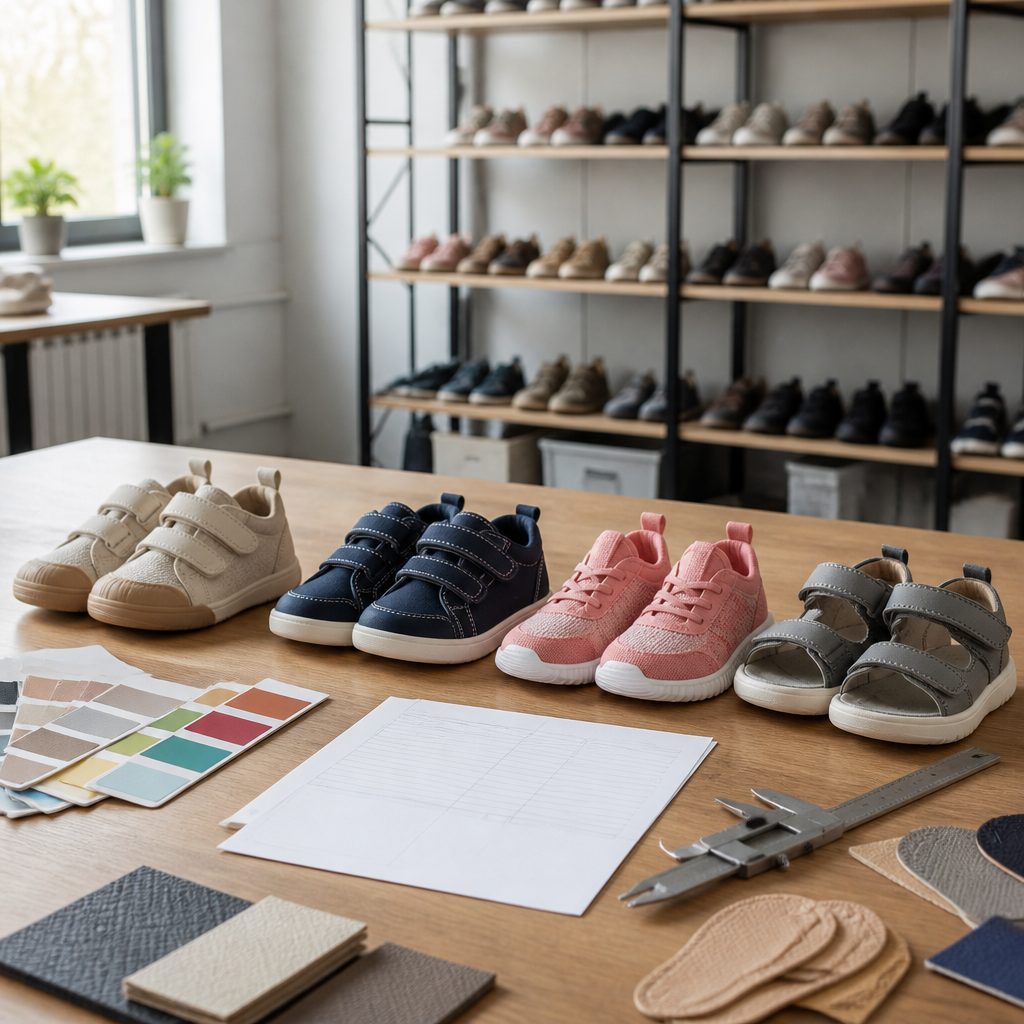
In buying work, a material description is useful only when it is attached to a defined shoe. For children's sneaker mesh upper wholesale sourcing, KidsShoeWorks provides two relevant starting points: a kids' sneaker listing and an engineered-mesh material description. Neither page is a finished specification for a particular program.
The editorial recommendation in this article is to use those references to prepare a bounded inquiry. State the sneaker details your team has decided, retain the published wording where it applies, and place unresolved issues in a separate set of questions for the quotation or sampling discussion.
Begin With the Sneaker Listing
The kids' sneaker product entry identifies a breathable mesh or PU upper under its build description. It separately labels colorway, logo, closure, and outsole texture as custom items. This gives a buyer a product-category reference, but it does not select one upper, closure, or visual direction for a new project.
| Product-page reference | Editorial recommendation for the buyer brief |
|---|---|
| Build: breathable mesh or PU upper | Name the requested upper direction. Keep it as a project preference until its use on the proposed sneaker is discussed. |
| Custom: colorway, logo, closure, and outsole texture | Record only the design points already decided by the buyer. Ask about any remaining point instead of treating the whole list as a fixed configuration. |
A kids sneaker mesh upper quote can begin with a simple sentence: the project is a children's sneaker and the buyer is requesting an engineered-mesh upper direction. Add the closure, logo, colorway, and outsole-texture requirements only when they are part of the current brief. The published listing does not support a comparison between mesh and PU, so the brief should not present one material as inherently better, cheaper, safer, or more durable.
Read the Engineered-Mesh Reference at Its Stated Scope
On the materials page, KidsShoeWorks describes engineered mesh as a light, breathable, quick-dry, knit-style upper. The same page names kids' sneakers, sports runners, and sandals as uses. Those statements identify the company's published description of engineered mesh; they do not define the composition or measured performance of a specific upper.
- Published material reference
Use the phrase engineered mesh and, where useful, retain the stated light, breathable, quick-dry, and knit-style attributes as a reference to the materials page.
- Project definition still needed
State the intended product role, size or age scope, visual direction, closure preference, and the exact upper reference the buyer wants considered.
- Question to preserve
Ask what additional information is needed to assess the requested upper direction against the submitted sneaker brief.
This distinction matters because a buyer may be sourcing an active-looking sneaker, a casual style, or a school-oriented product, while the material page does not confirm suitability for any particular school rule, retailer requirement, climate, market, or wear condition. Those are buyer requirements or inquiry topics, not published material claims.
Set the Inputs Before Requesting a Sample
Before asking about development or sampling, the buyer should turn broad preferences into usable inputs. This is an editorial recommendation for organizing the inquiry, not a statement of KidsShoeWorks' required process.
- Identify the product as a children's sneaker and attach the available visual reference.
- State the intended age or size scope. The quality page refers to toddler, little kid, and big kid sizing during fit review, but those labels should not be treated as a project sizing system.
- Describe the requested upper direction as engineered mesh, then note whether a lining or other component choice remains open.
- Record the preferred closure and any logo-placement requirement that needs to appear in the sample discussion.
- Separate decided requirements from observations, test evidence, or material information the buyer still needs to request.
The result does not need to be long. A clear brief identifies what the team is asking for today and avoids converting an unanswered question into an implied specification. That makes later mesh upper shoe sampling questions easier to review because the recipient can see the difference between a requirement and a request for confirmation.
Two Quality Checkpoints Use Different Component Lists
The quality page describes material control before the sample stage. At that checkpoint, upper, lining, outsole, and adhesive choices are confirmed. The page also describes incoming-material alignment, where samples for the upper, lining, outsole, label, and adhesive are aligned to the brief.
| Published checkpoint | Components named on the quality page |
|---|---|
| Material control before the sample stage | Upper, lining, outsole, adhesive |
| Incoming-material alignment to the brief | Upper, lining, outsole, label, adhesive |
The distinction is worth retaining exactly in an inquiry. A label appears in the incoming-material list but not in the earlier material-control list. For the buyer, the practical recommendation is to state which of these components are applicable to the proposed sneaker and which need a project-specific answer. Do not add a label requirement merely because it appears in one published checkpoint, and do not assume every named component is relevant to the same project.
Connect the Upper to the Whole Sample
The quality page describes sample review as a combined review of fit, comfort, logo placement, finish, and closure. A mesh upper belongs in that discussion as part of the proposed shoe, alongside the decisions that affect how the sample will be evaluated.
| Published sample-review point | Buyer-owned question |
|---|---|
| Fit and comfort | What size or age scope should the buyer's team review, and what observations matter to its brief? |
| Logo placement and finish | Which visual details need to be shown or checked in the submitted sample? |
| Closure | Has the buyer selected a closure direction, or is confirmation still needed? |
These questions are not an acceptance standard supplied by the published page. They are an editorial way to keep the upper discussion connected to the sample that will actually be reviewed. The buyer should state who will assess the sample and which unresolved points require additional evidence before an internal decision.
Build the Inquiry in Two Parts
Separate the current sneaker definition from requests about what may apply. This structure keeps a quotation conversation from implying that an unconfirmed option, document, or review activity is already included.
- Part one: current definition
Identify the children's sneaker, the engineered-mesh upper direction, the intended size or age scope, and any decided colorway, logo, closure, or outsole-texture requirement.
- Part two: questions for the project
Ask which development, sampling, and quotation options may apply. Where relevant, ask whether the brief can be used for material alignment and what additional information is needed to discuss the proposed upper.
- Documentation and review requests
The quality page identifies buyer-specific packing labels, market-specific material notes, inspection photo requests, third-party test coordination, and document requests from an importer or retailer as areas it can align around. List the items the buyer wants to discuss, rather than presenting them as included services or confirmed deliverables.
Use the quote request page to send the two parts together. The first part communicates the current shoe definition; the second preserves the questions that require an answer before the team relies on a sample, document, or commercial term.
Evidence Limits for This Mesh Inquiry
Editorial evidence-scope note: this article reviews only the linked materials, products, and quality pages. Within those pages, there is no stated price, minimum order quantity, lead time, mesh composition, thickness, weight, abrasion result, water-resistance result, washability result, colorfastness result, school-uniform acceptance, test result, or specific safety or regulatory claim for a proposed sneaker.
The same reviewed pages do not establish universal availability of an engineered-mesh upper or of every listed colorway, logo, closure, and outsole-texture option. They also do not show that packing labels, material notes, inspection photos, third-party test coordination, or importer and retailer documents apply automatically to a project. Treat each point as an inquiry topic. The published references can anchor the starting discussion; the submitted brief and project-specific responses must resolve the remaining requirements.
The materials page is the source for the engineered-mesh description and stated uses. The products page is the source for the sneaker build reference and separately listed custom items. The quality page is the source for the two material checkpoints, sample-review scope, fit-review categories, and areas of potential documentation alignment.
Sources and verification
- Kids' Shoe Materials | Mesh, PU, Canvas, Rubber & EVA | KidsShoeWorks First-party site source
- Children's Footwear Products | KidsShoeWorks First-party site source
- Quality Control for Children's Shoes | KidsShoeWorks First-party site source
Share the current children's footwear definition and ask which development, sampling or quotation options may apply to the project.
Send your project brief