Wholesale Buying Guides
Childrens Shoes Wholesale UK: Define the Receiving Brief
A footwear sample defines the shoe. Carton counts, inner packing, labels and export presentation define the receiving handover. Keep that brief visible before you compare wholesale offers.
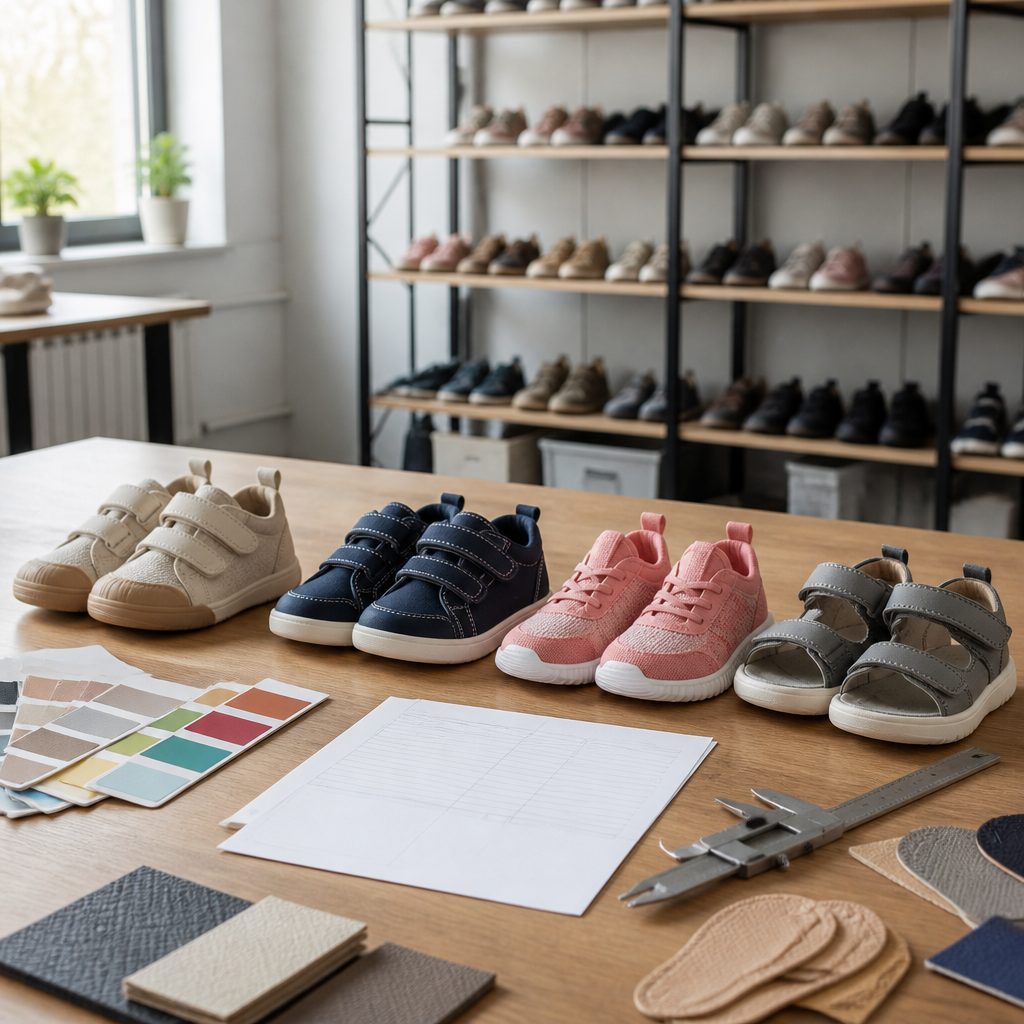
For buyers reviewing childrens shoes wholesale UK options, sample approval answers only part of the commercial question. The sample shows which shoe is under review. It does not, by itself, state how finished pairs will be counted, separated, labelled, or presented when the export run is ready for handover. Those packing fields still need a buyer-side definition before offers can be compared on equal terms.
KidsShoeWorks publishes packing as part of quality control for children's shoes: fit, bonding, flex, wear and packing are described as checks before an order leaves the factory. Packing discipline on that page covers carton counts, labels and export presentation. Final-packing checks cover carton counts, inner packing, labels and outer cartons before shipment. Checkpoints are described as aligned to the product brief and written inspection plan. That is the published review scope. It is not a universal packing format, a UK legal requirement, a project guarantee, or proof that every documentation option applies to every order. Editorial recommendation for the buyer: treat market, retailer, importer and warehouse rules as inputs you supply, and treat the quality page as a map for questions rather than as automatic commitments. Review the published quality-control scope when deciding which packing points belong in the current brief.
Keep the shoe and the receiving brief separate
A receiving brief is a buyer-side record of how the finished order should be identified and handled. Keep it distinct from the footwear definition, even when both travel in the same inquiry. Merging them into a single line such as “packing as discussed” hides open fields and makes two quotations look comparable when they are not.
| Record | What it covers | Editorial recommendation for the buyer |
|---|---|---|
| Footwear definition | Style or product reference and the shoe attributes under review. | Keep the current sample, artwork and product details identifiable by version. |
| Receiving brief | Carton-count instructions, inner-packing expectations, label or sticker content, and outer-carton presentation. | List each field separately; mark unresolved points as open questions. |
The KidsShoeWorks product page describes kids' sneakers with breathable mesh or PU uppers. Separately, it identifies colourway, logo, closure and outsole texture as customizable sneaker elements. Those are product attributes for that offering. They do not document a packing method, label layout or export-marking arrangement. See the children's footwear product families to confirm the product reference, then hold packing instructions in the receiving brief.
Four packing fields to settle before comparing offers
Use the following as an editorial checklist for kids shoe packing requirements. None of these fields is presented here as mandatory for the United Kingdom or for every project. If you do not yet have an answer, leave the field open and ask whether it affects quotation or review for this order.
- Carton-count instruction
State the counting basis receiving will use. KidsShoeWorks includes carton counts in packing discipline and again in the final-packing checkpoint. Editorial recommendation: write the instruction you need rather than assuming a default pair count or assortment rule.
- Inner-packing expectation
Describe any required unit separation or protection. Final packing on the quality page includes inner packing among the items checked before shipment. The page does not define one inner-pack format for all orders.
- Label and sticker content
Provide the exact content your brand, importer, retailer or warehouse requires. Packing discipline on the quality page covers labels; the packing-discipline table also refers to stickers and presentation. Buyer-specific packing labels appear among documentation items KidsShoeWorks says it can align around. Ask whether that item applies to the current project.
- Outer-carton presentation
Record identification and presentation needed for the downstream handover. Final packing includes outer cartons; packing discipline separately refers to export presentation. Supply your own market, customer or receiving requirements instead of inferring them from the published checkpoint list.
A prior sample, product image or earlier shipment can support discussion. Editorial recommendation: treat none of those as a current packing instruction unless you restate them in this order’s receiving brief.
Map each field to a published checkpoint
The quality page describes a practical ladder from materials through final packing. Use it to frame questions against what is written there—not to claim that every check or proof item will run on every order.
| Published checkpoint | Scope stated by KidsShoeWorks | Question for the buyer to include |
|---|---|---|
| Incoming materials | Upper, lining, outsole, label and adhesive samples are aligned to the brief. | Does the brief include the current label sample or reference that needs review? |
| Sample review | Fit, comfort, logo placement, finish and closure are reviewed together. | Which product points are being approved, and which receiving points remain open? |
| In-line checks | Assembly, stitching, bonding, flex and stability are checked during production. | Which construction observations belong in the written inspection plan? |
| Final packing | Carton counts, inner packing, labels and outer cartons are checked before shipment. | Which current packing instructions should guide the final-packing review for this project? |
Buyer questions stay buyer questions. The table does not convert them into documented company commitments beyond the published checkpoint descriptions.
Separate requirements, applicability questions and proof requests
A receiving brief loses clarity when three kinds of statement sit unlabelled in the same paragraph. Keep them distinct—especially when children's shoe export labels or documents are controlled outside the footwear team.
Buyer requirements: Instructions from your team, importer, retailer or warehouse on label content, carton identification, unit grouping or outer-carton presentation. These are your inputs, not claims that KidsShoeWorks has already performed a service.
Applicability questions: Ask which development, sampling, packing or quotation options may apply to the current footwear and receiving definition. A question does not establish that an option is available, included or agreed.
Evidence requests: KidsShoeWorks lists inspection photo requests among items it can align around. Separately, it lists third-party test coordination and document requests from an importer or retailer. On proof, the page states a preference for inspection photos, measured samples and the test reports a project actually requires over unrelated certifications. Ask whether each listed request may apply; the inquiry alone does not promise that evidence will be produced.
Send one current handover note with the inquiry
For a children's footwear wholesale supplier inquiry, the editorial recommendation is one controlled handover note instead of scattering packing decisions across artwork files, sample comments and logistics messages.
Identify the current footwear style or product reference and the version of any sample or artwork reference.
List carton-count instructions, inner-packing expectations, label or sticker content, and outer-carton presentation as separate fields.
Mark undecided fields as open so they are not inferred from an earlier reference.
Label buyer-supplied requirements separately from questions about development, sampling, packing or quotation applicability.
State any inspection-photo, third-party test coordination, or importer or retailer document question as its own line.
Name the buyer-side party who approves the finished definition.
A controlled note does not guarantee packing results or shipment outcomes. It gives a clearer record for comparing offers and for asking focused questions against the published checkpoints. Share the current children's footwear definition and receiving brief through the project inquiry form, and ask which development, sampling or quotation options may apply to the project.
Sources and verification
- Quality Control for Children's Shoes | KidsShoeWorks First-party site source
- Children's Footwear Products | KidsShoeWorks First-party site source
Share the current children's footwear definition and ask which development, sampling or quotation options may apply to the project.
Send your project brief