Sourcing Guidance
Childrens Shoes Wholesale Canada Sample Fields Freeze Map
Canada wholesale buyers often approve a sample photo without freezing the five published sample-review fields. Use this field freeze map so bulk has a clear target.
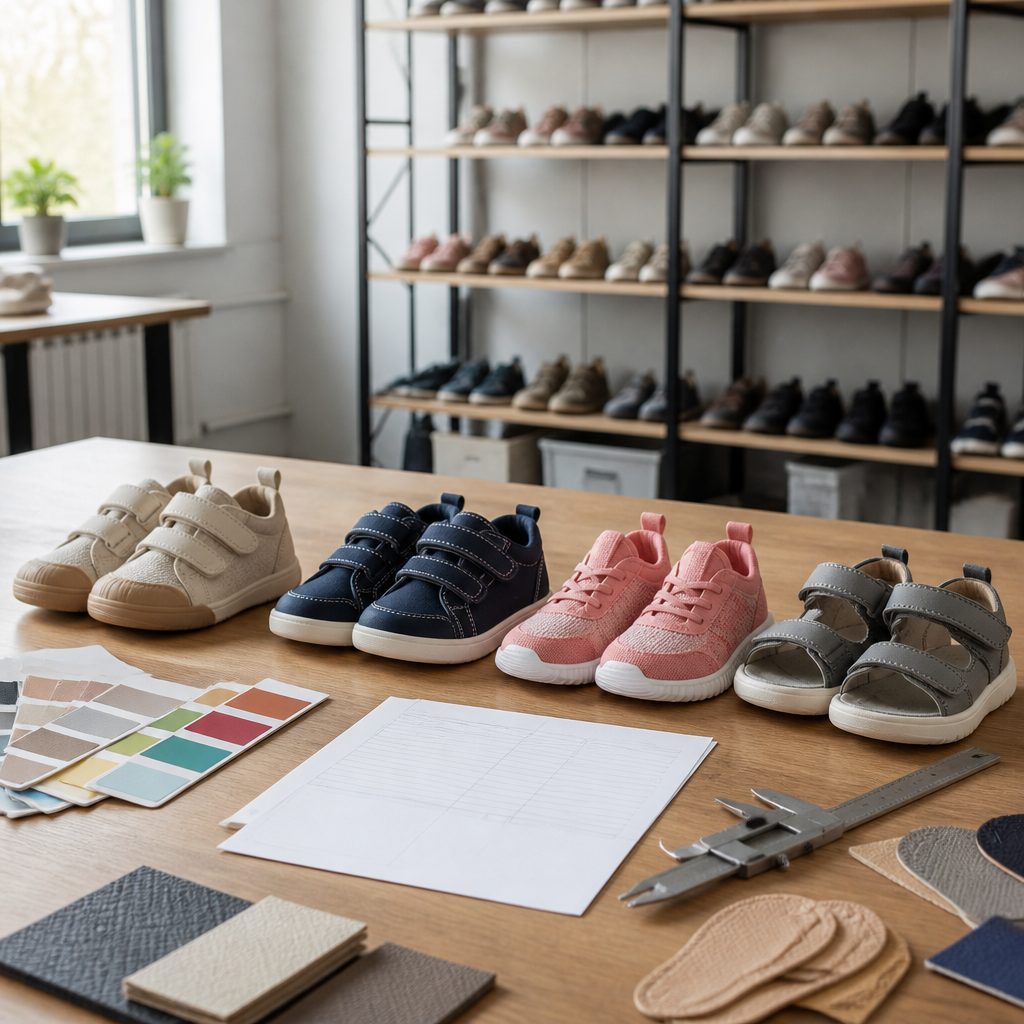
Canada wholesale teams often treat one approved pair as enough for production. Without a written freeze on each sample-review field, bulk can still miss the target. For childrens shoes wholesale Canada sample fields, the quality page names five items reviewed together at sample stage: fit, comfort, logo placement, finish, and closure. Freezing those, and only those, gives the order a shared bulk reference. Materials, construction, and packing stay on their own rungs of the inspection ladder described on the quality control page.
Photo-led approval is common under retail calendar pressure. Fit, comfort, logo placement, finish, and closure then drift between the sample you liked and the cartons that arrive. The map below stays bound to published sample-review language, not to a rebuilt materials or packing program.
A Canada wholesale sample photo is not a field freeze
A sample image records appearance at one moment. It does not, by itself, record whether the last size you tried still wears the same, whether the logo sits where the brief said, or whether the closure you approved is the one on the production tooling. Canada wholesale programs that move from a visual pass straight into a bulk PO often discover those gaps only at receiving.
Treat “approved sample” as a set of field decisions, not a folder of photos. If a field is not written into the freeze, the factory has no shared bulk target for that field. The quality page groups sample review as one checkpoint with a defined set of items reviewed together, and with one stated buyer benefit: a better chance that the bulk run matches the approved sample. That is the ceiling for what this article freezes. It does not invent extra criteria, pass rates, or service guarantees.
The only sample-review fields the quality page names
On the quality page’s inspection ladder, sample review covers five items reviewed together: fit, comfort, logo placement, finish, and closure. A kids shoe sample review Canada wholesale freeze should stay inside that set. Do not expand the list with colorway, outsole texture, mesh type, carton labels, or bonding checks unless you are deliberately writing a different stage of the plan.
- Fit
- Comfort
- Logo placement
- Finish
- Closure
Those five fields are the freeze list for this guide. Anything outside that set belongs earlier (materials), later (in-line construction or packing), or on a separate product-definition note (for example sneaker colorway or outsole texture). Keeping the list tight is what makes a Canada wholesale sample approval usable when the same style runs again or when a second size bracket is added.
Field-by-field freeze: what “approved sample” must mean
Use one decision per published field. The benefit language stays aligned to the quality page: each freeze improves the chance that bulk matches the approved sample. It does not promise zero defects or a specific market outcome. Freeze definitions such as length feel, width feel, or heel hold are editorial recommendations for the buyer’s brief, not factory checklist items named on the quality page.
| Sample-review field | Freeze decision for the Canada brief | Why it matters for bulk |
|---|---|---|
| Fit | As an editorial recommendation for the buyer, record which size or size bracket was worn or measured, and define what acceptable fit means for that sample. | Without a fit freeze, a later bulk size run has no shared reference beyond a photo of one pair. |
| Comfort | As an editorial recommendation for the buyer, note wearability observations for day-to-day use on the sample you approve, not a vague “feels fine.” | Comfort is listed with fit in sample review; leaving it unwritten lets subjective feedback restart after bulk is cut. |
| Logo placement | A wholesale kids shoe logo placement freeze fixes position, side, and relative scale against the sample (or against a marked photo of that sample). | Logo drift is a common bulk mismatch when placement was only “looked right” in a lifestyle shot. |
| Finish | As an editorial recommendation for the buyer, describe surface condition, edge neatness, and any finish detail you treat as pass/fail on the sample. | Finish is a sample-review field; it is not a substitute for full construction review during production. |
| Closure | Name the closure type and the operating behavior you approved on the sample. | Closure is reviewed at sample stage; changing it later without a new freeze resets the bulk target. |
Canada kids footwear sample approval fields work best when all five are frozen on the same sample set rather than approving photos for logo and finish while leaving fit and comfort verbal. The quality page describes them as reviewed together; splitting them without a written reason creates two approval stories for one style.
Keep material control, in-line checks, and packing out of the freeze
Sample-field freeze is one rung on the published quality ladder. Adjacent rungs stay adjacent. Mixing them into “sample approved” is how Canada briefs become unenforceable.
Earlier than sample freeze. Material control confirms upper, lining, outsole, and adhesive choices before the sample stage. The published benefit is fewer surprises after sample approval. Incoming materials checks are listed separately: upper, lining, outsole, label, and adhesive samples are aligned to the brief, also with fewer surprises after sample approval as the stated benefit. Confirm each track on its own wording; do not treat a sample photo as proof that every material choice is locked. For upper families and construction notes, the materials page is a separate reference, not a sample-review field list.
After sample freeze, during production. In-line checks cover assembly, stitching, bonding, flex, and stability while the order is being made. Construction review language on the quality page (stitching, bonding, flex point, and outsole stability) sits before packing, not inside the five sample-review fields. A finish freeze at sample stage does not replace bonding or flex checks on the line.
Later, at export handoff. Final packing covers carton counts, inner packing, labels, and outer cartons before shipment. Packing discipline is a logistics and receiving concern. It is not a substitute for logo placement or closure approval on the shoe itself.
In short: materials answer what was confirmed before sample, sample review answers which shoe attributes match the approved sample, in-line checks answer how assembly holds during production, and packing answers how the export carton is presented. Canada wholesale programs that collapse all four into one email trail lose the ability to rework only the stage that failed.
Where sneaker custom language overlaps, and where it must not
Many Canada kids programs start from sneakers. The products page describes kids’ sneakers as a starting point for private-label and retail orders, including casual wear and school use, with custom notes for colorway, logo, closure, and outsole texture, and with breathable mesh or PU upper as the build language. Logo and closure appear in both that custom list and the quality page’s sample-review list. Those two terms are legitimate shared vocabulary.
Colorway and outsole texture do not appear in the sample-review set. Treat them as product-definition notes on the style card, not as silent stand-ins for “finish” or for the full sample freeze. Mesh or PU upper language belongs with material and product definition; it is not one of the five sample-review fields. The materials page describes engineered mesh as light, breathable knit-style uppers used in kids sneakers, sports runners, and sandals, again product and material language, not a sample-review field. If you need finish frozen, freeze finish. If you need a colorway locked, lock colorway on the product brief without calling that action sample review.
When the program is a sneaker, write logo placement and closure once in the sample freeze, and write colorway, outsole texture, and upper family once in the product definition. Do not merge the two lists into one “custom sample” checklist that the evidence does not support as a single capability statement.
Fit brackets stay on the brief even after one sample passes
The quality page’s fit language covers toddler, little kid, and big kid sizing for day-to-day wearability. A single sample in one bracket does not automatically freeze the others. If your Canada assortment spans more than one bracket, state which brackets were reviewed and which remain open.
Hypothetical example for planning only: a buyer freezes fit and comfort on a little-kid sample and later adds big-kid sizes without new fit language. That is not a documented factory outcome; it is a common brief gap. Write the bracket scope into the freeze so bulk planning cannot assume one approved pair covers every age band on the PO.
Proof modality after freeze: photos and measured samples, not badge walls
After fields are frozen, proof requests should match how the quality page prefers to handle evidence: inspection photos, measured samples, and the test reports a project actually requires, rather than certifications unrelated to the order. Documentation topics listed there include buyer-specific packing labels, market-specific material notes, inspection photo requests, third-party test coordination, and document requests from an importer or retailer. Those are alignment topics, not automatic inclusions in every sample freeze.
- Request inspection photos that show the five frozen fields on the approved sample set.
- Request measured samples when fit or comfort freezes depend on dimensions, not only images.
- Scope third-party tests only when the project brief requires them; do not use a general badge wall as sample proof.
- Keep packing labels and importer documents on the documentation track, separate from logo and closure freezes.
That modality keeps the Canada wholesale conversation on evidence that can be compared to the freeze list. It also avoids treating unrelated certificates as a substitute for sample-field agreement.
Questions to attach to a Canada wholesale sample-field inquiry
Before you send a Canada wholesale sample brief, pin down which freeze items actually apply. Keep the list inside published quality and product language rather than treating every documentation topic as part of sample review:
- Which of the five sample-review fields (fit, comfort, logo placement, finish, closure) are in scope for this Canada wholesale style?
- Which size brackets (toddler, little kid, big kid) must be covered before bulk, and which sample sizes will represent each bracket?
- If the style is a sneaker, do logo and closure notes from the product card need to match the sample freeze wording?
- What inspection photos or measured samples should document the freeze after approval?
- Which material, in-line, packing, or importer document topics should stay outside sample review and be handled on their own tracks?
Share the current children’s footwear definition for the program, then ask which development, sampling, or quotation options may apply. Use the request a quote path when you are ready to put those field decisions next to a style brief. The goal is a freeze list your team and the factory can both read, not a photo gallery that means something different to each side.
Sources and verification
- Quality Control for Children's Shoes | KidsShoeWorks First-party site source
- Children's Footwear Products | KidsShoeWorks First-party site source
- Kids' Shoe Materials | Mesh, PU, Canvas, Rubber & EVA | KidsShoeWorks First-party site source
Share the current children's footwear definition and ask which development, sampling or quotation options may apply to the project.
Send your project brief