Product Development
How to brief children's shoes suppliers for mesh sneakers
A mesh upper is a material direction, not a complete product definition. Build a children's sneaker material brief that distinguishes buyer decisions from questions needing a project-specific response.
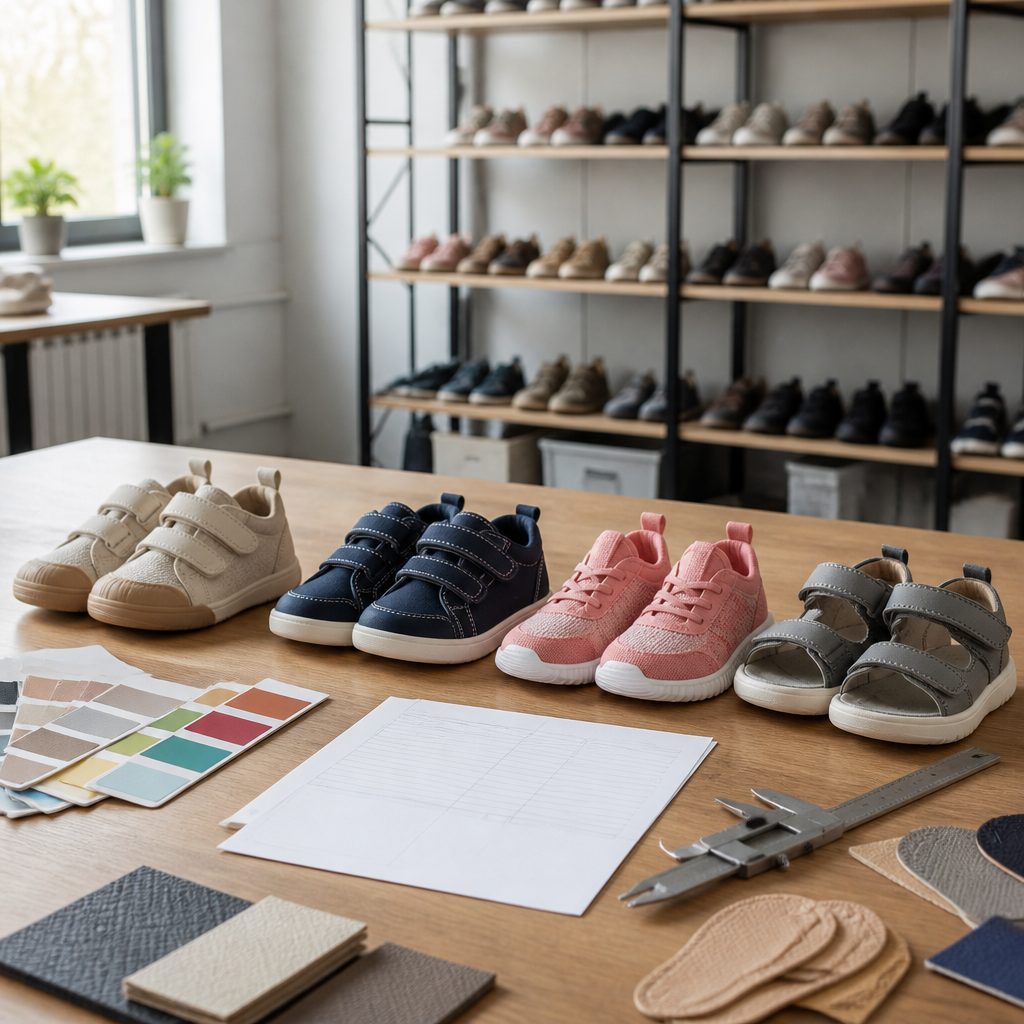
A request to children's shoes suppliers for mesh sneakers can sound complete while leaving the central product decision unresolved. "Mesh" identifies an upper direction, but it does not define the shoe's role, confirm a construction, or answer questions about evidence and commercial terms. A useful brief makes those gaps visible before they are mistaken for settled requirements.
This article offers buyer-side editorial guidance for shaping that brief. The published product and material descriptions provide a narrow starting point; development, sampling, quotation, material applicability, testing, availability, and commercial matters remain project-specific questions unless a project response establishes them.
What Engineered Mesh Actually Establishes
The materials page describes engineered mesh as a light, breathable, knit-style upper for warm-weather and active styles. It also lists engineered mesh for kids' sneakers, sports runners, and sandals.
That description can support a proposed material direction. It does not compare engineered mesh with PU, provide a performance measurement or test method, establish that a particular construction fits a proposed style, or confirm a material choice for an individual project. It also does not state price, availability, minimum order quantity, lead time, or other commercial terms.
| Published material context | Brief output for the buyer |
|---|---|
| Engineered mesh is described as a light, breathable, knit-style upper. | Record engineered mesh as the upper direction under consideration. |
| Warm-weather and active styles are named in the material description. | State the intended use in the buyer's own terms. |
| Kids' sneakers are among the listed uses. | Ask whether the proposed sneaker merits a further material and construction discussion. |
A Brief Has Four Types of Input
A children's sneaker material brief becomes more useful when it separates what the buyer has decided from what is merely being explored. This keeps an early concept from reading like a confirmed specification and gives the recipient a clearer basis for responding to the actual questions.
- Buyer-fixed inputs
- State the planned range role, the intended use context, and the wearer or size direction when those points affect the product definition. These are the buyer's decisions, not conclusions supplied by the published pages.
- Proposed upper direction
- Name engineered mesh as under consideration. Treat the exact construction as open until a project-specific discussion addresses it.
- Exploratory visual requests
- Keep appearance ideas distinct from material direction. A colorway, logo treatment, closure preference, or outsole-texture question can be exploratory without being presented as a confirmed configuration.
- Questions requiring a response
- Identify the matters that cannot be settled from the current references: material comparison, construction relevance, material notes, test-related discussion, and the development, sampling, or quotation path that may apply.
The value of this structure is not that every decision must be final at the first inquiry. It is that each item has a clear status: fixed by the buyer, proposed for discussion, exploratory, or awaiting a project-specific response.
Intended Use Comes Before Feature Requests
The kids' sneakers entry identifies daily wear and school retail under Best for. The materials page separately associates engineered mesh with warm-weather and active styles. Those category contexts can help a buyer frame a question, but neither one decides the role of a new sneaker.
Before listing visual details, write one concise description of the job the shoe is meant to do within the range. The wording should reflect the buyer's own intended use and design objective. That may be more informative than a broad label such as "active" or "school" because it explains why mesh is being considered without claiming an outcome for the proposed shoe.
- Name the sneaker's role in the planned range.
- State the intended use context in buyer-defined language.
- Explain the design reason for considering a mesh upper.
This sequence gives the upper direction a purpose. It also avoids treating a published category reference as a universal recommendation for private label kids mesh sneakers or any other proposed range.
The Visual Direction Is a Separate Decision
The kids' sneakers entry places a breathable mesh or PU upper under Build. Separately, it lists colorway, logo, closure, and outsole texture under Custom. Those labels describe different parts of the product entry, so they should remain separate in a buyer's request.
- Upper-material question
- State whether engineered mesh is being considered and what still needs to be discussed about that direction.
- Visible design question
- List colorway, logo, closure, and outsole-texture requests independently. Mark which requests are required and which are ideas to explore.
Separating these fields prevents appearance from silently deciding the material question. It also avoids reading the product entry's listed custom elements as confirmation that every combination, material choice, or design variation applies to a particular inquiry.
From Open Questions to a Supplier Inquiry
A kids mesh sneaker supplier inquiry does not need to imitate a completed technical specification. Its immediate purpose is to communicate the current definition clearly enough that the unresolved points can be addressed as questions. The following structure keeps the request bounded while preserving the buyer's priorities.
- Current shoe definition: Identify the children's sneaker category and the intended role in the range.
- Use context: Describe the buyer's intended use and the design objective behind the proposed shoe. Do not state a category reference as a performance result.
- Upper direction: Say that engineered mesh is under consideration. Ask whether a material and construction discussion may be relevant to the proposed sneaker.
- Visual direction: Record the colorway, logo, closure, and outsole-texture requests separately, with required points distinguished from exploratory ones.
- Evidence and next steps: Ask which material information, comparison discussion, or test-related discussion may be relevant. Ask which development, sampling, and quotation options may apply to the project.
This format makes it easier to see where a statement is a buyer instruction and where it is a request for information. A desired look is not evidence of a material result, and a request for a comparison with PU is not itself a comparison.
Quality Review Is Not Proof of a Result
The quality page identifies Incoming materials as a checkpoint where upper, lining, outsole, label, and adhesive samples are aligned to the brief. It identifies Sample review separately, where fit, comfort, logo placement, finish, and closure are reviewed together.
For the buyer, these are useful prompts for keeping the written brief specific as material and sample discussions progress. The two published checkpoint descriptions do not establish a test result, certification, final acceptance, or outcome for a particular order.
The quality page includes market-specific material notes in its documentation list. It separately includes third-party test coordination. A buyer may raise either topic as a project question, but their presence on that page does not show that either one applies to the proposed mesh sneaker or will produce a particular result.
What Remains Project-Specific
The final part of the brief should preserve uncertainty rather than hide it. The source record does not answer whether a requested mesh construction applies to the shoe, how mesh compares with PU for the buyer's objective, whether material notes or test-related discussion are relevant, or which commercial and development options may apply.
- Does the proposed mesh construction apply to this sneaker definition?
- What comparison information is relevant to the buyer's stated objective?
- Are material notes, document requests, or test-related discussions relevant?
- Which development, sampling, and quotation options may apply?
Use the quote request to share the current children's footwear definition, intended use, proposed upper direction, visual requests, and unanswered questions. A precise inquiry gives the material label its proper place: a starting point for a project discussion, not proof of a finished product outcome.
Sources and verification
- Kids' Shoe Materials | Mesh, PU, Canvas, Rubber & EVA | KidsShoeWorks First-party site source
- Children's Footwear Products | KidsShoeWorks First-party site source
- Quality Control for Children's Shoes | KidsShoeWorks First-party site source
Share the current children's footwear definition and ask which development, sampling or quotation options may apply to the project.
Send your project brief